

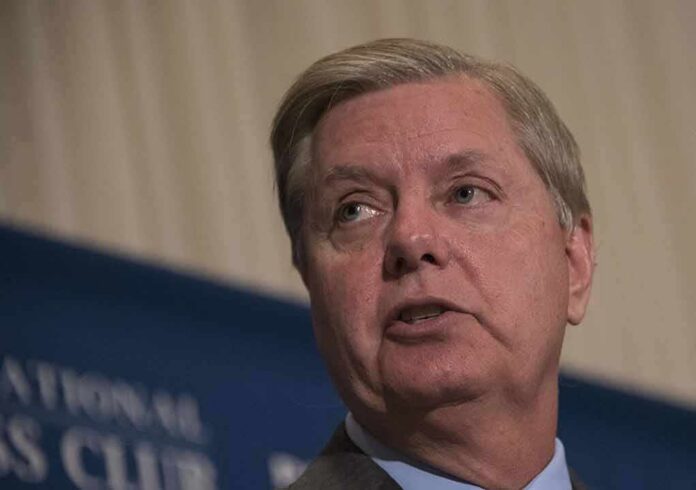
Three men went on camera to say the late Senator Lindsey Graham paid them for sex, and one says he was 17.
Story Snapshot
- Documentary features three first-person accounts with dates, places, and amounts.
- Producers say they hold receipts, photos, and travel logs for some claims.
- Major outlets stress the allegations have not been independently verified.
- Graham denied being gay during his life; his sister declined to engage.
What the documentary actually claims
The film, released by The Young Turks with partner studios, centers on men identified as Kelvin, Cory, and Jesse. Each man describes paid encounters with Graham across different years and hotels. Kelvin places an alleged 2001 encounter at an Arizona property and says he was 17, though he told Graham he was 18, and claims the activity continued after age concerns came up. Jesse recounts a 2012 meeting at the Beacon Hotel in Washington, District of Columbia, for $260. Cory describes a higher-priced overnight at the Mayflower.
Producers and allied reporting say they assembled supporting materials. The New Republic reported that the production shared travel logs that put Cory and Graham in Washington, District of Columbia, at the same time. It also cited claims of receipts and photographs tied to some encounters. Those materials, as described, would matter if authentic. The details add weight beyond rumor. But the public has not seen a full release of raw files with metadata, chain of custody, and outside forensic review.
What remains unproven and why it matters
Multiple outlets emphasize what the film does not yet provide to the public: independent corroboration. Reports note that newsrooms have not verified the men’s identities or the veracity of their stories. They also stress the lack of sworn records, hotel confirmations, or law enforcement filings produced for review. Graham’s death closes off direct rebuttal and discovery from the central figure. That raises the bar for document authentication if these claims are to stand as established fact.
The underage claim turns on what Graham knew and when. Kelvin says he told Graham he was 18, then claims Graham suspected he was 17 and continued anyway. That kind of factual tangle requires contemporaneous evidence: identification records, booking messages, or witnesses. Without it, arguments drift into partisan certainty rather than proof. Responsible standards demand clarity here, because age and knowledge are the legal and moral core of the most serious allegation.
How political media is shaping the reception
The release channel and timing drive the reaction. The Young Turks is a political outlet, so audiences read the film through a partisan lens, for or against. Some right-leaning figures brushed it off as old chatter, not a true October surprise. Others on both sides called the roll-out overhyped. That dynamic matches research on scandal coverage: salience comes from who is accused and the cultural frame, while verification often lags far behind the headlines.
Graham denied being gay during his life, and his sister, Darline Graham, declined to discuss whether he hired escorts. That does not resolve the claims, but it shows no detailed, sourced rebuttal exists in the public record yet. Several outlets also remind readers that prior rumors about male escorts never crossed from talk into evidence vetted by a credible, independent investigation. These points explain why many newsrooms keep a cautious tone.
What due diligence looks like now
The path to clarity is straightforward, if not easy. First, release all claimed receipts, photos, and travel logs in full, with original files and metadata. Second, seek independent forensic review by a neutral lab. Third, publish sworn statements with legal names where consent allows, and preserve raw interview footage for chain-of-custody checks. Fourth, match dates using hotel, airline, and payment records, and interview any identified intermediaries or staff as third-party witnesses.
These steps align with common-sense standards and conservative values: facts first, process visible, and equal rules for allies and opponents. If the evidence is solid, it will stand up to light. If it is weak, that will show too. The country benefits either way, because firm proof calms fevered claims, and weak proof keeps smear tactics from becoming the norm. Amid the noise, discipline beats drama. Let the documents do the talking.
Sources:
timesnownews.com, advocate.com, mediaite.com, jang.com.pk