

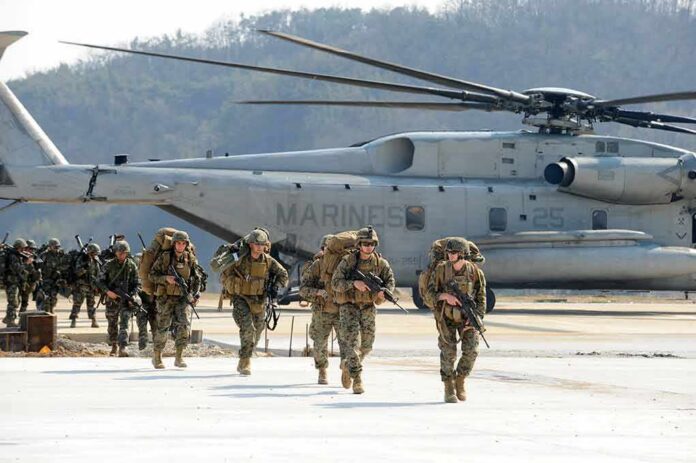
Eight Marines were hurt by an Iranian cruise missile, and the Pentagon said little until days later.
Story Snapshot
- Iran struck a vessel in the Strait of Hormuz on Sept. 14; eight Marines were injured.
- Injuries included smoke inhalation and possible mild brain trauma; all returned to duty soon after.
- The Pentagon did not publicly disclose the attack at the time; the wounded were later added to the database.
- The update came roughly days after the strike, fueling questions on transparency and timing.
What happened, when, and to whom
NBC News reported that an Iranian cruise missile hit a vessel in the Strait of Hormuz on Sept. 14, injuring eight United States Marines, according to three United States officials. The report said the Marines suffered smoke inhalation and possible mild traumatic brain injuries. All eight returned to duty soon after the incident, which means the injuries were not life-threatening. The Pentagon did not issue a public notice when it happened, and details surfaced later through press and database updates.
The Washington Post later noted that the Defense Department’s casualty database added eight Marines and 29 sailors to the wounded tally as part of a broader update, raising the public total since hostilities began to 861 at that point. Several outlets that echoed the NBC account said the eight Marines were added days after the strike, not the same day it happened. That sequence fed a round of questions about how the Pentagon reports non-fatal injuries during ongoing operations.
Why the disclosure gap matters
The Defense Casualty Analysis System exists to keep official counts and is updated daily by the services, but it does not function as a real-time newswire. News organizations have documented lags in public disclosure of non-fatal injuries during the Iran war, often explained by officials as operational security, medical evaluation time, or simple system delay. An official quoted in earlier reporting said commanders are not required to publicly announce injuries when troops quickly return to duty, which sets different expectations than many citizens assume.
Policy adds tension here. Defense guidance for potentially concussive events tells leaders to report cases, preferably within 24 hours, and to give at least 24 hours of rest if no concussion is diagnosed. The Marines’ quick return to duty fits the latter rule, but the lack of public notice clashes with modern expectations in a 24/7 media cycle. From a common-sense, conservative view, the public can accept brief delays for security. But silence that lasts beyond the immediate window invites mistrust and needless speculation.
What the facts support—and what they do not
The core facts have held through multiple outlets that relied on officials: eight Marines were injured in a Sept. 14 missile strike, injuries were not severe, and all returned to duty soon after. The Pentagon later reflected the injuries in its public casualty database, with the Washington Post documenting the broader update that included these eight Marines. Commentary videos framed the gap as a transparency problem and quoted assurances that the Pentagon could not hide a combat death, which is true as a practical and legal matter.
Eight U.S. Marines were injured in an Iranian cruise-missile strike on a vessel in the Strait of Hormuz on Sept. 14, NBC News reports.
The Pentagon’s public Iran-war tally has since risen to 861 wounded.— GlobePulses (@GlobePulses) September 28, 2026
This case does not prove a cover-up of deaths. It does show how non-fatal injuries get handled in a gray zone of classification, medical certainty, and messaging. The fix is simple and overdue: set a clear standard for timely public notification of injuries that does not tip sensitive operations. Announce the basics fast—who, what, where, when—then update specifics as evaluations firm up. That honors the troops, calms rumors, and keeps faith with a public that pays the bill for war.
Sources:
mediaite.com, iranintl.com, themedialine.org, bignewsnetwork.com, presstv.co.uk, turkiyetoday.com, bloomberg.com, us.headtopics.com, ground.news