
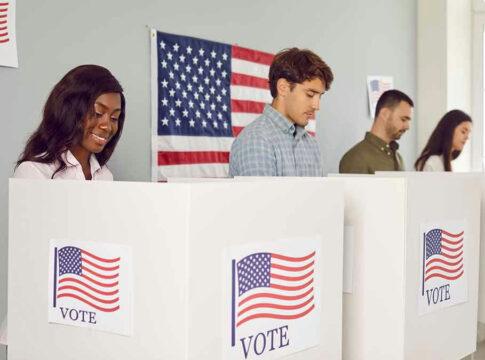
Today, the act of voting is considered sacrosanctly private, safeguarded by the curtain of a voting booth and the security of a sealed ballot box. However, for the first two centuries of American democracy, the right to vote was not only restricted to a select group of citizens (primarily white, male property owners), but it was also a public declaration.
This practice, known as viva voce (Latin for “by living voice”), meant voters did not use paper ballots. Instead, they would walk up to a table of election officials, candidates, and community members, and audibly announce their chosen candidate to be recorded in a poll book. This tradition persisted in some parts of the United States until the very end of the 19th century.
The Colonial Rationale: Accountability
Inherited from European parliamentary customs, the viva voce method was rooted in the idea that a vote was a public trust, not a private preference. Proponents of the system believed that voting aloud encouraged civic virtue and accountability.
A voter was expected to stand by his choice publicly, proving he was not swayed by private interest but was committed to the common good. Elections were often boisterous, festive social occasions, where neighbors and rivals alike witnessed the official recording of every vote.
The Dark Side of Public Voting
While the system promoted public engagement, it created a host of problems that eventually doomed it. Because every vote was openly known, viva voce voting was deeply susceptible to intimidation, coercion, and corruption.
- Patronage and Pressure: Landowners, employers, and political bosses could stand near the polls, watching—and recording—how their tenants, employees, or debtors voted. A vote against the prevailing local power could lead to severe social or economic consequences.
- Bribery: The public nature made outright bribery and the dispensing of goods and services on Election Day highly effective. A candidate or faction could easily confirm that a voter had delivered on their promise.
- Reinforced Hierarchy: Since only a privileged minority could vote, and their votes were public, the system reinforced the control of local elites and maintained existing social and political hierarchies.
The Slow March to Secrecy
The push to replace voice voting began in the mid-19th century as democratic ideals expanded and concerns over widespread voter fraud and intimidation grew. Reformers saw the need for a mechanism that protected the independence of the voter.
The solution came in the form of the Australian ballot, or secret ballot, which was introduced to the U.S. in the late 1880s. This method required the government, not the political parties, to print uniform ballots, and crucially, guaranteed the voter privacy while casting their selection.
The transition was gradual, but once adopted, the secret ballot quickly became the national standard. The final stand for public voting came in 1891, when Kentucky—the last state to hold onto the tradition—finally abolished viva voce voting, ushering in the era of true ballot secrecy across the nation.
The abandonment of the public vote marked a defining moment in American democracy, shifting the focus of electoral integrity from public accountability to the fundamental protection of the voter’s private choice.
Private voting is the best system however with the use of modern technology in the process it leaves the process suspectable to be hacked and falsified tighter security measures are needed to ensure the accuracy and legitimacy of the vote
The felon President Trump is out for total control. He no longer wants mail in ballots, which will keep a great many seniors from voting. In Mt. in particular, who wants to stand in long lines out in the cold to spend 10 minutes voting. We finally requested mail in ballots, no more driving into town to stand in long lines and freeze as the line slowly moves along. Trump knows many seniors are smart enough to remember Hitler and his Gestapo, which is equivalent to ICE under the Trump regime. We don’t allow dictators or Kings in our country. He is sticking his nose into areas that are not under the direct supervision of any President. Ex: Federal Reserve. His family is making millions during this term because of his self-appointed powers. Our Cowardly Congressional Republicans do nothing to protect our democracy or stop his intrusion into areas no President has the right to abolish or eliminate staff. We need people of integrity and apparently it is no longer Republicans. After many decades of backing and even working for the Republicans locally, I have re-evaluated the disastrous first term of Trump and now this second term where he is seeking to destroy entire Departments of Government. He eliminated the Dept. of Education. This is insane that we allow him to remain in office. It hasn’t been a full year, and our national debt just keeps exploding again in a Trump second term too. It is time for Americans who do not want our nation to go bankrupt, to make a fuss. I will make one prediction. If we allow Trump to destroy our Democracy, we may not ever get it back. Call, write, email your Congressional Delegation and warn then what we are seeing, Ice/Gestapo type raids, fear and division being worsened in our nation, ignorance for any debt reduction while he flies off at $1M per trip to Florida. He has to have an escort, plus one plane for the armored limo, and another for all the secret service personnel, for a 3-day trip. He thinks he is the great negotiator worldwide, but he is seen as foolish by our major long-term allies, who he alienates and offends. When he attended a birthday party for the late Queen Elizabeth, he was an embarrassment in front of all the world’s leaders of democracies. She literally had her Secret Service get the Trump whole famn damily, out of her country and wanted them warned not to return. The original invitation was for the President and Melania, no one else, but the crass, crude Trump family had all his kids and all their spouses and one boyfriend, crashed the Queen’s birthday party. They definitely do not have an ounce of Class, nor an understanding of basic norms.
He was an embarrassment in his first term, and now with Stephen Miller telling him what legislative bill to vote on, or not, this undereducated and rude man continues to be an embarrassment and now talks of staying in office three or four terms then hand it over to Ivanka. He has no intention of continuing our democracy. Contact your Congressional Members, whether he is mentally incompetent without prompting, he is a puppet now being lead by the group who devised Project 2024, begun when Biden was elected.
Americans used to be smarter than this. If his nick name was Hitler Revisited, would you have stopped voting a party line and actually paid attention to those seeking power over us all. Just wait. He lost an election and told lies and lies and lies to get people to come attack the capitol on Jan. 6. What will this egotistical megalomaniac do when he is told he can only have this last term in office, legally? God Help America. If our democracy survives this term of Trump, we will be lucky.