
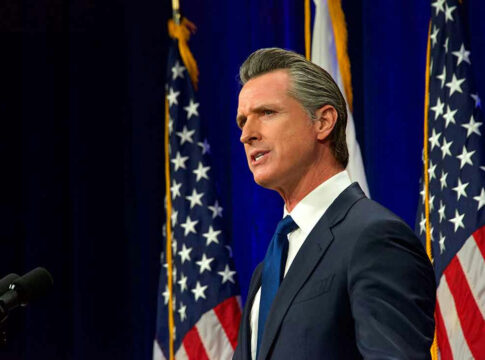
California’s COVID-era fraud mess is colliding with a new federal crackdown—putting Gavin Newsom’s governance under a brighter spotlight than any campaign ad ever could.
California’s $33 Billion Unemployment Fraud Problem Still Shapes 2026 Politics
California’s Employment Development Department became a national symbol of pandemic-era government failure after roughly $33 billion was stolen from unemployment insurance programs, including about $20 billion in federal funds, based on reporting that references state oversight and audits. The same reporting attributes much of the theft to international criminal networks that exploited weak identity checks and rushed benefit processing during lockdowns. Auditors had warned about vulnerabilities before COVID, yet the controls were not strengthened in time.
State-level accountability remains a central question because oversight findings described continuing risk years after the initial wave of fraud. Reporting tied to a 2026 auditor review says critical weaknesses were still not fully fixed, leaving the system exposed to repeat losses. For voters who watched “emergency” government programs expand overnight, this case stands out as a reminder that speed without safeguards can become a blank check for criminals—paid for by taxpayers and employers.
Trump Administration Pauses Billions and Demands Recipient Records
The Trump administration’s latest move escalated the federal-state conflict: more than $10 billion in federal funds to California programs were paused while federal officials demanded recipient lists and related documentation as part of fraud concerns. The reported totals include billions connected to Temporary Assistance for Needy Families, the Child Care and Development Fund, and the Social Services Block Grant. The administration’s message is straightforward: if California wants federal dollars, it must verify where the money goes.
California’s response has focused on impact rather than compliance. Newsom’s office has framed the paused funds as “critical lifelines” and argued the federal action is politically motivated while the state claims it prosecutes fraud. The documentation fight matters because it exposes a core philosophical divide: Washington insisting on tighter verification before releasing funds, and Sacramento warning that enforcement actions can disrupt benefit delivery. The practical outcome now hinges on whether California provides the requested data.
Businesses and Working Families Get Squeezed Between Fraud Losses and Funding Freezes
Fraud on the scale described does not vanish into a spreadsheet—it creates downstream costs. Reporting indicates California relied on federal loans to backstop the unemployment fund, and employers are now hit with higher taxes and surcharges as the state carries those obligations. For small businesses already battered by high costs, this is the predictable consequence of a system that paid out benefits without adequate identity controls. Taxpayers ultimately pay twice: once in stolen funds, then again in recovery costs.
At the same time, the paused federal funding creates immediate uncertainty for families who rely on childcare support and safety-net programs. That tension is politically potent: critics of Newsom can point to weak controls that invited fraud, while state officials can point to real families facing disruption when funds are halted. The common-sense conservative takeaway is that verification is not cruelty; it is the only way to protect legitimate recipients and stop the next criminal windfall.
What’s Verified, What’s Alleged, and What Still Needs Proof
Several key points are well supported across the provided reporting: the enormous unemployment fraud total, the existence of prior warnings about EDD vulnerabilities, and the Trump administration’s pause of federal funds pending documentation. Other claims are less settled. Specific attributions to particular foreign groups and the full national-security chain from stolen benefits to overseas operations are presented through expert commentary, but the underlying government documentation is not included in the provided materials.
Reporting also notes that Newsom’s former chief of staff, Dana Williamson, was indicted in late 2025 on bank and wire fraud charges unrelated to EDD. That detail is politically damaging optics, but it should not be treated as proof about the unemployment scandal. For voters demanding clean government, the stronger, documented issue remains the systemwide failure: a benefits apparatus that bled billions and still faces warnings, now forcing a high-stakes showdown with the federal government over transparency.
Sources:
Newsom Has His Own Massive State Fraud Problem
Trump demands California hand over recipient lists as $10B+ paused amid fraud concerns
Newsom chief of staff indicted
Newsom Has His Own Massive State Fraud Problem