
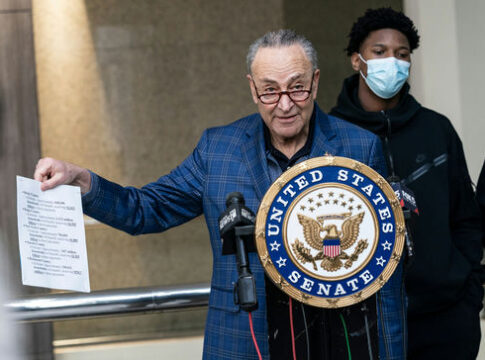
A single line from a 1996 House floor speech now ricochets across today’s immigration fights because it exposes what Washington used to admit out loud: fraud is the lubricant that makes illegal entry pay.
The 1996 Floor Speech That Refused to Stay in 1996
Rep. Chuck Schumer’s 1996 remarks landed with the bluntness of a prosecutor: illegal immigration was hard to stop because forged papers made it easy to work and tap benefits. He praised a “gentleman from Florida” for an amendment aimed at adding security features to Social Security cards, framing it as a narrow tool with an outsized payoff. The message to lawmakers was simple: fix the document problem, and you squeeze the incentive.
Schumer’s argument worked because it matched what employers and ordinary voters already knew. The Social Security card had become a de facto identity document for hiring, and once that card became easy to fake, the whole gate swung open. He described constituents demanding an answer for why Congress couldn’t control illegal immigration, then pointed to fraud as the practical explanation. He also insisted the amendment didn’t require reinventing government or creating a national card.
Why Social Security Cards Became the Soft Underbelly
The core problem wasn’t philosophical; it was mechanical. Federal law required employers to verify documents, but they were easy to counterfeit. That creates a compliance theater: businesses must collect paperwork, yet the paperwork can be manufactured. The Senate’s 1996 report on immigration control provisions emphasized document fraud as a central weakness, which tracks with Schumer’s floor emphasis. When identity proofing fails, enforcement shifts from rules to wishful thinking.
That vulnerability didn’t appear overnight. The 1986 Immigration Reform and Control Act sought to pair amnesty with employer sanctions, but it relied heavily on document inspections. Predictably, a market emerged to meet demand for “good enough” papers. Critics later pointed to fraud during legalization efforts and the persistent ease of counterfeiting birth certificates and Social Security cards. A government that can’t reliably verify work eligibility invites the very abuse it claims to deter.
The Political Tightrope: Anti-Fraud Without a National ID
Schumer and other lawmakers faced a political trap that still defines the issue: the country wants verification, but it distrusts centralized identity controls. In the 1990s, “national ID” was a third rail, opposed by civil libertarians and many conservatives who feared mission creep. The 1996 approach tried to split the difference by hardening a commonly used document rather than inventing a new one. That’s a defensible instinct: upgrade what exists, limit scope, and reduce data collection.
Conservatives tend to measure policies by outcomes and incentives. On that score, Schumer’s 1996 framing aligns with common sense: shrink fraud and you shrink unlawful access to jobs and benefits. Where the argument gets politically charged is in the sweeping claim about motivations for illegal entry.
The available record supports that he linked illegal immigration to fraud-enabled work and benefits; it doesn’t prove a universal motive for every migrant. Still, a system designed around exceptions collapses under predictable abuse.
From Then to Now: Verification Systems Evolved, Vulnerabilities Stayed
The ideas debated in 1996 didn’t vanish; they morphed into modern verification efforts, including pilot programs that eventually influenced E-Verify. Yet the basic challenge remained: verifying a person is who they claim to be, not merely that a number looks plausible. If an identity thief or document buyer can present a valid-looking identity, the system can still be fooled. That’s why voters keep circling back to the same question: why can’t the government secure the front door?
That looping frustration is also why old clips go viral. A resurfaced Schumer clip plays like a time capsule from a Congress that spoke more freely about fraud and enforcement. Critics use it to argue that inconsistencies in later political messaging exist, while defenders can argue that a focus on fraud is not incompatible with legal immigration. The practical point stands either way: border policy fails when interior verification fails, because the job market becomes the magnet.
What a 40-Second Clip Misses: The Unfinished Business of Enforcement
The clip’s power comes from its clarity, but clarity can hide complexity. Fraud prevention can mean better card technology, tighter issuance rules, improved employer verification, and sharper penalties for document mills. It can also mean refusing to expand benefits eligibility without reliable identity checks. Conservatives typically support these guardrails because they protect taxpayers and restore the rule of law without demanding endless new bureaucracy. The unresolved question is whether Congress will fund and enforce verification at scale.
Schumer’s 1996 emphasis on fraud still functions as a litmus test for seriousness. Politicians love grand speeches about compassion or toughness, but voters live with the downstream costs: wage pressure in some sectors, strained services in others, and a corrosive belief that rules only bind the compliant. A durable solution has to make legal hiring easy, illegal hiring hard, and identity fraud risky. Until then, the country will keep rehashing old speeches because the underlying leak has never been sealed.
Sources:
https://cis.org/Tale-Two-Senators
https://www.congress.gov/committee-report/104th-congress/senate-report/249/1