
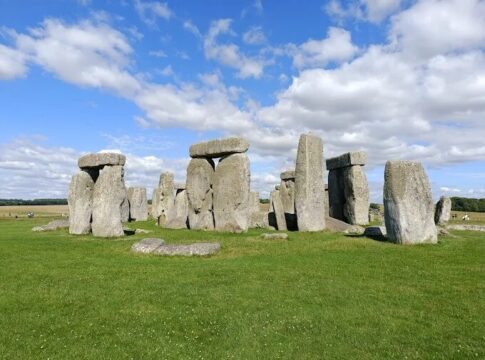
A ring of deep shafts bigger than any known prehistoric monument sat hidden near Stonehenge until modern sensors exposed it—and the digging turns out to be the easy part of the mystery.
The Discovery That Changed the Map of “Stonehenge Country”
Geophysical survey work in 2020 picked up something that didn’t fit the usual Stonehenge storyline: a wide ring of anomalies around Durrington Walls, the largest henge in Britain. Ground-truthing followed with coring and targeted investigation, and the “anomalies” resolved into deep shafts. The scale is the shock: a circle more than two kilometers across, dwarfing the famous stone circle that usually gets all the attention.
That first moment mattered because it forced a rethink of where the action was in the Neolithic landscape. Stonehenge stops looking like a lone masterpiece and starts looking like one dramatic room in a sprawling civic-and-sacred complex. For readers who like clear takeaways: the pits push Durrington Walls into the starring role, suggesting a planned perimeter that organized movement, visibility, and probably behavior in a way we rarely see preserved.
Not Nature’s Accident: How Scientists Checked the “Big Holes” Story
Archaeologists didn’t settle for “it looks man-made.” They stacked methods. Optically stimulated luminescence dating helped bracket when sediments last saw sunlight, supporting a Late Neolithic timeframe around 2480 BC. Geochemistry compared fills and chalk signatures to rule out random natural processes. Sedimentary ancient DNA teased out traces of local plants and animals embedded in the deposits, adding texture to the story of how the pits filled over time.
The case matters because chalk landscapes can produce weird features, and the public has heard plenty of overconfident archaeology claims that later collapse. Here, the research teams emphasized convergence: separate techniques all pulling toward the same conclusion. That’s how responsible field science should look. The pits appear deliberately dug, then gradually infilled, with patterns that don’t match typical natural voids in chalk. If you want to be persuaded, this is the kind of multi-tool verification to trust.
The Engineering Problem Hidden Inside a Ritual Landscape
Each pit reaches down roughly 5 to nearly 7 meters and spans up to about 10 meters across—serious earthmoving with Neolithic tools. The deeper puzzle is logistics. A circle that large demands planning across long distances: pacing, sight lines, landmarks, and an agreement on what “circular” means without modern surveying equipment. Researchers have highlighted how close the ring comes to a near-perfect circle, which implies measurement systems and leadership capable of coordinating teams.
That point deserves emphasis because it cuts against the lazy habit of treating ancient people as improvisers. You don’t get a vast ring by accident, and you don’t keep it coherent with casual guesswork. Someone chose where each pit should go, and enough people followed the plan to make the geometry show up 4,500 years later on a scientist’s screen. The pits are less “mysterious holes” than the footprint of an organized society.
Why Build a Circle of Shafts? Boundary, Pilgrimage Control, and Cosmology
Purpose remains interpretive, but the leading idea fits the setting: the pits likely marked a boundary in a ceremonial landscape centered on Durrington Walls and connected to nearby monuments such as Woodhenge. A boundary doesn’t need a wall to work; it needs a message. A ring of deep shafts broadcasts separation—inside versus outside—while allowing movement through chosen gaps. That makes sense for managing processions or pilgrim flows toward sacred spaces.
Researchers have also floated cosmological meaning: the boundary as a statement about order, the underworld, or a mapped universe. Those ideas can feel airy until you remember the hard fact underneath them: people invested enormous effort in a non-domestic structure. They weren’t building shelter or storage here; they were building meaning. From a common-sense, conservative lens, the impulse is recognizable: communities anchor identity in place, ritual, and tradition—then defend it with visible, unforgettable markers.
What This Finds About Us: Modern Doubt Meets Ancient Competence
Modern commentary sometimes treats archaeology like a playground for wild theories, and social media can turn every trench into a conspiracy. The pit circle resists that temptation because the evidence is technical and cumulative. It also pushes back on today’s reflex to underestimate earlier cultures. Precision, scale, and coordination point to social discipline—shared rules, leadership, and the ability to marshal labor for goals that weren’t immediately “practical” in a household sense.
The remaining open loop is the one that keeps this story alive: what did participants feel when they reached that boundary? The pits define a threshold, and thresholds shape behavior. Future work may sharpen how many pits existed, how they were sequenced, and how the ring related to seasonal events or movement routes. The next discovery may not be another spectacular object; it might be a clearer explanation of how a civilization organized itself around awe.
Sources:
New research uncovers secrets of Stonehenge’s vast Neolithic pits
Archaeologists unravel mystery behind deep pits found near Stonehenge
Digs: England’s Neolithic Pits
Massive pit circle near Stonehenge confirmed as Neolithic structure at Durrington Walls
Stonehenge’s Stones May Have Moved Without Humans
Archaeologists Are Unraveling the Mysteries Behind Deep Pits Found Near Stonehenge