
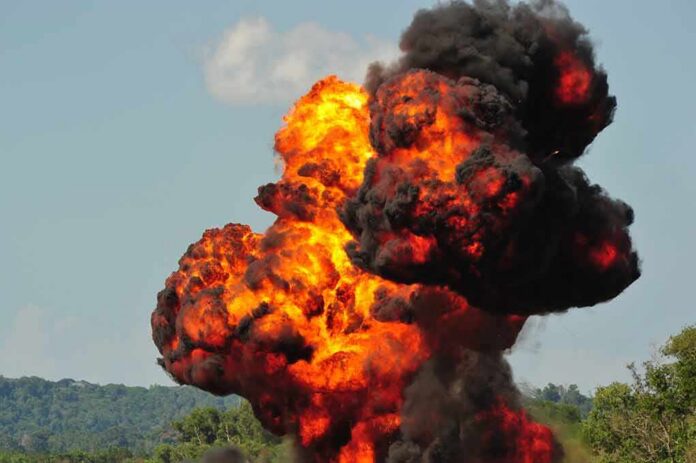
The Army blew up a stockpile it said was too unstable to move, and it did it on purpose to stop a worse blast.
Story Snapshot
- The Army carried out a planned detonation of degraded lead azide in Middletown, Iowa.
- Officials said moving the material risked an accidental explosion; on-site neutralization was chosen.
- Environmental Protection Agency permitted the emergency treatment; multiple agencies coordinated.
- Public health guidance advised evacuations or shelter-in-place with tight home-sealing for up to two days.
What happened, where, and why it mattered
The United States Army executed a controlled detonation at the Iowa Army Ammunition Plant in Middletown around 9 a.m. Central time on November 25, 2026. The target was a cache of lead azide that officials said had degraded, crystallized, and become dangerously sensitive. Army leaders stated the goal was simple and urgent: prevent an uncontrolled, spontaneous explosion by removing the threat in a managed way. The Army announced the plan, timing, and purpose in advance and framed the step as a safety action.
Army officials said transport was off the table because vibration, shock, or friction could set off the material. They argued that on-site treatment by intentional detonation cut the highest risks to workers and neighbors compared with moving the stockpile off base. That necessity claim, they said, drove the decision to neutralize the hazard where it sat, rather than load, ship, and unload it through public roads and towns.
Who signed off and how the rules were applied
The Environmental Protection Agency issued an emergency permit to store and treat the material as hazardous waste. That permit distinguished emergency treatment from ordinary disposal and allowed the Army to proceed under federal law. The Army also said it coordinated the operation with the Environmental Protection Agency, the Federal Emergency Management Agency, the Department of Health and Human Services, the Bureau of Alcohol, Tobacco, Firearms and Explosives, and state and local partners. This reflected a whole-of-government posture rather than a one-agency call.
The Iowa Department of Health and Human Services pushed out clear protective steps. Guidance covered evacuation zones, shelter-in-place instructions, and maps. Residents in certain areas were told to close windows and doors and keep ventilation to a minimum for 24 to 48 hours unless officials updated advice. That level of direction showed emergency plans moved from paper to practice, not just press release language.
Timing changes and how weather shaped the plan
The Army delayed the detonation window days earlier because of a forecasted temperature drop. Officials said colder conditions could further destabilize the crystallized explosive. The acting Secretary of the Army stated they would wait until the last safe moment before the temperature shift, then act. That adjustment signaled deference to on-the-ground safety math and showed leaders were willing to pause rather than stick to a rigid clock.
Today’s controlled detonation at the Iowa Army Ammunition Plant demonstrates the power of a coordinated, whole-of-government response. Initial assessments indicate that measures to contain the blast and limit the spread of lead dust exceeded expectations, and real-time air…
— Secretary Kennedy (@SecKennedy) November 25, 2026
Leaders also set a defined start time and location at the Middletown plant and provided public notice the day before. That kept local governments, hospitals, and emergency managers aligned on road closures, siren use, and message timing. The Army framed the effort as “controlled and mitigated,” emphasizing engineering steps to reduce pressure, heat, and potential off-site movement of dust. Officials stressed that the “why,” “where,” and “when” were fixed so the “how” could play out safely.
How to weigh the tradeoffs without the jargon
This case shows the classic hazardous munitions dilemma. Aging stockpiles can get more sensitive over time. Treatment brings its own risks in the moment. The real choice is which path is least dangerous. The Army said in-place detonation beat transport and other options on that test, and the Environmental Protection Agency’s emergency permit recognized that treatment track. Conservative common sense says you remove the worst immediate risk first, and you do it under tight controls and clear authority.
Sources:
youtube.com, army.mil, epa.gov, homelandsecurity.iowa.gov