
A president who can turn a heckler into a punchline owns the room in a way that no amount of scripted messaging can replicate — and that instinct, more than the joke itself, is what Friday night in Myrtle Beach actually demonstrated.
Key Points
- President Trump was interrupted by protesters during an August 21 rally in Myrtle Beach, South Carolina, held to support Senate candidate Darline Graham ahead of her runoff against Rep. Ralph Norman.
- One protester wore a shirt reading “Kill Your Local Pedophile” and was escorted out by security along with a second demonstrator.
- Trump dismissed the interruption with a quip that the protester was “going home to mom” to “get scolded” because “mom is voting for us,” barely pausing his remarks.
- The moment reflects a decades-old pattern in campaign politics: how a candidate handles a heckler often gets remembered longer than the heckler’s actual grievance.
- Rally disruptions are now near-routine at high-visibility political events, and how outlets frame them — as disorder, dissent, or evidence of composure — shapes public reaction as much as the incident itself.
What Happened at the Myrtle Beach Rally
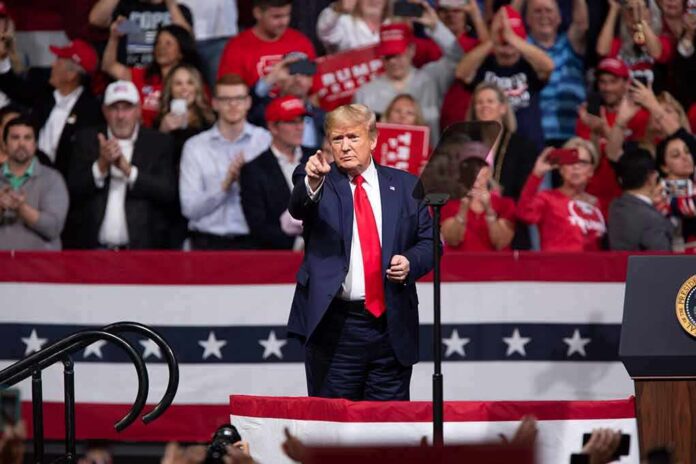
President Trump traveled to Myrtle Beach on August 21 to campaign for Darline Graham, a political newcomer seeking the U.S. Senate seat left vacant by her late brother, in a runoff against Representative Ralph Norman. The stakes were more than local color: Reuters framed the visit as an early test of the White House’s political muscle heading into the November midterms. Midway through his remarks, at least two protesters disrupted the event. One wore a black T-shirt bearing the words “Kill Your Local Pedophile,” and both were removed by security and convention-center staff, consistent with the White House pool report of the evening.
Trump did not stop the rally to manage the disruption at length. Instead, he delivered a single dismissive line — that the protester was “going home to mom” and would “get scolded” because “mom is voting for us” — and continued his remarks almost without a pause. Multiple outlets covering the rally independently captured the same exchange, and the crowd’s reaction, audible in video from the event, was immediate and favorable to the president. The episode lasted seconds, not minutes, and the broader speech continued largely uninterrupted afterward.
The Shirt, the Ejection, and Why It Mattered More Than the Joke
The content of the protest — a slogan invoking violence against alleged pedophiles — is not incidental to how this moment traveled. Visual, provocative protest messaging tends to dominate coverage and social sharing regardless of the underlying policy grievance, because it is instantly legible and instantly shareable. That dynamic played out here: coverage of the rally leaned heavily on the shirt’s wording and the physical ejection of the protesters, sometimes as much or more than on the substance of Trump’s remarks about Graham’s candidacy. Security removed the demonstrators without reported incident, a detail that matters because it distinguishes this from rally disruptions that have escalated into confrontations at past Trump events.
That distinction has precedent. The 2016 campaign saw an entire rally in Chicago canceled outright after protesters flooded the venue, an episode that became a flashpoint in debates over campaign security and free-speech tensions at political events. Measured against that history, Myrtle Beach was a minor disruption, resolved quickly and without altering the event’s course — which is precisely why the story became about the comeback line rather than the confrontation.
The Rhetorical Playbook Behind the One-Liner
Trump’s handling of hecklers has been a recognizable feature of his public style since 2015, and the “mom” line fits a familiar template: minimize the protester, invoke a folksy image of domestic authority, and let the crowd do the work of drowning out the interruption with laughter or applause. It is a technique built for the compressed attention span of live television and short-form video, where the clip that survives is rarely the protest chant but almost always the retort. Research on campaign-rally coverage confirms this bias toward performance: outlets and campaign communications teams alike understand that how a candidate reacts in the moment often becomes more shareable, and more politically useful, than what provoked the reaction.
This is not unique to Trump, even if he has refined it into a signature move. Howard Dean’s 2004 primary campaign was effectively derailed by a single vocal outburst that got replayed out of context for weeks, a cautionary tale often cited in studies of political framing. The lesson campaigns have drawn since is straightforward: composure under interruption reads as strength, visible irritation reads as weakness, and a well-timed joke can convert a liability into a highlight reel moment. Trump’s line did exactly that on Friday night, and the enthusiastic crowd reaction on video suggests it landed with the room as intended.
Why Rally Disruptions Keep Recurring — and Why the Response Matters More Than the Protest
Presidential campaign events have drawn protesters for as long as there have been presidential campaign events; demonstrations against sitting presidents and candidates are a durable feature of American political life, not an aberration tied to any one figure or party. What has changed is the speed and volume at which a single ten-second exchange now circulates — clipped, captioned, and reposted across video platforms within hours, often stripped of the surrounding context of the speech itself. Academic work on protest coverage consistently finds that the framing choices outlets make, whether to emphasize disorder or dissent, shape audience judgment about legitimacy far more than the raw facts of the disruption do.
For campaigns, the practical takeaway is durable regardless of the shirt slogan or the protester’s grievance: a fast, confident, even humorous response neutralizes a disruption in the moment it happens, while a rattled or defensive one prolongs it in the retelling. Myrtle Beach offered a clean example of the first pattern. Darline Graham’s runoff against Ralph Norman will be decided on turnout and message discipline, not on a heckler’s T-shirt — but the rally clip will likely outlive the substance of either candidate’s stump speech, which is its own commentary on how modern campaigns are consumed.
🚨 FACT CHECK: No, Trump Wasn't “Heckled by His Own Crowd” in South Carolina
A viral post is claiming President Trump was “heckled by his own crowd” at Friday night's Myrtle Beach rally.
That's a pretty misleading way to describe what happened.
Trump was interrupted by a… pic.twitter.com/WjZOIHu5xQ
— 🎹 Ames™ 🎹 (@Real_Ames) August 22, 2026
Sources:
reuters.com, tmz.com, washingtontimes.com, x.com, youtube.com, cnn.com, experts.umn.edu, tandfonline.com, sites.psu.edu, en.wikipedia.org