
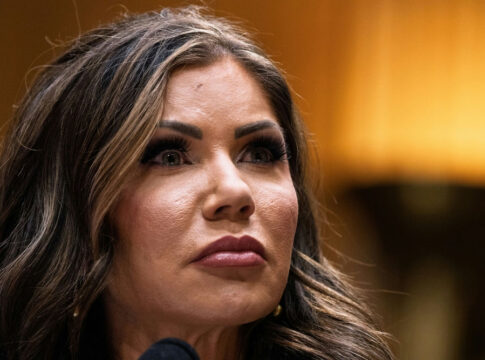
The most unsettling part of Department of Homeland Security Secretary Kristi Noem’s spyware claim isn’t the tech—it’s the idea that the threat was already inside the building, sitting close enough to hear every word.
Noem’s allegation: spyware installed by her own DHS staff
Noem’s account came through a podcast interview, not a court filing or an inspector general report. She described software placed on her phone and laptop “from the time” she entered the office, allegedly used to spy on her and capture meetings. She also said the problem extended beyond her to other political appointees. That detail matters: it shifts the story from personal grievance to a potential internal campaign.
Kristi Noem Reveals 'Deep State' DHS Staffer Installed Spyware on Her Phone and Laptop to Spy on Her (VIDEO) https://t.co/OfN4J5QyhT #gatewaypundit via @gatewaypundit
— LisaMo (@LisaMoMentor2) February 27, 2026
Her description follows a familiar Washington pattern: a leader arrives, the bureaucracy resists, and someone starts leaking. The twist is the method. Spyware isn’t a loose-lips problem; it’s a systems-and-access problem. Installing it generally requires proximity, permissions, or deception. If her claim is accurate, the real headline becomes operational control—who touched the devices, who managed accounts, and could implant tools without tripping alarms.
Why the “Musk team found it” detail changes the power story
Noem said Elon Musk and his team helped identify the software. That single claim does two things at once: it implies the compromise was real enough to be detected by outside technical expertise, and it signals a new dependency chain in which political leadership leans on private-sector talent to secure federal operations. Conservatives often argue that government should run lean and competent; this is what happens when agencies can’t—or won’t—police their own digital house.
The practical question is what “identified” means. Did they discover suspicious network traffic? Unusual mobile device management profiles? Evidence of remote access tooling? The public doesn’t have that detail, and no independent confirmation is provided in the research. Without artifacts—logs, forensic summaries, or an investigation memo—every side fills the vacuum with what it already believes about the “deep state,” Silicon Valley influence, and internal sabotage.
🚨 BREAKING: Sec. Kristi Noem just shockingly announced that Elon Musk helped her uncover SPYWARE installed by DHS STAFFERS onto her phone and computer
TRAITORS MUST BE PROSECUTED!
"@ElonMusk and his team were extremely helpful to me. They helped me identify that some of my own… pic.twitter.com/NJxZz5y9xh
— Eric Daugherty (@EricLDaugh) February 26, 2026
Polygraphs, firings, and device sweeps: what those actions signal
Noem said the culprits were brought in, polygraphed, and fired. In national security circles, polygraphs get used as an investigative tool and as a pressure tool. They can narrow a suspect pool, but they don’t replace evidence. Firings, meanwhile, can be decisive management or premature cleanup, depending on what actually existed on the devices. The “regular sweeps” detail suggests she believes the risk persists beyond a single incident.
She also described discovering a “secret file room” containing classified documents and said that attorneys now hold them. That claim adds drama, but it also raises basic chain-of-custody questions: who found them, who logged them, and what authority governed the transfer? If a secure compartmented facility ran off the books, investigators would normally care less about the politics and more about who accessed it, when, and why it wasn’t on the official security map.
The larger DHS surveillance context makes this allegation explosive.ve
This episode doesn’t land in a vacuum. DHS components, including ICE, have faced scrutiny over surveillance tools that can scale from targeted monitoring to broader collection. A congressional oversight letter in early 2026 pressed DHS on “mass surveillance” technologies, and related reporting has highlighted capabilities that can map devices across neighborhoods. Those controversies usually center on government power pointed outward—at citizens, suspects, or protesters.
Noem’s story flips the arrow inward, toward leadership itself. If DHS personnel can allegedly surveil the Secretary, the agency has a governance problem before it has a privacy problem. Conservatives tend to back law enforcement tools when used with clear authority, narrow scope, and accountability. Internal spying, by contrast, looks like factional warfare with taxpayer-funded infrastructure. That sort of environment produces one predictable outcome: leaders clamp down, and everyone’s freedoms shrink.
What a common-sense reader should demand before believing any side
Noem’s critics dismiss the claim as paranoia; her supporters see it as vindication of long-standing suspicions of internal sabotage. Common sense says neither camp should get a blank check. A real spyware incident leaves traces: device images, indicators of compromise, admin access records, and a clear explanation of how installation occurred. A serious response would also specify whether DHS security teams or an inspector general were involved, and whether law enforcement opened a case.
Until that proof emerges, the most responsible takeaway is narrower but still troubling: trust inside DHS appears fractured enough that a Secretary publicly described her own workforce as a potential threat. That’s a management failure regardless of party. If career staff truly acted disloyally, accountability must be evidence-based. If leadership overstated events, the agency still pays the price in morale and credibility. Either way, the public deserves documentation, not vibes.
Kristi Noem Reveals 'Deep State' DHS Staffer Installed Spyware on Her Phone and Laptop to Spy on Her (VIDEO) | The Gateway Pundit | by Cristina Laila https://t.co/njbMKXvifV
— “Once you label me, you negate me. “ (@onceyoulabelme) February 27, 2026
One final irony hangs over the whole saga. DHS sits at the crossroads of border security, counterterrorism, and cyber defense—missions that require discipline, not intrigue. When the Secretary says she needs outside tech muscle to detect monitoring on her own devices, Americans should ask a blunt question: if the department can’t secure its top official, how confident can it be about securing the country? That question won’t go away with firings.
Sources:
Paranoid ‘ICE Barbie’ Kristi Noem Drops ‘Bonkers’ Claims About Her Own Staff
Brown Leads Oversight Letter to DHS on ICE’s Troubling Mass Surveillance Tech