

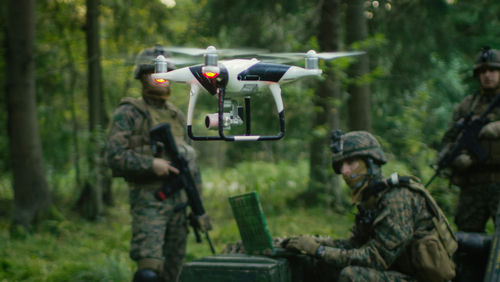
As the United Nations warns that “killer robots” could become a license for atrocity crimes, both Americans who distrust global elites and those who distrust the warfare state have new reasons to worry about where this technology is heading.
Story Snapshot
- The UN chief is pressing for a global ban on lethal autonomous weapons that can kill without real human control.
- Over 100 countries back talks on a treaty, but major powers still resist strict limits on this technology.
- Experts warn these weapons could speed up war, lower the bar for killing, and make blaming anyone much harder.
- Both conservatives and liberals who already feel betrayed by elites now face a future where algorithms pick who lives and dies.
What the UN is demanding on “killer robots”
United Nations Secretary-General António Guterres has again called for a global ban on lethal autonomous weapon systems, which are weapons that can select and kill targets without real human oversight.[1] He says there is “no place” for these systems in the world and calls machines with the power and discretion to take human lives without human control “politically unacceptable” and “morally repugnant.”[1] He wants new international law that clearly bans these weapons and sets strict rules on any military use of artificial intelligence by 2026.[1]
Supporters of a ban argue that algorithms can never grasp the value of human life, so they should not decide who lives and who dies.[2] They warn that fully autonomous weapons could break basic rules of war meant to protect civilians, because software may misread crowds, emergency workers, or surrendering soldiers as threats.[1] These systems could also be copied or hacked, spreading cheap, deadly power to rogue states, terrorist groups, or criminal gangs far faster than older weapons.[4]
How close the world already is to algorithmic warfare
Autonomous weapons are not just science fiction anymore; United Nations reports say systems that can pick and attack targets on their own already exist in some form and are being tested in real conflicts.[2] A global campaign called the Campaign to Stop Killer Robots formed in 2013 to push a preemptive ban on “machines that determine whom to kill.”[5] The International Committee of the Red Cross now urges new rules with three pillars: no autonomous weapons that target humans, bans on highly unpredictable systems, and strict human control over all other uses.[2]
United Nations member states have debated these weapons for a decade under the Convention on Certain Conventional Weapons, but talks have moved slowly and often get bogged down by powerful countries that want to keep military options open.[1][5] Even so, momentum is building. A recent United Nations General Assembly resolution on autonomous weapons was backed by 156 countries, raising alarms about an arms race, easier escalation of wars, and the spread of these tools to non-state actors.[4] That resolution echoes Guterres’s call for a “two-tier” approach: outright bans on the worst systems and tight regulations on the rest.[1][4]
Why both left and right see a “deep state” danger here
For many Americans, this fight over killer robots lands on top of a deeper anger: a belief that the government, big tech, and defense contractors already ignore the people while they profit and gain power. Conservatives who support a strong military still worry about a permanent war machine that outsources fighting to unaccountable algorithms, removing US soldiers but also removing human conscience from the battlefield. Liberals who fear surveillance and discrimination see another tool that could be turned on protesters, migrants, or minority communities at home.
Critics warn that autonomous weapons could make it easier for leaders, generals, and intelligence agencies to wage “clean” wars that stay off the nightly news, with far less political cost and almost no personal risk for decision-makers.[3][7] When a drone or ground robot kills the wrong family, who is to blame—the programmer, the commander, the manufacturer, or the algorithm itself? That fog of responsibility feeds the sense that elites can break moral and legal lines and then hide behind code and complexity.[1][3] For citizens on both sides who already doubt that the law is applied fairly, this looks like the next step in a system that protects the powerful and treats ordinary lives as data points.
What comes next, and what is at stake for American values
By pushing for a treaty by 2026, the United Nations is trying to get ahead of a technology that is racing forward faster than politics.[1] Over 100 countries now support a legally binding agreement that would ban the most dangerous systems and require “meaningful” human control over any use of lethal force.[2] Yet several major military powers, including the United States, still resist a full ban and argue that existing laws of war are enough if commanders follow them.[5] That leaves a growing gap between public concern and what governments are willing to give up.
For Americans who care about the Constitution, limited government, and basic human dignity, the core question is simple but stark: do we allow unelected experts, secret programs, and black-box algorithms to gain the power to decide who lives and who dies in our name? If lethal autonomous weapons spread without strict limits, they could deepen the very trends many already fear—unaccountable elites, endless low-visibility wars, and a culture where human life is weighed by a machine. If they are tightly controlled or banned, it would mark a rare moment where citizens and nations drew a hard line before a new technology quietly rewrote the rules of power.
Sources:
[1] Web – Robot weapons must not become ‘licence for atrocity crimes’: UN
[2] Web – UN chief calls for global ban on ‘killer robots’ | UN News
[3] Web – Autonomous weapons that kill must be banned, insists UN chief
[4] Web – UN: Start Talks on Treaty to Ban ‘Killer Robots’ | Human Rights Watch
[5] Web – UN chief calls for global ban on ‘killer robots’ – The European Sting
[7] Web – Next steps for treaty on killer robots laid out in UN …