
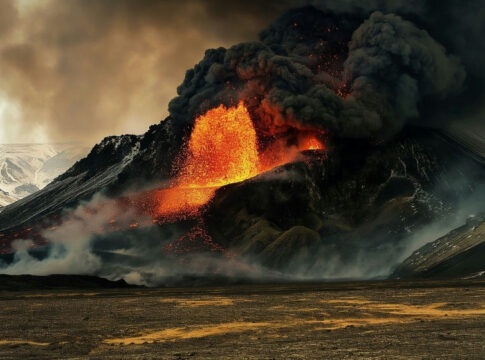
The underwater volcano that captured global headlines in 2022 with an eruption heard around the world is not waking up to end civilization, despite what sensational headlines would have you believe.
The Reality Behind the Eruption That Actually Happened
Hunga Tonga-Hunga Ha’apai sits approximately 65 kilometers north-northwest of Tonga’s capital, rising 2,000 meters from the seafloor as part of the Tonga-Kermadec Islands volcanic arc. This submarine stratovolcano made legitimate headlines on January 15, 2022, when it unleashed one of the most powerful eruptions in modern history. The blast sent an ash plume 58 kilometers into the atmosphere, generated tsunamis that killed three people in Tonga and reached coastlines from Japan to Peru, and produced sonic booms audible in Alaska. The Tonga Geological Division and international monitoring networks documented the event meticulously, providing no ambiguity about its genuine magnitude.
What Made This Eruption Scientifically Unique
Unlike typical volcanic eruptions dominated by ash and sulfur dioxide, the 2022 Hunga Tonga blast injected an unprecedented volume of water vapor into the stratosphere. This distinction matters enormously. Traditional eruptions like Mount Pinatubo in 1991 cool the planet temporarily by reflecting sunlight with ash particles. Hunga Tonga’s water vapor injection created different atmospheric dynamics, with effects persisting into 2023 before dissipating. Scientists estimate the explosion’s force between 15 and 61 megatons of TNT equivalent across multiple sequential blasts. The volcano had built a new island during 2014-2015 eruptions, only to obliterate much of it in 2022, reshaping the caldera structure underwater.
The Climate Impact Debate Continues
Researchers continue parsing the eruption’s atmospheric legacy, though not because the volcano threatens renewed activity. Studies published through 2024 examine whether the stratospheric water vapor contributed to subsequent global temperature patterns. Texas A&M researchers disputed claims that Hunga Tonga played a primary role in 2023-2024 warming, noting the effects were minor compared to carbon dioxide-driven trends. Other analyses documented how the vapor initially cooled tropical regions in 2022 before circulation changes reversed the pattern. These scientific discussions focus on understanding past events, not predicting imminent catastrophe. The lingering research interest reflects the eruption’s rarity, not evidence of reawakening danger.
Who Monitors This Volcano and What They Actually Report
Kelepi Mafi, Tonga’s chief geologist, leads local monitoring efforts alongside the Tonga Meteorological Services and Ministry of Lands. These agencies coordinate with the Global Volcanism Program at the Smithsonian Institution and New Zealand’s Wellington Volcanic Ash Advisory Center. Satellite systems like HIMAWARI-8 provide real-time surveillance of the caldera region. The monitoring infrastructure exists precisely to separate genuine volcanic threats from background seismic noise. Current data shows no precursory activity resembling the December 2021 unrest that preceded the 2022 eruption. Aviation safety protocols and tsunami warning systems remain operational, but they respond to measurable phenomena, not speculative scenarios invented for clicks.
Why Doomsday Volcano Stories Persist Despite Facts
The “civilisation-ending” framing reveals more about content economics than geology. Submarine volcanoes lack the visual drama of erupting mountains like Vesuvius or Fuji, so sensational language compensates. The 2022 event provided genuine spectacle, atmospheric booms recorded thousands of miles away, blood-red seawater from suspended ash, and a tsunami sequence that disrupted Pacific communities. Recycling this real drama with fabricated “red alert” urgency creates engagement without requiring new facts. Conservative principles value truth over sensationalism, a standard particularly relevant when alarmist narratives distort scientific consensus. The actual 2022 impacts, three deaths and significant property damage in Tonga, deserve accurate remembrance without exaggeration into extinction-level fantasy.
What the Volcano Actually Threatens Today
Hunga Tonga-Hunga Ha’apai remains an active volcano in a subduction zone, meaning future eruptions are geologically inevitable on timescales of years to decades. That reality differs fundamentally from claims it is currently “beginning to wake.” The volcano’s location above the Tonga Trench ensures continued magma generation, but modern eruptions, even powerful ones, do not end civilisations. The 2022 event, despite its record-breaking characteristics, caused localized devastation rather than global collapse. Responsible monitoring by Tongan authorities and international partners provides the early warning capacity that separates manageable natural disasters from apocalyptic mythology. The absence of current seismic or thermal anomalies in official databases confirms the volcano’s dormant status, at least for now.
Sources:
Global Volcanism Program: Hunga Tonga-Hunga Ha’apai
Wikipedia: Hunga Tonga–Hunga Ha’apai
CIRA Satellite Library: Hunga Tonga-Hunga Ha’apai Eruption
Eos: Atmospheric Effects of Hunga Tonga Eruption Lingered for Years
Texas A&M: New Study Disputes Hunga Tonga Volcano’s Role in 2023-24 Global Warm-Up