
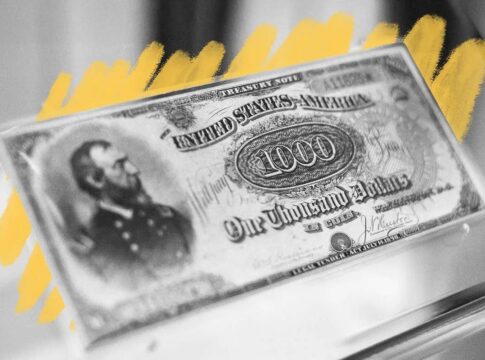
The history of American currency is a vibrant journey through economic innovation, wartime desperation, and cultural shifts. From the colonial frontier to the high-stakes financial world of the mid-20th century, the United States has cycled through dozens of different monetary experiments. Many of these currencies served a vital purpose for a specific era before ultimately being retired by shifting policies or the march of technology.
These defunct tenders do more than just represent old money; they act as historical artifacts. They tell stories of colonial rebellion, the struggle to unify a young nation, and the massive scale of 20th-century commerce. Here is a deeper look at the first of five forms of U.S. currency that are no longer in circulation but remain legendary among historians and collectors.
1. The Pine Tree Shilling: A Colonial Act of Defiance
In the early 1650s, the Massachusetts Bay Colony was a rising commercial powerhouse in the New World. However, it faced a fundamental obstacle to its growth: there was almost no hard currency in the colonies. The British Crown deliberately limited the flow of official sterling to the Americas to keep the colonies economically dependent on the mother country.
This scarcity forced New Englanders to rely on a cumbersome system of bartering with “commodity money”—using items like corn, beaver pelts, and musket balls to pay debts. Seeking to break free from this bottleneck, the General Court of Massachusetts took a bold and technically illegal step. In 1652, they authorized the creation of a local mint in Boston, led by silversmiths John Hull and Robert Sanderson.
The Design and Symbolism
The mint produced silver coins in denominations of three pence, six pence, and one shilling. The design was intentionally simple but symbolic of the rugged New England landscape.
- The Trees: While the “Pine Tree” is the most iconic, the mint actually cycled through three different designs over several decades: the Willow Tree (1652–1660), the Oak Tree (1660–1667), and finally the Pine Tree (1667–1682).
- The 1652 Date: Interestingly, almost all of these coins were stamped with the date 1652, regardless of when they were actually struck over the next 30 years. Historians believe this was a clever legal loophole; by keeping the 1652 date, the colonists could claim the coins were minted during the English Interregnum (when there was no king), potentially avoiding the wrath of the British monarchy once it was restored.
Legacy and Modern Worth
The Pine Tree Shilling became the lifeblood of the New England economy, accepted far and wide as a reliable standard of value. It was a tangible early expression of American self-reliance, proving that the colonies could manage their own financial affairs without London’s oversight.
Eventually, the British government caught up with the “illegal” mint and shut it down in the 1680s, but the legend of the shilling lived on. Today, these coins are considered the ultimate prize of American colonial numismatics. Because they were made of high-quality silver and represent the dawn of American capitalism, authentic specimens are highly sought after, typically valued between $1,500 and $3,000, with rare, high-grade versions reaching much higher at auction.
Sources:
President Trump Marks Six Months in Office with Historic Successes
Trump Administration Accomplishments – McLean County Republicans
Celebrating Big Wins of the Trump Administration – HHS.gov
Trump’s 2025 Executive Orders – Holland & Knight