
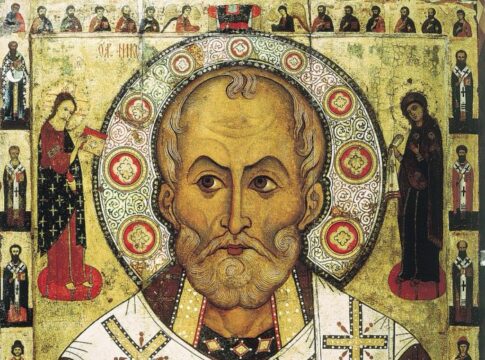
While he is globally recognized today as the inspiration for Santa Claus, the historical St. Nicholas of Myra was a 4th-century Greek bishop whose life was defined by fierce theological conviction and extraordinary acts of secret charity.
The Historical Figure
Nicholas was born around 270 AD in Patara, a port city in Lycia (modern-day Turkey). He was born to wealthy parents who died in an epidemic, leaving him a significant fortune. Nicholas chose to use this inheritance to assist the needy, the sick, and the suffering.
By his early thirties, he was appointed the Bishop of Myra. Unlike the jolly figure of modern legend, the historical Nicholas lived through the “Great Persecution” under Emperor Diocletian, during which he was imprisoned and tortured for his faith before being released by Emperor Constantine.
The Three Gold Balls: A Legacy of Charity
The most famous legend associated with Nicholas involves a poor man with three daughters. In that era, without a dowry, the daughters faced a grim future.
To save the family’s honor without seeking public recognition:
- Nicholas went to the house under the cover of night.
- He tossed a bag of gold coins through an open window (or, in some versions, down the chimney).
- He repeated this for each daughter.
Legend says the gold landed in stockings or shoes drying by the fire, a detail that gave birth to the tradition of hanging stockings by the fireplace.
The Council of Nicaea
Nicholas was not only a philanthropist; he was a central figure in early Church history. He was one of the bishops who attended the Council of Nicaea in 325 AD.
Historical tradition (and some colorful folklore) suggests that Nicholas was so passionate in his defense of the deity of Christ that he allegedly slapped the heretic Arius during a heated debate. This portrays a man of fiery temperament and deep conviction, quite different from the “jolly old elf” image.
The Evolution into “Santa Claus”
The transformation from Bishop Nicholas to Santa Claus was a centuries-long process involving several cultural shifts:
- Sinterklaas: In the Netherlands, he became Sinterklaas. Dutch settlers brought these traditions to New Amsterdam (New York) in the 17th century.
- English Influence: In England, the character merged with “Father Christmas,” a personification of holiday cheer.
- Poetry and Art: In 1823, the poem “A Visit from St. Nicholas” (better known as “The Night Before Christmas”) defined many modern traits: the sleigh, the reindeer, and the physical appearance.
- Thomas Nast: The 19th-century cartoonist Thomas Nast further solidified the visual of a plump, bearded man living at the North Pole.
Patronage
St. Nicholas is the patron saint of an incredibly diverse group, including:
- Children: Due to his generosity.
- Sailors: Legend tells of him calming a storm at sea to save a crew.
- Pawnbrokers: The three bags of gold are symbolized by the three gold balls often seen outside pawn shops.
- The Falsely Accused: He is credited with saving three innocent men from execution.
Today, while the red suit and reindeer dominate the winter season, the legacy of St. Nicholas remains a testament to the power of anonymous giving and standing up for the vulnerable.