
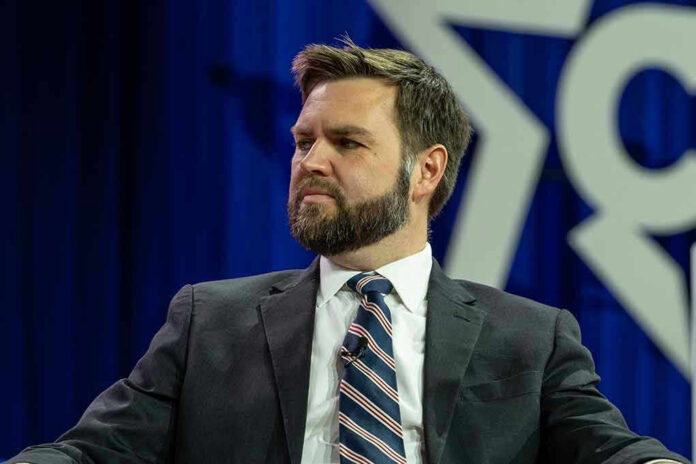
The room went silent after a lone voice shouted “Jesus Christ does not support genocide,” and Vice President JD Vance did not blink.
Story Snapshot
- Vice President JD Vance was heckled mid-speech at a Turning Point USA event at the University of Georgia in Athens.
- The heckler accused the administration of harming children and invoked Jesus Christ by name.
- Vance answered on the spot and resumed his remarks as the event continued.
- Coverage and clips captured the exchange and its tone for a national audience.
Heckling Breaks Into A Campus Speech
Vice President JD Vance took the stage Tuesday at a Turning Point USA event at the University of Georgia in Athens. About ten minutes into his remarks, a voice cut through the crowd: “Jesus Christ does not support genocide.” Another line followed about killing and bombing children. Reports and video align on the words and timing. Vance paused, answered from the lectern, and moved on with the program as attendees settled back in.
Major outlets placed the exchange squarely in Athens at a Turning Point USA event. The remarks and the setting match across coverage from national and international desks. Clips show Vance responding in the room, not dodging or deferring. One broadcast report added that the attendee was later removed, which fits what on-site footage suggests but does not change the core point: the interruption did not stop the event from continuing.
What Vance Said And Why It Landed
Vance answered the religious claim head-on, then shifted to policy points about humanitarian aid and restraint. That approach matters. A speaker who engages calmly, then returns to substance, undercuts the spectacle. The crowd saw a short clash, not a shutdown. For conservatives, that models order, civility, and resolve. For undecided students, it shows a speaker willing to face heat and still argue policy on the merits, not emotion alone.
The phrases hurled at the stage tapped into a wider fight over the Middle East. Campus debates often hinge on moral language that paints opponents as villains. That style can rally a base but rarely persuades a middle. Vance’s reply avoided a personal fight and centered policy claims. That kept the event from spiraling into a shouting match. Viewers at home saw a contrast between accusation and argument. In politics, that contrast is the point.
Where This Fits In The Campus Speech Pattern
Universities host heated speakers, and students push back. That cycle is normal in a free society. The hard line appears when protest shifts from audible dissent to a “heckler’s veto” that blocks speech altogether. Legal and policy guides draw that line clearly: brief counterspeech is protected; sustained disruption that drowns out the speaker crosses it. Here, the exchange was sharp but short, and the event continued, which keeps it well shy of that boundary.
Guess TPUSA was set-up for/with Trump and JD Vance next; all for the billionaires and zionists Eretz Israelis … After all the Trump team rectruited both #CharlieKirk and #ErikaKirk Religion hijacked for votes, once again
— Karma'geddon • αντιδιαφθορά • Anti Corruption (@AndySanTH) September 11, 2026
Administrators and hosts have duties too. They must allow protest that stays within time, place, and manner rules, and they must keep events from being shut down by noise or threats. Groups across the spectrum agree on that baseline even as they argue about edge cases. This event shows how it can work: let the protester speak once, let the speaker answer, then return to the program. That balance upholds both expression and order.
Why The Moment Matters Beyond The Room
Clipped video now decides what millions remember. A ten-second exchange can define an hour-long event. The Athens footage shows a message match between reports and what viewers can see for themselves. That reduces spin and helps people judge tone and tempo on their own. The larger lesson for candidates and campus hosts is simple: be ready for a single loud line, answer it cleanly, and get back on track. Discipline beats drama in the end.
Sources:
redstate.com, abcnews.com, nytimes.com, washingtonexaminer.com, facebook.com, instagram.com