Ten states walked away from Trump’s Great American State Fair, but Pennsylvania’s senators and homegrown companies turned that boycott into a quiet test of what patriotism looks like in the age of political consumerism.
Story Snapshot
- Roughly one-fifth of states refused to send delegations to Trump’s Great American State Fair over cost and partisan concerns.[2][4]
- Pennsylvania officially joined the boycott, citing taxpayer cost and lack of willing corporate sponsors.[4][5]
- Senators Dave McCormick and John Fetterman later stepped in with private partners to represent the Commonwealth anyway.[10]
- The clash shows how modern boycotts are less about policy change and more about signaling whose version of America gets center stage.[19]
How a birthday party for America turned into a partisan stress test
The Great American State Fair was billed as a once-in-a-generation celebration on the National Mall, tying into the country’s 250th birthday.[1][3] Every state and territory received an invitation, with planners promising food from all fifty states, military demonstrations, and even a 110-foot ferris wheel.[1] The Trump administration sold it as a patriotic showcase, something like a modern World’s Fair, complete with large pavilions and big-name musical acts.[2][4] On paper, it looked like bipartisan apple pie. In practice, it became a loyalty test.
Several Democratic-led states balked as the event’s branding shifted from national celebration to Trump-centric spectacle.[1][2] Oregon officials complained that shipping costs to Washington were far higher than expected, with one email flagging a $70,000 bill as “substantially” beyond what they could justify to taxpayers.[2] Others pointed directly at tone. When Trump promised to kick things off with “the Greatest Rally, EVER,” governors heard campaign rally, not civic ceremony.[1][2] That was the moment a party turned into a boycott.
Why ten states said no and what that really means
By late June, at least seven to ten Democratic-led states, including Connecticut, Illinois, Maine, Massachusetts, North Carolina, Oregon, Washington, and Pennsylvania, had formally declined to participate.[1][3][4][7] Their public reasons fell into two buckets. First, cost: state officials claimed the price of designing, shipping, and staffing a pavilion was too high relative to any concrete benefit for taxpayers.[2][4][5] Second, partisanship: governors and tourism agencies said the fair felt more like a Trump-branded event than an even-handed national commemoration.[2][3][4]
Pennsylvania’s move was especially symbolic. This is the state where the Declaration of Independence was adopted, the literal birthplace of 1776.[3][4] Yet the Department of Community and Economic Development announced that VisitPA would not attend, citing high taxpayer costs and the failure to find businesses willing to sponsor a booth.[4][5] For many conservatives, that sounded less like fiscal prudence and more like corporate fear of bad press. When companies refuse to put their name on a flag-themed pavilion because Trump is involved, politics has seeped into every corner of public life.
Pennsylvania’s senators step into the vacuum
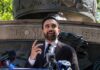
The story could have ended with Pennsylvania absent from a national birthday party. Instead, two unlikely partners changed the script. Local 21 News reported that Republican Senator Dave McCormick and Democratic Senator John Fetterman teamed up to ensure Pennsylvania would still be represented.[10] They worked with state organizations and businesses willing to participate, building an unofficial delegation to fill the hole left by the governor’s decision.[10][12][13] In a polarized era, that kind of bipartisan move is rare and telling.
Trump’s State Fair Faces Fresh Embarrassment!
Amid the Sparse Attendance, Empty Spaces & just Two Rides at Trump's Long-Promised "Great American State Fair," Some Attendees Managed to Make an Interesting Discovery! But It Likely Won't Please Trump! https://t.co/vTs28OD1VT pic.twitter.com/FqkJIIqfF5— D. Lesser (@HarleyGal54) June 28, 2026
The senators’ effort did more than add one more tent on the Mall. It reframed the fight. Governors used the boycott to signal opposition to Trump and to the fair’s partisan tone. McCormick and Fetterman used participation to signal something else: that love of country should not be held hostage by media narratives or party branding. Their approach fits a broader pattern researchers describe as political consumerism, where people “boycott” or “buycott” events to express their values.[19] Here, the “buycott” came from senators and private businesses, not the state bureaucracy.
What this boycott shows about modern patriotism and conservative common sense
History is packed with boycotts, from the Boston Tea Party to Montgomery’s buses.[16][21] Courts have treated peaceful political boycotts as protected speech, but scholars warn that most modern boycotts fail without clear goals and sustained coordination.[17][20][25] The Great American State Fair dust-up fits that pattern. Ten states made a statement. Yet the fair still went forward, all fifty states were represented one way or another, and Trump’s team kept control of the stage.[2] Symbolic victories do not always move policy, but they do reveal where the cultural lines are drawn.
From an American conservative viewpoint grounded in common sense, two truths can sit side by side. States have every right to refuse to spend public money on events they see as partisan theater. Taxpayers deserve transparency on costs, and right now, dollar figures are fuzzy.[2][4][5] At the same time, refusing to show up at a national celebration risks turning patriotism into another partisan commodity. McCormick and Fetterman’s choice to step in with private partners threads the needle: limit taxpayer exposure, but do not leave the flag undefended.
What comes next when every picnic becomes a political choice
Researchers now find that large numbers of Americans regularly join boycotts and “buycotts” for political reasons, and those rates are rising.[19][24] People no longer just vote at the ballot box; they vote with where they go, what they attend, and what they share online. The Great American State Fair shows the downside of that trend. A national birthday event turned into a proxy war over Trump, leaving ordinary citizens stuck between dueling narratives about crowd size, cost, and whose patriotism counts.[2][7][9]
This is why the Pennsylvania story matters more than one row of empty tents. When governors stay home but senators and businesses still show up, the message is clear: America is bigger than any one politician. Citizens who care about conservative values—limited government, strong national pride, and local control—should demand hard numbers on costs and clear boundaries on partisanship. But they should also resist the urge to sit out every shared ritual just because they dislike the headline speaker. If we turn every fair into a front line, sooner or later there is no common ground left to defend.
Sources:
[1] Web – 10 States Boycott the Great American State Fair, But PA Senators and …
[2] Web – ‘Packed to the brim’: Trump says 45K guests attend Great … – WCIV
[3] Web – Trump scrambles to exaggerate pitiful crowd size at Great American …
[4] Web – Great American State Fair | Washington DC
[5] Web – What we know about Trump’s Great American State Fair | CNN Politics
[7] Web – The opening day of Trump’s Great American State Fair went exactly …
[9] Web – The Great American State Fair is off to an incredible start! Freedom …
[10] Web – Thousands celebrate America 250 at Great American State Fair in DC
[12] Web – PA officially to not participate in the Great American State Fair – …
[13] Web – Pennsylvania skipping Trump state fair celebration – The Hill
[16] Web – Pennsylvania skips Great American State Fair in Washington, DC
[17] X – Senator Dave McCormick: Pennsylvania to Participate in Great …
[19] Web – [PDF] A CASE FOR THE POLITICAL BOYCOTT – West Virginia Law Review
[20] Web – [PDF] BOYCOTTS: A F IRST AMENDMENT HISTORY I. AND THIS …
[21] Web – Boycotts, buycotts, and political consumerism in America
[24] Web – Boycotts in America: A history of political and social protest
[25] Web – History of Successful Boycotts | Ethical Consumer