

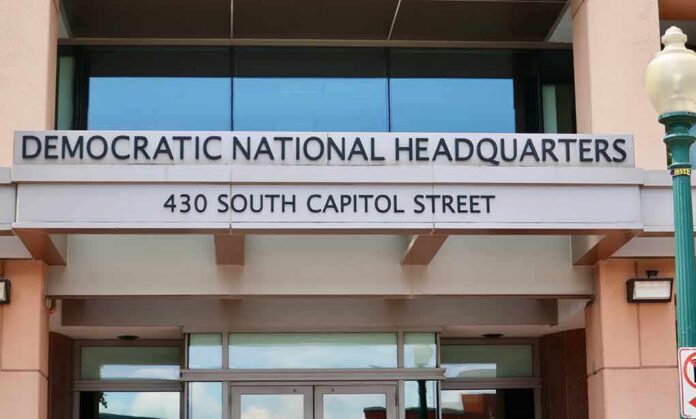
The party that claims it can manage America’s economy just had to mortgage its own headquarters to keep the lights on.
Story Snapshot
- The Democratic National Committee used its Washington, D.C. headquarters as collateral for a $15 million credit line.
- Federal reports show the DNC entered the 2026 midterm stretch with more debt than cash on hand.
- Republicans enjoy a huge money edge, with tens of millions in cash and no reported debt.
- Democrats say pledging the building is “not new,” but this loan is their largest off-year borrowing yet.
The Headquarters-On-The-Line Moment
The Democratic National Committee’s building at 430 South Capitol Street is more than office space; it is now a bargaining chip. Reporters at NOTUS revealed that the DNC put its physical headquarters up as collateral last year to secure a $15 million line of credit for off-year elections and groundwork for 2026. District of Columbia deed records back up that claim, showing the property tied to the new credit facility. For a national party that once bragged about small-dollar energy, this is blunt, old-fashioned leverage.
MORNGING ALL
BROKE Democrats Put Up DNC Headquarters as COLLATERAL for Massive $15 Million Loan Ahead of 2026 Midterms😅😂🤣— Major Anthony Jones (@majorbrainpain) July 27, 2026
Conservative outlets quickly framed the move as a bright red warning siren. Townhall described a “cash-poor” DNC mortgaging its headquarters to escape a “financial fiasco,” stressing that this was the party’s biggest off-year loan ever. RedState noted that while the Republican National Committee sat on nearly $130 million, the DNC was in the hole and had stopped the usual transfers to House and Senate campaign arms because money was so tight. That is not normal behavior for a confident national operation heading into a high-stakes midterm.
Debt, Cash, And A Lopsided Money War
Federal Election Commission reports paint a simple picture even a busy reader can understand. By the end of June 2026, the DNC reported about $16.3 million in cash and roughly $18.5 million in debts and loans. Fox News highlighted that imbalance as a $2.2 million gap, with liabilities above reserves only 100 days before voters head to the polls. Salon summarized it bluntly: the Republican National Committee has around $128.5 million banked, and the DNC is about $2 million in debt.
The New York Times earlier tracked the slide. As 2026 began, the DNC had about $14 million in assets against $17.5 million owed, a deficit of roughly $3.5 million. That gap did not vanish; later coverage and video commentary noted the committee still carried tens of millions in obligations linked to the October 2025 borrowing. From an American conservative perspective, this is the core issue: a party that pushes expansive spending and more control in Washington cannot balance its own books without pledging real estate.
How The $15 Million Loan Became Necessary
To understand why the headquarters went on the line, follow the timeline of losses and bills. After the failed Biden–Harris 2024 campaign, the DNC agreed to help pay off more than $20 million in lingering campaign debt. Politico later reported that by October 2025, the committee was spending heavily, dropping $16.9 million in a single month and then securing $15 million in loans to rebuild reserves and fund elections in Virginia and New Jersey. At the end of that month, it showed $18.3 million cash on hand, with most of that coming from borrowed money.
The Wall Street Journal and the New York Times both described the October facility as a way to “strengthen” the DNC’s position and restore “diminished financial reserves.” Their coverage was measured, but the numbers still tell a hard truth. The committee had not carried more than $15 million in total debt since 2014, yet it hit that mark again years later after overextension and weak fundraising. Loans did not appear because everything was fine; they appeared because cash did not match the ambitions of the national party.
“Not New” Versus “Never This Big”
Democrats push back on the collapse narrative with one main talking point: this is not the first time the building has backed a loan. NOTUS quoted a DNC official saying the headquarters had been used as collateral before, including 2014, 2018, and 2019. RedState and other outlets echoed that line, noting prior cycles where the property secured past credit lines. On the surface, that sounds like routine treasury management, not panic.
BROKE Democrats Put Up DNC Headquarters as COLLATERAL for Massive $15 Million Loan Ahead of 2026 Midterms https://t.co/yLJp1CkWMe #gatewaypundit via @gatewaypundit
— Batalysta (@batalysta) July 27, 2026
But even that defense concedes something important. The current credit line is described as the DNC’s “largest-ever off-year borrowing.” Politico also stressed that the party usually does not take on loans of this size this early in the cycle. The legal paperwork is not public in full, so outsiders cannot compare every covenant across years, yet the scale and timing set this facility apart. From a common-sense conservative lens, repeating a risky move at larger size, with weaker cash and a stronger rival across the aisle, looks less like routine and more like a pattern of poor discipline.
What This Signals Heading Into 2026
The headquarters collateral does not prove immediate bankruptcy. The DNC still has cash, donors, and legal access to credit. But the financial picture now depends on continued borrowing and carefully staged payments. Coverage from PJ Media and others points out that the committee is paying hundreds of thousands in interest and will owe more than $1.6 million in principal every month starting in January. Those are real dollars that cannot go to voter outreach, field staff, or candidates already nervous about President Trump’s strong position.
Party borrowing is not unusual, yet here the scale, debt burden, and huge money gap with Republicans force a clearer judgment. A committee that once promised technocratic skill is now propping itself up with a mortgaged headquarters, delayed vendor payments, and raided convention funds. Voters who trust their gut do not need a finance degree to read that signal. If you cannot run your own organization without hocking the building, you have no business telling the rest of the country how to spend and save.
Sources:
facebook.com, thegatewaypundit.com, townhall.com, redstate.com, foxnews.com, pjmedia.com, youtube.com, nytimes.com, wsj.com, washingtonpost.com