

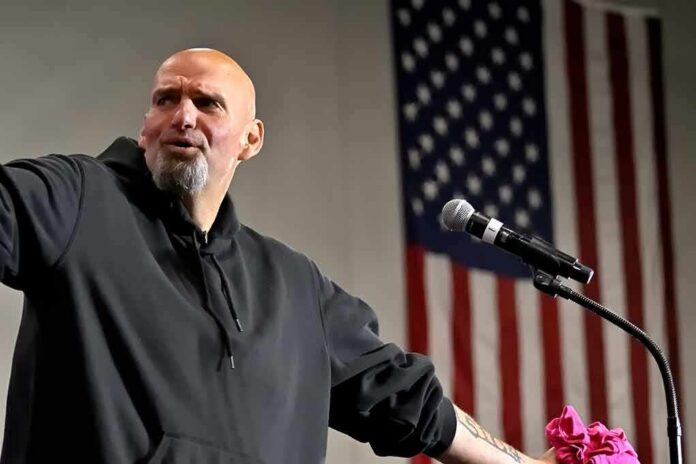
John Fetterman said “I’m a lifelong Republican” on live TV—then doubled down hours later that he’s a lifelong Democrat.
Story Snapshot
- Fetterman affirmed he will remain a Democrat and be a key vote if Democrats win the Senate.
- His GOP convention video praised a Republican ally and railed against “extremes” and socialism.
- Democrats in Pennsylvania blasted the move; some voters now view him as more Republican.
- Commentators claimed a broader shift, but Fetterman rejects any party switch.
What Actually Happened And What He Said Next
Senator John Fetterman appeared by video at the Republican midterm convention in Dallas to introduce Pennsylvania Senator Dave McCormick. He called himself a “common sense Democrat,” praised work with President Trump on steel issues, and vowed to “reject the extremes and socialism”. Hours later, he issued a statement saying he would not switch parties. He said he votes with Democrats and would be the fifty-first vote if they take the Senate, restating he is a “lifelong Democrat”.
Media clips then circulated of a separate exchange where Fetterman said “I’m a Republican,” then corrected to “I’m a Democrat.” Commentators framed the slip as a tell. Fetterman’s record and repeated statements counter that claim. He says the Dallas video introduced “a great American and friend” from across the aisle and does not signal a party change. He argues his stance targets extremes, not his own party label.
How The Backlash Formed—And Why It Stuck
Several Democrats in Pennsylvania condemned his convention cameo, seeing it as aid to Republicans close to the midterms. Coverage emphasized that he did not name Democrats but echoed Republican messaging on rejecting “socialism”. Polling write-ups showed many Pennsylvania voters now view him as more Republican, including a large share of Democrats. This response fits a known pattern: short, vivid cues redefine a politician faster than longer records can repair that frame.
Conservative voices used the moment to argue a deeper shift. Commentator Bill O’Reilly predicted Fetterman “is going to be a Republican,” pointing to tone and targets rather than any formal step. That is assertion, not evidence of a change. On the facts, Fetterman has denied a switch in an opinion piece and in multiple statements, and he calls himself a “terrible Republican” on policy fit. The clash is framing versus record—novel video versus consistent label.
The Record Versus The Vibe Test
Fetterman’s voting and public pledges align with Democrats, and he keeps saying so. The viral slip and the Dallas video give opponents a clean clip that feels like a turn. That is why the story lingers. Research on framing shows that when partisans hear a cue that validates what they already think, it beats longer, duller proof points almost every time. The fix is repetition and action. Words matter, but votes and coalitions matter more over time.
This video frames the recent Senate vote on H.Con.Res.89 as a high-stakes legislative battle, aiming to highlight political divisions within the Senate regarding the ongoing conflict with Iran. By emphasizing that Senator John Fetterman (D-PA) broke with his party to vote against…
— Joe (@JoeMaristela) September 26, 2026
A common-sense read lines up this way. If a senator plans to switch parties, he does not say on the same day that he will be the crucial Democratic vote if his party wins the Senate. He does not publish an opinion piece saying he has no plans to leave his party and would be a bad fit as a Republican. The conservative instinct to reward cross-aisle cooperation is sound; calling it a formal switch is not supported by the record so far.
Why This Moment Still Matters
The Dallas video is a window into a potential coalition lane for blue-collar issues. Republicans heard a Democrat talk about steel, borders of debate around socialism, and national pride. That message resonates with many swing voters. Democrats heard a colleague hand the other side a campaign ad. Both reactions can be true. The real test now is not a one-liner on TV. It is Fetterman’s next months of votes, partners, and bills—where labels meet outcomes.
Sources:
youtube.com, foxnews.com, forbes.com, cnn.com, politico.com, people.com, inquirer.com, theguardian.com, sas.rochester.edu