
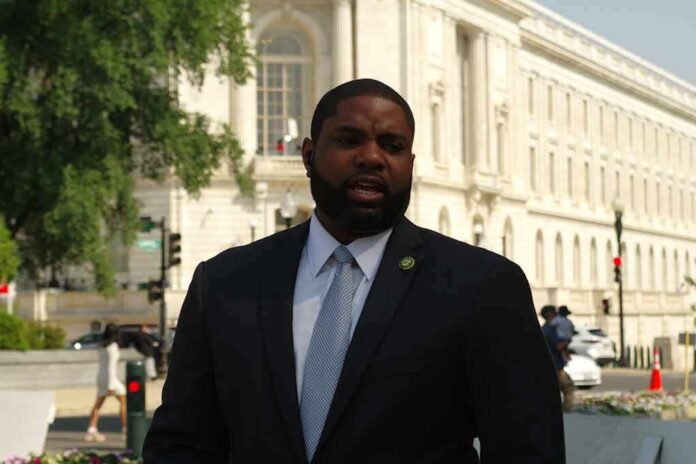
Florida elected Byron Donalds governor, and one TV host tried to snatch the moment with a racial litmus test.
Story Snapshot
- Byron Donalds won Florida governor with about a 1.3-point margin over David Jolly.
- He is set to become Florida’s first Black governor and the nation’s first elected Black Republican governor.
- Symone Sanders Townsend used “all kinfolk ain’t skinfolk” to question his alignment with Black voters.
- The clash revives an old debate: identity milestones versus policy outcomes.
What Florida Actually Decided On Election Night
The Associated Press called the race for Byron Donalds, who earned 4,132,355 votes, or about 50.0 percent, to David Jolly’s 4,024,669, or about 48.7 percent, with 99 percent reporting. Multiple outlets noted the history in plain terms: Florida elected its first Black governor, and the country elected its first Black Republican governor to a governorship. The margin was close enough to feel real, not ceremonial. Voters made a choice with stakes, not a nod to symbolism. That is how mandates are built in competitive states.
Reports also stressed Donalds’s alliance with President Trump and the Republican Party’s long hold on the governor’s office. Many pundits predicted an easy Republican walk. Voters delivered something harder to dismiss. They extended one-party control, yes, but they did it by choosing a candidate who breaks a barrier while running on a clear conservative brand. That is not a contradiction. It is a sign that identity and ideology can mix in new ways, if the candidate connects.
The “Kinfolk” Swipe And Why It Backfired
MS NOW host Symone Sanders Townsend reacted by saying, “all kinfolk ain’t skinfolk,” and argued Donalds would continue Ron DeSantis’s direction in Florida. That is a sharp line for cable, but a weak test for citizenship. If the standard is “agree with my platform or forfeit your identity,” it is not a standard at all. It is a power move. Voters just weighed Donalds’s record, his pitch, and his alliances, and still chose him. That verdict outranks a studio slogan.
Critics went further. A Politico report described DeSantis-era changes on how race is taught and on diversity policies, and tied Donalds to that path. It also noted Donalds publicly criticized a piece of Florida’s African American history standards in 2023, which drew heat from DeSantis’s staff. That detail matters. It shows Donalds can split with allies when he thinks the line is crossed, even while staying on the right. That is not “skinfolk theater.” It is independent judgment inside a coalition.
What The Milestone Means, And What It Does Not
History books will mark the firsts. Florida’s first Black governor. The nation’s first elected Black Republican governor. Those are facts, not spin. They will also mark the numbers: a tight race that forced both sides to earn votes in every county. But those facts do not answer every policy question. They should not. Elections start the job; they do not finish it. The right measure now is delivery on schools, safety, jobs, affordability, and competence.
Some editorials claim Donalds’s alignment with Trump and DeSantis equals harm to Black Floridians, pointing to fights over education content, public-sector unions, and diversity programs. Those are assertions, not settled outcomes. The fair test is simple and conservative: judge by results you can see. Are students learning more? Are streets safer? Do paychecks go further? Are freedoms protected? If policies work, labels fade. If they fail, voters correct the course. That is self-government, not hashtag politics.
How Voters Weighed Identity And Ideology
National outlets said Donalds campaigned as a staunch Trump ally and still won statewide in a very competitive contest. That tells us two things. First, Florida’s electorate will back a conservative who speaks plainly about priorities. Second, many voters refuse to let race dictate party. That is healthy. It means candidates must persuade, not posture. It also means gatekeepers do not get to police who counts as “authentic.” Citizens do. At the ballot box. Every time.
Scholars have long argued over descriptive versus substantive representation. Voters just gave a practical answer: the person who can win and govern gets the chance to prove it. Florida gave Byron Donalds that chance. Sanders Townsend gave him a label. Only one of those will pave a road budget, pick an education chief, and manage a hurricane. If Donalds governs well, the slur fades into footnotes. If he does not, voters will write the next chapter just as clearly.
Sources:
redstate.com, apnews.com, nbcnews.com, indystar.com, theledger.com, foxnews.com, politico.com, miamitimesonline.com