
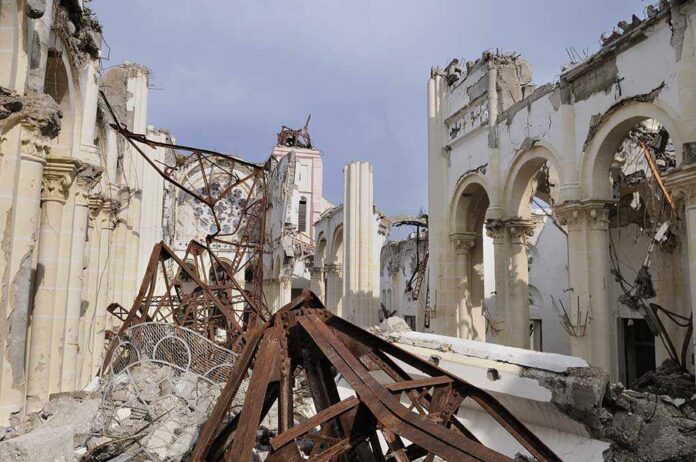
Fire investigators in Buffalo have confirmed what many neighbors already suspected: someone deliberately set the blaze that tore through the historic former St. Ann’s Church complex on the city’s East Side.
Quick Take
- Buffalo officials ruled a fire at the 140-year-old former St. Ann’s Church complex an arson, following several blazes at the site since January 2026.
- The church has now burned multiple times, including a four-alarm fire that gutted the adjacent school building and a later three-alarm fire.
- Online posts have linked the fires to rumors the property could become a mosque, though city officials have not confirmed any such redevelopment plan.
- Buffalo Mayor Sean Ryan says the city will not pay the roughly $2 million cost to tear down the fire-damaged site.
- Similar suspected-arson fires at historic churches in Toronto and Idaho show this is part of a wider pattern involving vacant, contested religious properties.
Investigators Confirm Arson At The Historic East Side Complex
Buffalo officials determined a fire at the former St. Ann’s Church was arson, days after crews had already contained a separate three-alarm fire at the same site. It marked the second fire at the vacant church complex within one week. Fire officials said the second blaze was intentionally started, a conclusion that followed a stretch of uncertainty about what caused the flames in the first place.
🚨🚨BREAKING NEWS 🚨
🇺🇸 Second Blaze Hits 140-Year-Old St. Ann’s in a Week as Conversion Push Intensifies
A 140-year-old church in Buffalo, New York, has suffered its second fire in seven days. St. Ann Church was hit by what authorities are investigating as arson, coming just… pic.twitter.com/aA6MmJKQna
— Corefrontline (@corefrontline) July 23, 2026
Before the formal arson ruling, investigators were careful with their words. One fire official told WKBW that early evidence did not “conclude any type of arson,” but added “there is a human element involved, whether or not that was intentional has yet to be determined”. That caution matters. It shows officials worked through evidence step by step rather than jumping to conclusions, even as the site burned again and again.
A Complex That Has Burned Before
This was not the first fire at the property. In January 2026, a four-alarm blaze destroyed the former school building on Emslie Street, part of the same St. Ann’s complex, leaving the four-story structure a roofless shell. That fire alone caused an estimated $600,000 in damage to the historic East Side building, according to photos and reporting shared by local outlets.
Months later, crews returned to fight a three-alarm fire at the same site, six months after the earlier four-alarm blaze. Then came the fire investigators ultimately ruled arson. Buffalo Mayor Sean Ryan has since said the city will not pay to demolish the site, estimating that cost at around $2 million and arguing taxpayers should not bear that burden.
Redevelopment Rumors Fuel Online Speculation
Much of the public anger has centered on what happens next to the land. Social media posts have speculated that the site could be redeveloped into a mosque, with some users framing the fires as suspiciously convenient for that outcome. One widely shared post asked plainly what would replace the church, then answered its own question: a mosque. City officials have not confirmed any finalized redevelopment plan tied to the fires.
That gap between online speculation and confirmed fact matters. Skepticism about official redevelopment plans for beloved historic buildings is fair, especially after repeated fires at the same site. But drawing a straight line from arson to a specific future use, without confirmed city records or zoning filings backing it up, is a separate claim from the arson finding itself, which investigators have documented.
Part Of A Wider Pattern With Historic Churches
Buffalo’s case is not unique. Toronto’s St. Anne’s Anglican Church suffered a four-alarm fire in 2024 that gutted a national historic landmark full of irreplaceable murals and stained glass. More than a year later, police and fire officials confirmed that blaze was also being investigated as suspected arson. A church near the Idaho-Canada border met a similar fate, with federal investigators ruling that fire arson as well.
BREAKING: 140-year-old St. Ann church set on fire in Buffalo, NY
Cause determined to be arson pic.twitter.com/LlA1n5MNsp
— THE GREAT AWAKENING (@Q_1776_United) July 23, 2026
Fire data consistently shows vacant and contested buildings carry higher risk for intentional fires, simply because empty structures are easier targets and harder to secure. That pattern fits both Buffalo and Toronto. It does not settle every question about motive, but it does explain why investigators, and the public, treat repeated fires at abandoned historic churches with heightened suspicion rather than dismissing them as coincidence.
Sources:
thegatewaypundit.com, wivb.com, youtube.com, wkbw.com, audacy.com, facebook.com, toronto.anglican.ca, ncronline.org