
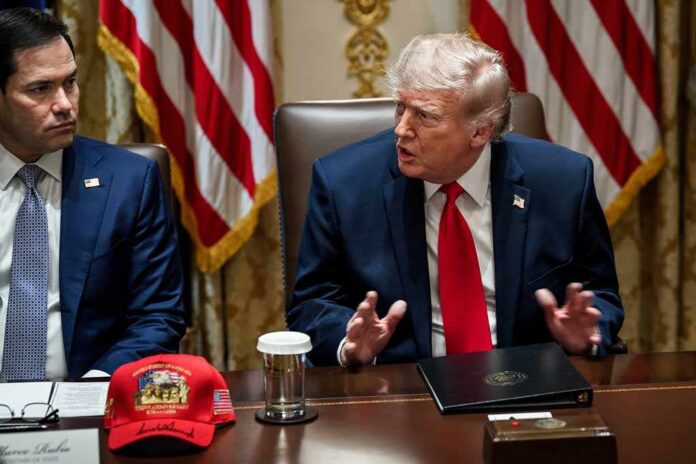
President Trump told Attorney General Todd Blanche, by name, to seek the death penalty for anyone who murders a firefighter.
Story Snapshot
- Trump made the demand at a White House Rose Garden luncheon on October 15, 2026, directly addressing Attorney General Todd Blanche.
- He described a firefighter being shot while climbing a ladder and said the killer should face execution.
- Trump argued the punishment would stop such shootings almost immediately, calling it a deterrent.
- Federal law still requires a qualifying federal offense before capital punishment can apply, meaning not every case will qualify automatically.
What Trump Said And Who He Said It To
Trump did not float this as a vague campaign talking point. He turned to his sitting Attorney General, Todd Blanche, during a Rose Garden event honoring first responders, and said it plainly: “Anybody that murders a firefighter, going up a ladder, and they shoot him… Death penalty, Todd.” The remark was specific, public, and aimed at the man who runs federal prosecutions.
Reporting from the event described Trump saying he had already directed the Department of Justice to pursue capital punishment in firefighter-murder cases. That framing matters. This wasn’t pitched as a wish for Congress to someday pass. It was described as marching orders to the nation’s top law enforcement agency, issued in front of cameras and a room full of first responders.
The Case For Deterrence, According To Trump
Trump’s reasoning was simple and blunt. He argued that if killing a firefighter carried a guaranteed death sentence, the shootings would all but disappear, calling it something that would become an “ancient crime” almost overnight. It’s the kind of argument that resonates with anyone who has watched news coverage of firefighters ambushed while doing their jobs. Protecting people who run into burning buildings for strangers is not a controversial goal.
Whether the policy would actually produce that result is a separate question from whether people want it to. The National Research Council’s widely cited 2012 review concluded that existing studies on capital punishment and deterrence were not reliable enough to say whether the death penalty changes homicide rates one way or the other. That’s not a knock on Trump’s instinct. It’s a reminder that tough-sounding policy and measurable results don’t always arrive together.
Why This Can’t Simply Be Flipped On Like A Switch
Here’s the part that gets lost in the headlines. The federal death penalty isn’t a blanket tool a president can apply to any murder he finds outrageous. Federal capital cases require a specific federal offense, proven culpability, and legally defined aggravating factors under the Federal Death Penalty Act of 1994. A firefighter’s killer typically faces state charges, not federal ones, unless the case crosses into federal jurisdiction, such as a crime on federal property or one tied to another federal offense.
That legal reality doesn’t make Trump’s directive meaningless. The Department of Justice already runs a centralized review process for every case eligible for capital charges, and a presidential directive can shape how aggressively prosecutors pursue those that qualify. But it does mean the policy’s real-world reach depends on how many firefighter killings actually fall under federal law, something that varies case by case rather than applying nationwide by presidential word alone.
Part Of A Larger Pattern Of Support For First Responders
Trump’s death-penalty remark didn’t come out of nowhere. Months earlier, he signed the Honoring Our Fallen Heroes Act as part of the National Defense Authorization Act, expanding survivor benefits for firefighters who die from job-related cancers. Fire service groups praised the law as overdue recognition that the dangers of the job extend well beyond the fireground. Taken together, the benefits expansion and the death-penalty push paint a consistent picture: an administration positioning itself as firmly on the side of first responders, both in how it treats their sacrifices and how it threatens those who would harm them.
TRUMP: Death penalty for anyone who kills a firefighter. At a Rose Garden luncheon, he said he directed AG Todd Blanche to pursue it, and vowed the same for cop killers: "We're bringing the death penalty back." What do you think? #RealUSAStories #Trump pic.twitter.com/oMSWdPbU3N
— Real USA Stories (@RealUsaStories) October 16, 2026
What happens next runs through Attorney General Blanche’s department, federal prosecutors, and ultimately the courts. Capital cases demand proof beyond a reasonable doubt and strict procedural safeguards no matter who sits in the Oval Office. Trump has set the tone from the Rose Garden podium. Whether that tone becomes consistent federal practice will be decided case by case, inside a legal system built to move slower than any single speech.
Sources:
ap7am.com, tommyxtopher.substack.com, usatoday.com, cmsapi.theepochtimes.com, iaff.org, nvfc.org, nap.nationalacademies.org, ntrl.ntis.gov