
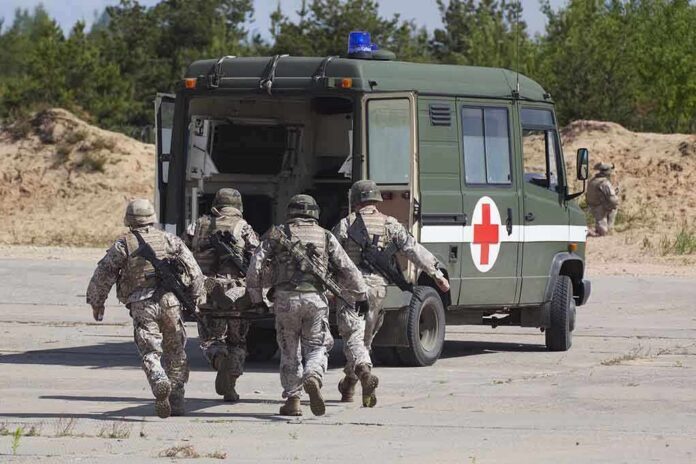
Two young American soldiers died on a dusty Jordanian air base after Iranian missiles slipped through our defenses, and Washington’s response says as much about politics and trust as it does about the war itself.
Story Snapshot
- Pentagon named First Lt. Tyler Feehan and Pvt. Isabella Gonzales as the two Americans killed in the Friday attack in Jordan.
- U.S. Central Command says Iranian ballistic missiles and drones hit Muwaffaq Salti Air Base, killing two, leaving one missing, and wounding four.
- Their deaths pushed the Operation Epic Fury toll to 16 killed, before a later Iraq fatality raised it to 17.
- President Trump’s “ceasefire’s over” stance and past Pentagon secrecy on injuries now shape how many Americans trust what they are told.
Two Names, Two Lives, And A Very Specific Base
The Pentagon’s Monday release did something simple but powerful. It put names, faces, and hometowns on a story most people only saw as a red flash on a map. First Lieutenant Tyler James Feehan, 25, was from Ewa Beach, Hawaii. Private Isabella Gonzales, 19, came from Carrollton, Texas. Both served in Army air defense commands tied to Muwaffaq Salti Air Base in Jordan, a key site in the Iran conflict. That is not rumor; that is the official record, repeated across outlets that rarely agree on anything.
U.S. Central Command set the frame for what happened that Friday. Its statement said at least two intermediate-range ballistic missiles were fired from Iran at the base, supported by drones, just after extra Air Force personnel arrived as part of President Trump’s reinforcements. Two service members were killed, one went missing, and four were wounded badly enough to be flown to local hospitals, then discharged. That is the U.S. military’s own description of the attack, not a pundit’s spin.
A War With A Running Body Count
These two deaths did not come out of nowhere. They landed in the middle of a running tally that feels more like a stock ticker than a memorial wall. Before Friday, reports showed 14 American service members dead in Operation Epic Fury, with more than 400 wounded. The Jordan attack raised that to 16 killed. Then Central Command confirmed another soldier died the next day in northern Iraq, during a controlled blast to clear ordnance from a downed Iranian drone, raising the total to 17. The numbers move, but the pattern stays: Iran fires at our positions across the region, and American names follow.
This attack also broke a grim pause. Pentagon and media reports noted it marked the first American combat deaths in the Iran conflict since March, when earlier strikes and crashes killed multiple service members in Kuwait and elsewhere. In other words, the war never really stopped; it just slipped out of daily headlines until two more coffins appeared on the flight line. For older readers who watched similar cycles in Iraq and Afghanistan, that rhythm feels sadly familiar.
Trump’s Message And The Politics Around The Casualties
President Trump did not treat the attack as a one-off tragedy. His team had already signaled a hard line, with talk that “the ceasefire’s over” and vows to “swiftly punish” Iran for killing Americans. Central Command followed with nine straight nights of strikes on Iranian command centers, air defenses, missile launch sites, and infrastructure meant to control the Strait of Hormuz. That is classic deterrence logic: hit back fast and hard so the enemy thinks twice about firing again.
For many conservatives, that kind of response matches a basic value: when Americans die overseas, the enemy should feel it. But here is where trust gets messy. In the days before the Jordan attack, major reporting found the Pentagon had quietly withheld dozens of American injuries in the Iran war from public view. Central Command later confirmed more than 400 injured, but only after outside pressure. When a government asks for unity and sacrifice while trimming the casualty numbers, common sense says you keep one eye on the scoreboard.
What We Know, What We Don’t, And Why It Matters
On the core facts, the record is firm. Two named service members died in Jordan. One remains missing. Four were wounded and treated. Another soldier died in Iraq the next day during ordnance disposal tied to an Iranian drone. The missiles are officially blamed on Iran, and that matches a wider pattern of Iranian ballistic missile and drone attacks on U.S. bases since late February. There is no serious, sourced counter-story claiming these deaths did not happen or that the soldiers were misidentified.
⚡️🚨 Digest — 10:01–11:03 UTC
US Central Command confirms more than 400 American service members were injured in the confrontation with Iran, a major escalation of earlier reports the Pentagon concealed casualties.
🟠 Telegraph/Washington Post: US may lack missile stocks to…
— Middle East Observer (@ME_Observer_) July 20, 2026
The gaps sit elsewhere. So far, the public has not seen radar tracking data, missile telemetry, or an open forensic report on debris from Muwaffaq Salti Air Base. That kind of evidence would lock in details on launch points, missile types, and impact paths. Instead, we rely on Pentagon and Central Command statements, amplified almost in unison by major media. Given Iran’s long history of using proxy forces and lying about its own attacks, that official story is very plausible. Yet for citizens who saw casualties hidden just days before, “trust us, we have the data” sounds thinner than it should.
How A Single Strike Fits A Long War On Americans
This is not some isolated clash over a desert runway. Analysts have pointed out that Iranian actions, often through terror proxies, have killed well over a thousand American troops in Iraq and Afghanistan over the last fifteen years. Operation Epic Fury is only the latest chapter where Iran tests U.S. resolve with missiles and drones while American leaders debate how hard to hit back. The Jordan strike shows something important: Iran can still get rounds through our air defenses and kill Americans even at well-known bases.
For a reader who glances at the news between errands, the lesson from Tyler Feehan and Isabella Gonzales’s deaths is simple. The war with Iran is real. Young Americans are dying in it. Your government is hitting back, but it has also played games with the casualty numbers. A conservative, common-sense view says honor the fallen, demand clear facts, and insist that any future deals with Tehran start from one hard rule: no more dead Americans, anywhere, ever again.
Sources:
thegatewaypundit.com, detroitnews.com, ndtv.com, republicworld.com, youtube.com, nytimes.com, cbsnews.com, defencesecurityasia.com, fdd.org, reuters.com, timesofisrael.com, reddit.com, en.wikipedia.org