
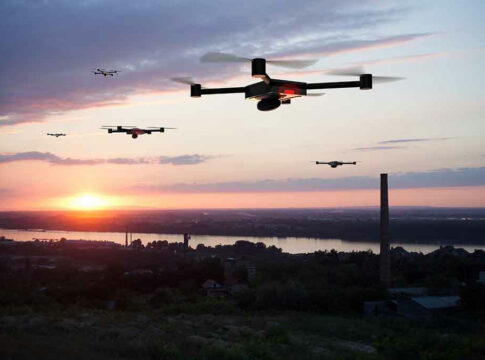
Four military-grade drones hunting a president’s plane over the Irish Sea exposed just how fragile Europe’s security really is when hybrid warfare comes out of the shadows.
Drone intrusion that turned a “routine” visit into a test of resolve
Zelensky’s flight into Dublin was supposed to be standard diplomatic choreography: fast approach, secure landing, convoy into the city, and a carefully scripted show of Irish solidarity with Ukraine. Instead, four unidentified military-style drones pushed into the no-fly zone around Dublin Airport just as his aircraft neared Irish airspace, forcing security services to watch a real-time stress test of their defenses. The president’s plane landed slightly ahead of schedule, avoiding direct contact more by timing than by superior technology.
The drones did not just appear and vanish in minutes; they stayed on station for up to two hours, circling above the Irish Navy ship LÉ William Butler Yeats, which had been quietly deployed in the Irish Sea as part of the security net for the visit. That endurance and precision tracking point toward military-grade quadcopters operated by people who understood both airspace restrictions and political symbolism. For any conservative paying attention, the message is clear: hostile actors can now probe Western leaders’ security with hardware you can launch from a small boat or a remote coastline.
Hybrid warfare in practice, not theory
Analysts often describe “hybrid warfare” as a blend of military and non-military tools—drones, cyber, sabotage, and disinformation—to pressure a target without triggering a conventional war response. This incident fits that playbook almost too neatly: no visible explosions, no casualties, just a deliberate violation of a no-fly zone protecting a head of state, carried out with deniable technology and leaving investigators guessing whether the drones came from land or sea. The ambiguity is not a bug; it is the core feature of modern coercion.
The lights on the drones were reportedly switched on intentionally, a bizarre choice if the goal were secret surveillance but perfectly logical if the operators wanted to signal capability and contempt. Instead of a silent reconnaissance mission, Ireland got a floating billboard advertising how easily its airspace could be penetrated even during a high-profile visit. From a conservative, common-sense standpoint, this is not “gray zone” behavior; it is an adversary testing how much humiliation Western governments will quietly absorb before they invest in real defenses and clear red lines.
Irish vulnerability and Western complacency
The most uncomfortable detail for any serious observer is that the Irish Navy vessel under the drones had no air-defense systems at all and could not neutralize the threat with handheld countermeasures because the drones loitered outside effective range. That gap turns a modern warship into an expensive spectator when a hostile actor chooses to operate just beyond arm’s reach. It also underlines a wider Western habit: governments talk about “emerging threats” while relying on luck, timing, and procedural workarounds instead of hardware and readiness.
Security meetings after the incident pulled together the Irish police, Defence Forces, and senior officials, but coordination cannot substitute for capability when an adversary sends real machines into your restricted airspace. Conservative values emphasize preparedness, deterrence, and the moral duty of the state to protect guests it has invited and citizens who live under its flag. By that standard, this episode should be a wake-up call, not just a one-off investigation destined to disappear into bureaucratic files and carefully worded press releases.
Signals to allies, adversaries, and ordinary citizens
Zelensky’s visit carried more than symbolism; Ireland pledged €100 million to help Ukraine counter Russian hybrid attacks and another €25 million for its energy sector, effectively acknowledging that the frontline is no longer only in Donbas or the Black Sea but in European airspace, infrastructure, and information systems. A drone intrusion timed with that pledge looks, at minimum, like an effort to show that supporting Ukraine carries real-world risk even far from the battlefield. Whether or not investigators ever prove who flew the drones, adversaries will study how Dublin handled the breach.
⚡️ Was Zelensky almost assassinated? The president narrowly avoided a drone attack
As Volodymyr Zelensky’s plane was departing Ireland, four large drones were heading toward Dublin Airport, The Journal reports.
The UAVs reached the point where the presidential aircraft was… pic.twitter.com/x32yUUxEm7
— NEXTA (@nexta_tv) December 4, 2025
For ordinary Europeans and Americans, the lesson is uncomfortable but clarifying. A handful of relatively cheap unmanned aircraft forced a NATO-adjacent state to scramble, exposed a lack of counter-drone options, and raised questions about how many other airports, ports, and political events sit one step away from similar harassment. A conservative reading of the facts says this: peace is no longer the absence of tanks at the border, it is the presence of serious capabilities to swat down the small, deniable probes before they ever touch a president’s flight path.
Sources:
Military drones targeted Zelensky’s plane en route to Dublin according to report
Zelenskyy’s plane in Ireland was followed by military drones
Drones over Dublin incident classified as hybrid warfare
Zelensky plane followed by military drones near Dublin
We are never safe. Our guard should always be up. Respect others and encourage them to be honest and trustworthy. Expect nothing more.
Honesty seems to have disappeared in our governments, especially in the USA!