
An armed attacker opened fire just outside the White House, testing the Secret Service, rattling the nation, and raising fresh questions about how close threats are getting to President Trump.
Story Snapshot
- Secret Service agents fatally shot an armed suspect near a White House checkpoint; a bystander was also wounded.
- Officials say agents engaged the shooter immediately and kept President Trump and those inside the grounds safe.
- Conservatives are demanding answers about how an attacker with multiple weapons got so close to the president.
- Control of key evidence by federal agencies could limit independent scrutiny of what really went wrong.
Shooting Outside White House Highlights Ever-Present Threat
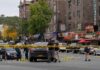
Federal officials say a man armed with a firearm opened fire near a Secret Service checkpoint close to 17th Street and Pennsylvania Avenue, just outside the White House grounds, wounding a bystander before agents shot him and ended the attack. Reports describe a chaotic scene as law enforcement vehicles rushed in, streets locked down, and nearby areas briefly sealed while agents secured President Trump and staff within the complex.[1] The suspect later died at a hospital, while the wounded civilian remains under medical care.[2][4]
According to the United States Secret Service, the suspect approached a security post near a White House access point, produced a weapon, and opened fire on officers who then returned fire and stopped the threat.[2][4] News footage and eyewitness reporting indicate the confrontation unfolded within seconds, reinforcing how quickly such incidents can move from routine screening to a life-or-death gunfight.[1][2] Officials stressed that the scene was rapidly contained, with no injury to the president or his immediate protective detail.[1][2]
Law Enforcement Praises Rapid Response, But Gaps Remain
At a joint press conference, leaders from the District of Columbia police department, the Federal Bureau of Investigation (FBI), and the Secret Service emphasized that agents “engaged immediately” when the suspect opened fire and “prevented anyone from being harmed” beyond the attacker and one bystander.[1] That framing mirrors recent defensive statements after another high-profile incident at the Washington Hilton, where a heavily armed suspect charged a Secret Service checkpoint during the White House Correspondents’ Dinner and was intercepted before reaching the ballroom.[1][2]
Officials point to these cases as evidence that the protective model is working: layered security, checkpoints as the decisive line, and agents trained to make split-second decisions under fire.[1][3] A former Secret Service agent analyzing the Correspondents’ Dinner incident argued that “the security plan did work,” noting that agents stopped the attacker outside the inner perimeter, away from the president and senior officials.[2] For conservatives who remember the chaos and paralysis of past administrations during crises, the contrast of decisive action under President Trump’s team is not lost.[4]
Conservatives See Pattern of Breaches and Limited Transparency
Even while recognizing the courage of front-line agents, many on the right see a troubling pattern: attackers with serious arsenals are still getting disturbingly close to the president and other key sites before being stopped.[1][2] In the Correspondents’ Dinner case, officials admitted the suspect reached a lobby checkpoint with a shotgun, handgun, and multiple knives, raising questions about upstream screening and intelligence.[1] In the latest White House shooting, the suspect again reached a checkpoint before the gunfire began, suggesting perimeter defenses remain vulnerable.[2]
Former security officials note that after any major breach, agencies control the key evidence: radio traffic, surveillance video, internal timelines, and after-action reviews.[1][3] That means the same institutions under scrutiny decide what the public sees and when. History shows how early narratives can harden quickly, as with former Capitol Police Chief Steven Sund’s testimony about January 6, where delays, political pressure, and post-hoc blame games clouded accountability. Many conservatives fear a repeat pattern of sanitized summaries and buried details.
Why This Matters for Constitutional Government and Public Trust
Repeated security scares near the White House do more than rattle nerves; they raise deeper questions about whether Washington’s permanent security bureaucracy is truly adapting, or simply managing headlines.[1][3] When suspects penetrate multiple rings of security with weapons, Americans have every right to ask whether intelligence sharing, access control, and event planning are being executed with the seriousness a constitutional republic deserves.[1][3] Too often, official briefings emphasize that “the president is safe” while leaving upstream failures unexplained.[1][2]
"They did engage him immediately."
Former Capitol Police Chief Steven Sund discussed the Secret Service response to the suspect during the shooting outside of the White House on "Wake Up America Weekend." @ChiefSund @kenziebeachtv pic.twitter.com/hL8JzDvjxV
— NEWSMAX (@NEWSMAX) May 24, 2026
For conservatives who value law and order, limited government, and honest accountability, the path forward is clear. Congress should demand full timelines, radio logs, and surveillance footage from these incidents, not just talking points.[1][3] Independent experts should reconstruct how close these attackers actually came and whether warning signs were missed.[1][3] Protecting the presidency is not about protecting bureaucracies; it is about safeguarding the Constitution, ensuring public servants can do their jobs, and making sure every breach leads to real fixes—not another polished press conference.
Sources:
[1] YouTube – IN FULL: DC Police, FBI, Secret Service speak after …
[2] YouTube – Secret Service director defends agency’s response to …
[3] Web – Courage under fire – Police Executive Research Forum (PERF)
[4] YouTube – Former Capitol Police Chief | Wake Up America Weekend