

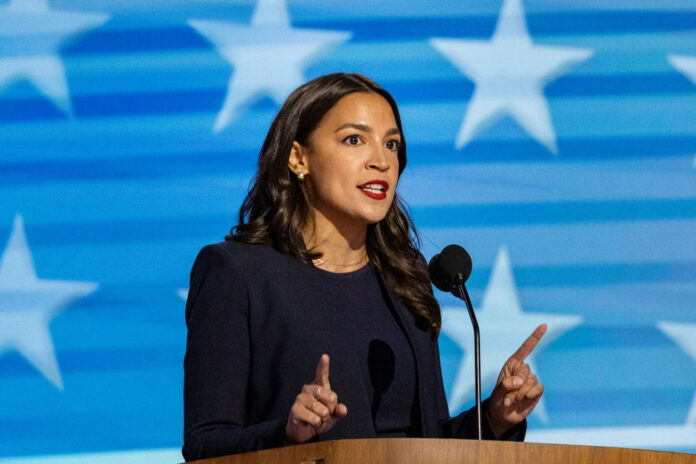
Alexandria Ocasio‑Cortez just handed Republicans a golden sound bite, dismissing their complaints about Democratic redistricting schemes with a flippant “wah wah wah” while simultaneously admitting her party now embraces the very gerrymandering tactics they’ve spent a decade condemning.
The Virginia Ruling That Sparked the Firestorm
A conservative judge in Virginia delivered a blow to Democratic map‑drawing ambitions by invalidating a redistricting amendment and the results of a related special election. The ruling effectively rolled back a Democratic strategy to secure favorable congressional and legislative boundaries in a state that has trended blue in recent cycles. Virginia Republicans had challenged the legitimacy of the referendum that authorized the amendment, arguing procedural irregularities tainted the process. The judge agreed, throwing the state’s redistricting framework into legal chaos and potentially shifting control over who draws the lines for the next election cycle.
AOC’s Telling Response and What It Reveals
Ocasio‑Cortez took to social media to blast Republicans, accusing them of blocking gerrymandering reforms for a decade while aggressively rigging maps in states like North Carolina and Texas. She dismissed GOP complaints about the Virginia situation with a childish “wah wah wah,” framing Democratic efforts as justified retaliation. AOC claimed her party would no longer “roll over” and insisted Democrats are simply playing by the rules Republicans established. She even invited the GOP to join a bipartisan ban on partisan gerrymandering, asserting Democrats “have the bill right here” but Republicans “don’t want to” pass it.
The congresswoman’s remarks reveal a striking shift in Democratic messaging. For years, the left positioned itself as the principled defender of fair maps and independent commissions, condemning Republicans for manipulating district boundaries to entrench power. Barack Obama and Eric Holder built entire post‑presidency initiatives around ending partisan gerrymandering after the GOP swept state legislatures in 2010 and locked in favorable maps for a decade. Reform movements championed independent commissions in states like California, Michigan, and Virginia, presenting neutral redistricting as a moral imperative essential to democratic legitimacy.
The Hypocrisy Democrats Can No Longer Hide
AOC’s dismissive tone and fighting words expose what conservatives have long suspected: Democrats never truly opposed gerrymandering on principle. They opposed losing because of it. The moment the shoe is on the other foot and Democrats gain leverage through court rulings or state power, the reformist rhetoric evaporates. Jeffries’ promise of “maximum warfare, everywhere, all the time” confirms the party has abandoned any pretense of favoring neutral processes over raw partisan advantage. This is the same Democratic Party that howled when Republicans cracked Nashville across multiple districts in Tennessee or attempted to carve up Kansas City in Missouri.
Virginia’s post‑2020 redistricting process was supposed to be different. Voters approved a system designed to limit pure legislative gerrymandering, bringing in experts Bernard Grofman and Sean Trende to draw maps under bipartisan oversight. The resulting congressional map produced four strongly Democratic districts, four less strongly Republican seats, two narrowly Democratic districts in Northern Virginia, and one toss‑up in Hampton Roads. It was relatively balanced but leaned slightly Democratic. Republicans had grudgingly accepted the process, but when Democrats pushed further with an amendment to lock in even more favorable terms, a judge finally said no.
The Rucho Decision and the Arms Race It Unleashed
The 2019 Supreme Court decision in Rucho v. Common Cause declared partisan gerrymandering claims non‑justiciable in federal courts, leaving the issue to state constitutions and state judges. That ruling removed the last potential federal brake on redistricting warfare, unleashing an arms race where both parties now pursue every legal and political advantage available at the state level. Republicans capitalized first, drawing aggressive maps in Texas, North Carolina, and elsewhere after the 2020 Census. Democrats sued repeatedly, framing themselves as defenders of democracy while simultaneously pursuing favorable gerrymanders in Illinois and Maryland wherever they held power.
The Washington Examiner notes that both parties display situational ethics on redistricting. When reforms produce maps that help them, they celebrate fairness and independence. When those same neutral processes yield unfavorable results, they find reasons to challenge or bypass them. The GOP’s structural advantage from the 2010 cycle has eroded in the Trump era, as heavily Republican rural areas and increasingly diverse urban centers have reshuffled the partisan geography. Democrats now see an opening to reclaim ground through aggressive map litigation and state‑level power plays, and they are seizing it with both hands.
AOC's Embarrassing Remarks on Redistricting Show Just How Hypocritical Dems Arehttps://t.co/ew5dIjynVs
— RedState (@RedState) May 18, 2026
AOC’s “wah wah wah” comment captures the new Democratic posture perfectly. It is not an argument for reform or fairness. It is a taunt, a declaration that Democrats intend to fight as dirty as they accuse Republicans of fighting. Ocasio‑Cortez frames this as necessary self‑defense, claiming the GOP spent ten years refusing to ban gerrymandering, so Democrats have no choice but to gerrymander back. That logic might resonate with the Democratic base, but it obliterates any remaining credibility the party had on voting rights and fair representation. You cannot spend a decade positioning yourself as the party of democracy and then openly embrace the same tactics you condemned as threats to democracy.
What This Means for Future Elections
Jeffries’ “maximum warfare” declaration signals that redistricting will remain a central battleground in every election cycle for the foreseeable future. Candidates, donors, and voters in swing states face perpetual uncertainty about district boundaries and election validity. Legal challenges will drag on for months or years, creating confusion and potentially suppressing participation. The normalization of this conflict erodes public trust in the electoral process and feeds the perception that both parties care more about power than principle. When leaders openly boast about waging map warfare, ordinary voters are left wondering whether their votes even matter or if the outcome is predetermined by whoever controls the state legislature and courts.
Sources:
Washington Examiner: All redistricting reformers are hypocrites
Latin Times: Virginia redistricting fight erupts after conservative judge voids referendum
Sacramento Bee: Opinion on redistricting