

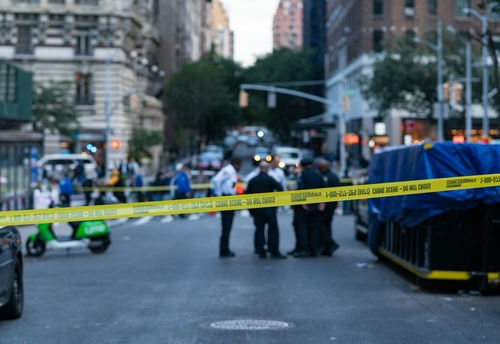
The attack on a 21-year-old woman, raped at knifepoint in one of Manhattan’s “trendiest” neighborhoods, exposes how unsafe even the glossiest parts of New York City have become.
Story Snapshot
- A 21-year-old woman was raped at knifepoint in Greenwich Village, police say.
- New York City Police Department released a surveillance image and launched a manhunt for the suspect.
- The case fits a broader pattern of knife attacks and sexual assaults across the city.
- Gaps in information and slow justice fuel anger over crime, policing, and public safety.
A brutal crime in a neighborhood sold as safe
Police say a 21-year-old woman was walking through Greenwich Village when a stranger pulled a knife and raped her. This is not a dark alley in a forgotten borough. It is one of the city’s most marketed neighborhoods, full of cafes, nightlife, and tourists. The New York City Police Department confirmed the attack and labeled the suspect “wanted for rape,” a phrase that carries both legal weight and moral outrage. The contrast between glossy marketing and grim reality is jarring.
New York City Police Department Crime Stoppers released a surveillance image showing an unidentified man they say is wanted in connection with the attack. Police asked the public for tips, urging residents to call the Sex Crimes Hotline or Crime Stoppers. This is standard procedure in serious sex crime cases. It signals that detectives do not yet have a solid lead on the suspect’s identity and that they rely on ordinary New Yorkers to close the gap.
A city with more cases than answers
This case does not stand alone. A report from a New York City television station described a 13-year-old girl dragged off a bus and raped in Van Cortlandt Park in the Bronx. Another local story showed a 59-year-old woman raped at knifepoint in Kaiser Park near Coney Island, with police circulating a sketch of the suspect. A separate article from a city newspaper detailed a 23-year-old woman raped at knifepoint by a stranger in her Jamaica, Queens apartment. The pattern is clear: attackers armed with knives, victims caught in everyday routines, suspects often unidentified.
City data show hundreds of rape and sex crime complaints across the boroughs every year, with Manhattan and the Bronx carrying heavy loads. Another report on New York City’s sexual assault kit backlog explained how delays in DNA testing once kept serial rapists on the street longer than they should have been. When you combine rising reports, slow lab work, and repeat offenders, you get a city where many victims see justice only after more people are hurt. That reality clashes hard with political claims that crime is under control.
How the system responds, and where it falls short
New York City Police Department promotes victim counseling and medical services, promising help with trauma, court navigation, and safety planning. That support matters. A rape at knifepoint can leave lifelong scars, even when physical wounds heal. Prosecutors have shown they can win tough cases. Manhattan District Attorney Alvin Bragg’s office announced a prison sentence for a man convicted of raping two women at knifepoint. That case proves that when evidence is strong and victims are supported, the system can put predators behind bars.
But high-profile statements also show troubling trends. After a knifepoint rape near the Coney Island boardwalk, a member of Congress blasted the fact that the suspects were in the country illegally and tied the crime directly to border and sanctuary policies. That aligns with conservative concerns about weak enforcement and the costs of ignoring immigration law. At the same time, a city report admits that some sexual assault kits went untested for years, leaving victims without closure and criminals free to reoffend. From a common-sense conservative view, this is a double failure: borders not secured, labs not funded, everyday citizens paying the price.
Media framing, missing details, and public trust
The tabloid headline called the suspect a “sicko” and highlighted the “trendy NYC nabe,” focusing the reader’s eye on neighborhood status instead of investigative facts. That kind of framing grabs attention but can blur key details. For instance, while police confirm the rape and the victim’s age, they have not publicly released a full suspect description or the exact intersection of the attack. Questions remain about the precise date and location, because the Crime Stoppers alert references a June 14 incident while other descriptions point to late June. These gaps do not erase the victim’s ordeal, but they create room for doubt and speculation.
Side B in this dispute—the idea that the report might be false or exaggerated—has no real evidence so far. No witness, document, or organization has stepped forward to say the attack did not happen. That matters. Skepticism alone is not a case. Yet public trust still suffers when basic information is missing or slow to appear. Everyday New Yorkers see repeated stories of knifepoint rapes, delayed lab tests, and politicians arguing over talking points while victims wait for justice. They draw a simple conclusion: in New York City, safety in “trendy” neighborhoods is not guaranteed, and the system that is supposed to protect them must prove, not just promise, that it is on their side.
Sources:
nypost.com, youtube.com, instagram.com, facebook.com, x.com, nytimes.com, norwoodnews.org, nyc.gov