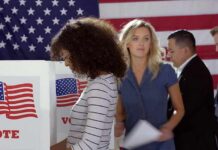
A Dearborn poll worker on hidden camera told a man who said he was not a U.S. citizen that he could vote for Senate, just not for president.
Story Snapshot
- Undercover video shows a poll worker saying a noncitizen can vote for U.S. Senate.
- Federal law bans noncitizens from voting in elections for Congress or president.
- Michigan says only U.S. citizens may register or cast any state or federal ballot.
- Dearborn describes election workers as trained staff who assist voters at polling sites.
The Footage And The Claim
O’Keefe Media Group released video from a Dearborn polling place that shows an Arabic-speaking poll worker telling an undercover operative, who said he was not a U.S. citizen, that he could not vote for president but could vote for other races. The Western Journal reported the worker answered “Yeah” when asked about voting for Senate candidate Abdul El-Sayed. The Gateway Pundit published the same core exchange and framed it as a bombshell.
Michigan’s state guidance is direct. Only U.S. citizens may register or cast a ballot in any state or federal election, and applicants attest to citizenship under penalty of perjury at multiple checkpoints. Dearborn’s own materials say election workers, also called inspectors, are hired to assist at polling places and process election activity, which includes answering voter questions and guiding people through the process. Those duties make clear answers matter at the check-in table.
What The Law Requires, In Plain Terms
Federal law leaves no gray area on federal races. Title 18, Section 611 of the United States Code states that an alien may not vote in an election held in part for a member of the Senate or the House of Representatives, or for president or vice president. The statute allows narrow exceptions not at issue here and sets penalties of a fine, up to one year in prison, or both. Any advice that a noncitizen can vote for the United States Senate conflicts with that rule.
That bright line explains the reaction the clip sparked. Voters expect a single standard in every precinct. Common sense says the same. One set of rules for citizens, another for noncitizens, is how our system works. American conservative values stress equal rules, clean rolls, and zero room for confusion about who can vote in federal contests. A worker who blurs that line undermines public trust, even if no illegal ballot was actually cast.
Dearborn’s Election Floor: Training, Role, And Risk
Dearborn hires election workers to support site operations, manage lines, check registrations, and help voters complete legal steps correctly. That means front-line answers set the tone. A wrong answer at the table can lead to a wrong action in the booth. The video centers on a live help moment. The worker reportedly split eligibility between president and Senate. That distinction does not exist in law for noncitizens. The city’s training should close that gap before doors open.
Under 18 U.S.C. § 611, noncitizens are prohibited from voting in federal elections, including U.S. Senate races, subject to narrow exceptions.
↓
O’Keefe Video: Dearborn Poll Worker Tells Undercover Non-Citizen He Can Vote for Senate, Just Not President https://t.co/zTHBY51IKo— Dogs Chained And Throttled On X (@baileyjer) November 4, 2026
Michigan’s top election office repeats that only U.S. citizens may register or vote, period. The office also points to research that found very few suspected noncitizen votes among millions cast in 2016. That broader data shows the base rate is tiny. It does not soften what the clip shows. One worker’s error can still cause harm if it reaches a ballot. Systems must be built for zero-fail answers on citizenship and federal races at every station, every time.
What To Watch Next
The key questions now are simple. Did any noncitizen receive or cast a ballot after that exchange? Did the worker follow or depart from training? Was this a one-off lapse or a pattern? The cleanest fixes are also simple. Verify the worker’s assignment. Review training materials used before Election Day. Audit incident logs from the site. If needed, refresh training with a blunt rule: if someone states they are not a U.S. citizen, do not issue a ballot that includes any federal race.
Why This Matters Beyond One Precinct
Elections run on thousands of small moments. Most pass without notice because workers follow the script. But a single misstatement about citizenship and federal eligibility can light up a national feed before lunch. Fair elections rely on clear law, clear training, and clear answers at the desk. Voters deserve all three. Enforcing the federal ban on noncitizen voting and Michigan’s citizen-only policy is not partisan; it is the minimum standard for trust in the results.
Sources:
thegatewaypundit.com, uscode.house.gov, westernjournal.com, dearborn.gov