

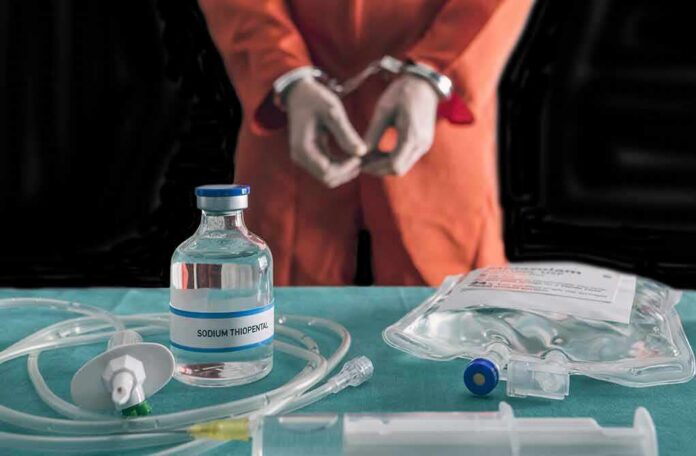
Texas pronounced Reinaldo Dennes dead minutes after he cried out, “Don’t let me suffer like this.”
Story Snapshot
- Texas officials say the execution followed protocol and ended at 7:08 p.m.
- Witnesses report repeated cries of pain and a long struggle to place lines.
- The procedure lasted about an hour as staff searched for a vein.
- Florida’s pace shows a wider return to frequent executions in some states.
Texas says protocol held; witnesses describe clear pain
Texas executed 70-year-old Reinaldo Dennes on November 19, 2026, for the 1996 murder of Houston jeweler Janos Szucs during a diamond heist. Reporters in the chamber heard Dennes moan about pain and plead for relief as staff worked to place the intravenous lines. The Texas Department of Criminal Justice said the procedure followed protocol and was completed with a medical pronouncement at 7:08 p.m. The agency framed the outcome as consistent with law and policy.
Accounts from the viewing room describe a long, tense start. Staff struggled to find suitable veins for two lines. The team ultimately placed catheters in Dennes’s neck and left foot. Reporters and the spiritual adviser said Dennes complained that his right leg felt like a severe cramp. An Associated Press reporter called the scene unlike dozens of executions he had seen before, citing the intensity of Dennes’s distress. The state later suggested Dennes’s pain complaints were not truthful.
Timeline inside the chamber
Witnesses say the execution began when Dennes was secured to the gurney. Staff attempted multiple placements before establishing access. The drugs flowed at about 6:52 p.m., after more than an hour in the chamber. Officials reported the procedure was completed at 7:07 p.m., and a physician pronounced death one minute later. The state emphasized the orderly close. Reporters emphasized the time, the vein search, and the audible pain. Both facts can be true at once.
Texas officials maintained a measured tone in post-execution comments. A spokesperson stated the team followed protocols and the execution was successfully carried out. That reflects how states judge these events: the checklist finished, the legal sentence done, the medical pronouncement made. Witnesses used a different yardstick. They highlighted pain, delays, and the effort to establish access. That gap fuels ongoing debate over what “success” should mean in a death chamber.
The wider return to frequent executions
Florida’s schedule has accelerated this year, while Texas continues to carry out sentences. The day Texas executed Dennes, Florida moved toward another record-setting pace, signaling how some states are reasserting the death penalty as a firm tool of justice. Supporters say this honors juries, brings finality, and protects the public. Critics focus on process problems and visible suffering. Both trends now run in parallel, and tension rises when a case looks messy to the naked eye.
Reinaldo Dennes repeatedly cried out in pain before he died by lethal injection Thursday in what Texas officials declared a normal execution. https://t.co/mKpBP5uOzD pic.twitter.com/zITFlzrztj
— Houston Chronicle (@HoustonChron) November 21, 2026
American courts have set a clear bar for method-of-execution challenges. The United States Supreme Court requires inmates to propose a workable alternative that would cut the risk of severe pain and is available to the state. That is a high hurdle, by design. It favors settled procedures unless states refuse a practical fix. That standard explains why states defend protocol compliance so strongly after a difficult execution like this one.
What the facts say—and what they do not
Three points stand out after Huntsville. First, Texas completed the execution within its written rules and recorded a prompt time of death. Second, witnesses described extended attempts to secure access and repeated cries of pain. Third, many people will judge the event by which of those two frames they trust more. A conservative view prizes order, accountability, and truthful reporting. It also expects government to do hard jobs without avoidable error. Both instincts apply here.
The public does not need graphic play-by-play to grasp the stakes. If the state says the procedure worked and observers heard suffering, leaders should square those accounts with clear records. Families of victims deserve closure that does not invite doubts about competence. Officers and medical staff deserve protocols that work under stress. Taxpayers deserve a process that is firm, fast, and clean. That is not softness on crime; it is basic government standards.
Sources:
youtube.com, apnews.com, houstonpublicmedia.org, edition.cnn.com, tdcj.texas.gov, abc7ny.com, reprieve.org, supreme.justia.com