
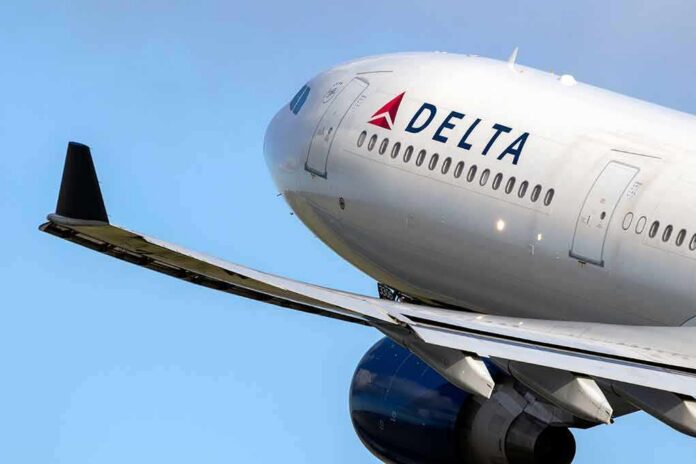
Delta’s automated weight-and-balance system glitched, and Atlanta’s departures slowed while crews did the math by hand.
Story Snapshot
- Federal Aviation Administration said Delta’s weight-and-balance automation caused delays, not air-traffic systems.
- Delta confirmed it used manual workarounds to keep flights moving while restoring automation.
- A brief ground stop and then ground delays stretched wait times at Hartsfield-Jackson Atlanta International Airport.
- Flight delays piled up in Atlanta and across Delta’s network during the pre-Thanksgiving rush.
What broke and why that matters before takeoff
Delta reported problems with its automated weight-and-balance system on Sunday morning in Atlanta. The Federal Aviation Administration said the issue sat inside Delta’s operation and did not involve federal air-traffic systems. Weight-and-balance numbers tell pilots how heavy the plane is and where that weight sits. Crews need those figures to set takeoff speeds and ensure a safe center of gravity. Without automation, flights wait for accurate numbers done by approved manual steps.
Delta said teams used manual workarounds to push departures while technicians worked to restore the system. That shift kept safety first but slowed the rhythm of the world’s busiest hub. Manual math takes time and demands checks by dispatchers and crews. Each flight needs its own set of numbers. One automated hiccup turns into dozens of extra minutes across gates, crews, and taxiways when a hub’s schedule stacks tight connections.
How operations shifted from stop to slow-go
The Federal Aviation Administration briefly issued a ground stop for Delta flights tied to the Atlanta hub, according to Reuters. Crews then moved to a ground-delay program as the system disruption continued. A ground stop pauses departures to avoid unsafe or chaotic conditions. A ground-delay program meters them out to match what the airline can safely handle. This sequence fit the problem: safety-critical data slowed, so planes left later, not faster.
Atlanta travelers saw ripple effects across arrivals and departures. One station count cited hundreds of delays at Hartsfield-Jackson, including about 200 inbound and 164 outbound, based on FlightAware snapshots reported during the incident. Other outlets captured different totals as the day evolved, which happens when live dashboards refresh minute by minute during a busy holiday window.
Scope beyond Atlanta and what passengers felt
Delays reached well beyond Atlanta. Reuters reported thousands of delayed flights nationwide as the disruption hit Delta’s broader schedule. When a hub slows, aircraft and crews fall out of place, and the network needs time to catch up. Connections misalign, turn times stretch, and the problem jumps to the next city. This is how a single operations system can bend a large airline’s day even when planes and weather look fine.
Equipment outage in Atlanta causes over 1,300 Delta flight delays https://t.co/kcKsuMnESH
— Oliver Stuenkel 🇧🇷 (@OliverStuenkel) November 22, 2026
Comparisons to recent tech disruptions add useful context. Research on the 2024 CrowdStrike outage found that average delays in Atlanta jumped and cancellation rates rose during peak impact. That event differed in cause but taught the same network lesson: modern airline systems have few easy substitutes, so failures spread quickly until automation returns. The repeat pattern argues for deeper resilience, not more apologies posted after the fact.
Safety, responsibility, and the path to resilience
Delta kept the core safety rule intact: no plane goes without solid numbers. That is the right call every time. Still, the timing hurt. Thanksgiving traffic leaves little slack for recovery. For travelers, this feels avoidable because it was a company system, not a storm. The Department of Transportation has treated past information-technology outages as controllable events, which raises expectations for care, compensation, and clear communication when airline tools fail.
Common sense and conservative values favor accountability and redundancy. Airlines should harden critical tools, test failovers, and train for manual modes at scale. Weight-and-balance is not optional; it is the preflight spine. The fix is not a press release. It is stronger architecture, vendor scrutiny, and drills that prove the airline can run safely and swiftly when automation blinks. Build resilience on calm days so holiday Sundays stay boring.
Sources:
tri-cityherald.com, foxcarolina.com, wjla.com, newjersey.news12.com, link.springer.com