
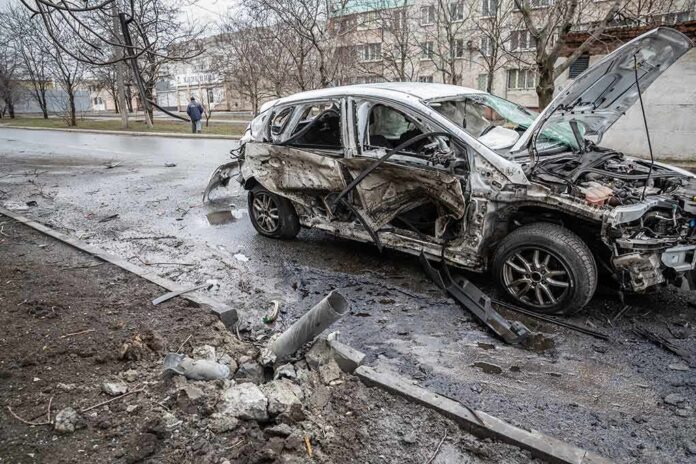
A car exploded on a busy Moscow street, leaving a high-profile exile torn and a city on edge.
Story Snapshot
- Russian investigators opened a criminal case after a car exploded in southern Moscow.
- Reports named the injured driver as Sergei Zavorotny, an aide to ex–Ukrainian Prime Minister Mykola Azarov.
- Some outlets said the case is treated as attempted murder by a dangerous method.
- No suspects, motive, or claim of responsibility have been confirmed.
What happened on Kirovogradskaya Street
Russian authorities said a car blew up in Moscow’s Chertanovo district and seriously injured the driver. The Investigative Committee, which handles major crimes, opened a criminal case and sent investigators to the scene. Multiple outlets identified the victim as Sergei Zavorotny, a former spokesman or aide to Mykola Azarov, Ukraine’s prime minister from 2010 to 2014, who has lived in Russia and appeared as a pro-Kremlin voice. He was taken to a hospital after the blast and was reported in serious condition.
The official early statements did not name suspects or a cause. One outlet reported investigators are treating the blast as attempted murder by a dangerous method, citing Russian sources, though other reports did not list charges or a case number. This attack followed another reported car bombing in Russia two days earlier, raising public concern about a pattern, even as details in both cases remain thin.
Who Zavorotny is and why that matters
Zavorotny worked with Azarov during the Yanukovych era and later stayed in Russia. Reports describe him as a pro-Kremlin commentator in recent years. That profile offers a plausible motive line: a political figure who backed the Kremlin and criticized Ukraine might draw hostile interest. That said, a motive is not proof. Azarov blamed Ukrainian intelligence but offered no evidence, and no authority has presented supporting records for that claim. A careful reader should separate motive theories from verified facts.
An alternative context adds more layers. A report from The Insider said a 2020 United States Senate Intelligence Committee assessment identified Zavorotny as an officer of Russia’s Foreign Intelligence Service, and a source claimed he earlier served in the Soviet security services. The outlet also linked him to propaganda operations in Europe before the current war. If accurate, that background could broaden the list of possible enemies beyond a simple “critic of Ukraine” frame. But even this account stops short of naming a perpetrator.
Competing theories about the blast itself
Several media framed the explosion as a likely car bomb and relayed Telegram channel claims that a device sat under the driver’s seat and detonated by remote. The Telegraph stressed that officials had not confirmed the cause and that the Telegram details were unverified. The Moscow Times presented another version: a mechanical failure in the car’s gas equipment could have caused the blast, though it also mentioned a preliminary magnetic-bomb claim from other sources. These theories cannot both be true; only forensics will sort them.
Former Ukrainian official aide Sergei Zavorotniy was severely injured in a car bombing in Moscow, marking the second high-profile explosive attack targeting prominent figures in Russia within 48 hours. pic.twitter.com/LxdRYHTNkN
— Azat TV (@azattelevision) November 13, 2026
Public reporting has not answered key questions. No one has claimed responsibility. Officials have not said who the intended target was or confirmed whether Zavorotny was attacked for who he is versus simply being the car’s owner and driver. The Investigative Committee has kept control of early details, which creates an information gap that rumor quickly fills. The gap invites spin from all sides, but spin does not equal evidence. Americans value due process and facts; we should wait for lab results and charges.
How to read this event without getting played
Violence against exiles and political figures has a track record in the region, and both Russia and Ukraine have used covert methods in this war. That background makes any fast, confident claim of blame suspect in the first week. The conservative approach is simple: ask for proof that can stand up in court. Demand the case file identifiers, the crime-scene photos, the residue analysis, and the device fragments. Accept that sometimes a headline hides a simpler cause, like a mechanical failure, until experts rule it out.
What should come next is clear. Investigators should release the legal classification, the relevant criminal-code provisions, and the case number. Forensics should clarify whether an external explosive device existed, and if so, its type and trigger. If the attack was targeted, surveillance footage and communications should show pre-attack scouting or cueing. If it was not, the mechanical inspection should explain the failure path. Until then, treat every confident claim about motive and blame as a sales pitch, not a finding.
Sources:
zerohedge.com, kyivpost.com, washingtonpost.com, kalminer.com.au, theins.press, thedailybeast.com, charlotteobserver.com, euromaidanpress.com, monoscoops.com