
Russia’s top envoy in Washington, Alexander Darchiev, died suddenly at 66, and the diplomatic chessboard just lost a key piece.
Story Snapshot
- Russia’s Foreign Ministry announced Darchiev’s sudden death at age 66 on November 11.
- He served as ambassador to the United States since early 2025, replacing Anatoly Antonov.
- No cause of death was given in the ministry’s statement or in media summaries.
- The loss lands during tense Russia–United States relations, shrinking channels for high-level contact.
What Moscow Announced And What It Means
Russia’s Foreign Ministry said Ambassador Alexander Darchiev died suddenly on November 11 at age 66, using formal language to mark his rank and service. Russian state-linked and international outlets echoed the announcement within hours, noting that no cause of death was disclosed. That narrow, consistent wording set the public record and left the practical question that matters for policy: who now handles the most sensitive Russia–United States talks while Moscow names a successor?
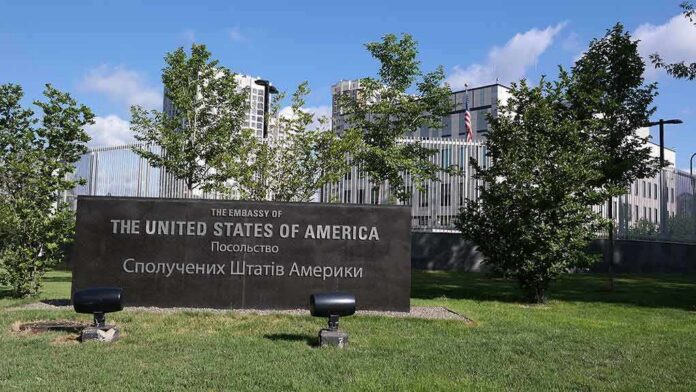
Darchiev took over Russia’s embassy in Washington in early 2025, succeeding Anatoly Antonov amid a hard freeze in the relationship. Reports at the time described him as a veteran of United States affairs and a steady operator in crisis management. His portfolio spanned sanctions issues, prisoner exchanges, and minimal military-to-military deconfliction through diplomatic notes. The ambassador’s daily work did not grab headlines, but it helped keep fragile lines open when hotlines ran cold.
Why This Vacancy Matters Right Now
Ambassadors are not figureheads. They are the last reliable switchboard when leaders disagree and mid-level envoys stall. The embassy manages messages that cannot live on press releases. With Darchiev gone, routine friction grows sharper. Visa problems last longer. Consular disputes risk escalation. Even small gaps in protocol can snowball into public spats. A strong mission can cushion bad news; a leaderless one cannot. Moscow will move to designate a chargé d’affaires, but that stopgap lacks an ambassador’s weight.
Washington and Moscow remain locked in disputes over sanctions, proxy conflicts, and cyber claims. Tensions elevate the value of any direct, disciplined line. Seasoned ambassadors know which calls to make and which to ignore. They can test proposals quietly, saving both sides from public grandstanding. When that skill set leaves overnight, mistakes multiply. The prudent course now is fast continuity at the embassy and clear rules for urgent contacts until a new envoy arrives.
The Sparse Public Details And A Narrow Caveat
The Foreign Ministry did not provide a cause of death, location, or medical detail in its announcement. Media reports noted the absence of those particulars and repeated the ministry’s phrasing that he “passed away suddenly”. That is the established public record. The lack of added detail does not change the confirmed fact of death; it does, however, limit what anyone can responsibly claim beyond that point. Responsible reporting keeps the focus on what was said and what it affects.
Darchiev’s Role In A Long, Hard Season
The ambassador faced a wall of practical problems. Sanctions enforcement touched banks, energy traders, and shipping. Cultural and scientific ties thinned. High-level visits became rare, and formal talks often ended with statements that agreed on nothing. In that climate, an envoy’s value is measured by the crises that never made the news because they were solved in a secure room. Colleagues described Darchiev as experienced and calm under pressure, traits that reduce risk when tempers spike.
BREAKING: Russia's ambassador to the U.S., Alexander Darchiev, has died at age 66, the Russian Foreign Ministry announced. No cause of death has been given. pic.twitter.com/QTdEF9MyPT
— Monitoring the Situation (@monitoringmeme) November 11, 2026
Recent history shows why observers watch these moments closely. Several Russian diplomats and senior officials abroad died unexpectedly in the last decade, a pattern that drew attention even when causes were reported as natural or accidental. That backdrop explains the intense interest when an ambassador dies, but it does not, by itself, change the facts of this case. The ministry’s statement is the core record, and the reporting matched it on the basic details.
What Happens Next, And What To Watch
Expect Moscow to appoint a senior deputy as acting head of mission within days. Watch for a formal notice to the United States Department of State and for routine embassy services to continue without interruption. The practical test will be whether scheduled diplomatic exchanges on consular matters, detainee cases, and sanctions compliance proceed on time. If meetings slip or statements harden, the vacuum is already costing both sides. Stability favors quick naming of a successor with deep United States experience.
Sources:
insiderpaper.com, interfax.com, abcnews.com, tass.com, themoscowtimes.com, straitstimes.com