

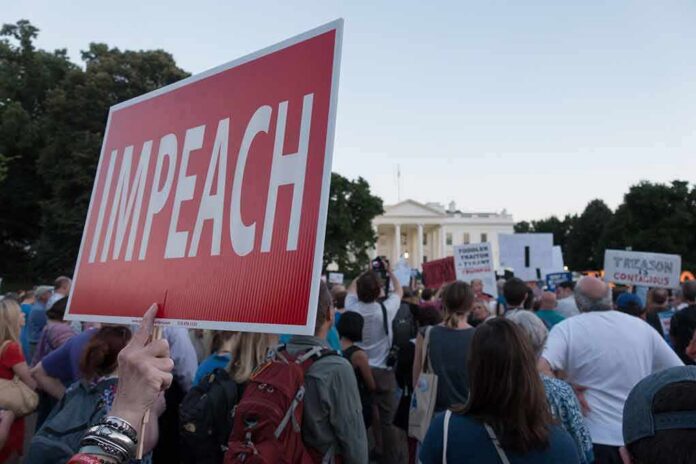
A libertarian Republican just forced his own party to vote on impeaching President Trump’s Defense Secretary over a war in Iran.
Quick Take
- Representative Thomas Massie filed eight articles of impeachment against Defense Secretary Pete Hegseth on September 15, 2026.
- The core charge says Hegseth kept fighting in Iran without a declaration of war or Congress’s approval, breaking the War Powers Resolution.
- Hegseth calls the push “political theater” and says the Iran campaign was a “courageous and historic effort.”
- House Speaker Mike Johnson previously canceled a floor day, blocking an earlier vote attempt before the resolution could reach the chamber.
What Massie’s Resolution Actually Claims
Massie’s 34-page resolution lays out eight separate articles against Hegseth. Three of them focus on the Iran war itself, arguing Hegseth waged war without a congressional declaration, a statutory authorization, an attack on the United States, or any imminent threat that would justify it. That is a specific legal theory, not a vague complaint. It points straight at Section 2(c) of the War Powers Resolution, a 1973 law built after Vietnam specifically to stop presidents from treating war as a one-man decision.
Article III goes further, claiming the fighting continued past the law’s 60-day clock and a possible 30-day withdrawal window. Article II says Hegseth ignored a direct order from Congress itself. Both the House and Senate passed H. Con. Res. 86 telling the administration to pull troops out, and Massie’s filing says Hegseth kept the operation running anyway. If true, that is not just a policy disagreement. It is a cabinet officer allegedly overriding a direct congressional command.
The Civilian Harm Charge And What’s Still Missing
Article IV accuses Hegseth of ignoring laws meant to protect civilians during the strikes, with NPR reporting Massie specifically alleged unnecessary civilian deaths. That is a serious claim, but the public record right now does not include casualty counts, strike locations, or documents tying specific deaths to a Hegseth decision. A skeptical reader should notice that gap. Serious allegations deserve serious proof, and right now the resolution itself is the main document available.
The same holds for H. Con. Res. 86. Massie’s team says it legally required withdrawal. But the publicly available reporting does not include the resolution’s full text, vote tallies, or any White House legal response explaining whether the administration believed it was bound by that vote. Congress and the executive branch have sparred over exactly this kind of question since Nixon’s era, and courts have rarely stepped in to settle it.
Hegseth’s Response Leans On Defiance, Not Detailed Rebuttal
Hegseth has not offered a point-by-point legal defense against the specific War Powers claims. Instead, he has gone on offense, calling the articles a “sham” and insisting the Iran campaign stopped Tehran from getting a nuclear weapon. His exact words: the war was “a courageous and historic effort that will ensure Iran never gets a nuclear weapon”. He has also framed himself as a fighter standing with President Trump’s agenda, telling critics, “We are not defenders anymore. We are warriors”.
Pentagon spokesman Sean Parnell echoed that defiance, branding the impeachment push a “sham witch hunt.” But one voice inside the defense world pushed back on the premise itself. Former Pentagon official Rick Stengel questioned whether Hegseth even controlled the war decisions, arguing responsibility runs straight to President Trump. That is a fair point worth sitting with. Cabinet secretaries carry out presidential policy; they rarely invent it alone.
“We're not worried about that,” Hegseth told reporters in Newport, R.I., on Monday when asked about Massie’s impeachment salvo.
More on Hegseth's response: https://t.co/7aDUuICcYm pic.twitter.com/hkglxdWKEv
— WFRV Local 5 (@WFRVLocal5) November 9, 2026
Why This Vote Matters Beyond One Man’s Job
Only two cabinet secretaries have been impeached in American history, and the last one, William Belknap, was charged all the way back in 1876. That rarity is exactly why Massie’s move carries weight regardless of the outcome. It forces every House Republican on record, either defending unchecked executive war power or standing behind a constitutional check that conservatives have historically championed when a Democrat occupied the Oval Office.
Speaker Johnson already showed leadership can slow this down by canceling a legislative day before the earlier push could reach the floor. Whether that happens again, the underlying question will not go away quietly. Congress wrote the War Powers Resolution for a reason, and conservatives who believe in limited government and constitutional guardrails should want that question answered on the record, not buried by a scheduling trick.
Sources:
facebook.com, cbsnews.com, abc13.com, wlwt.com, npr.org, nbcnews.com, signalscv.com, adn.com, reuters.com