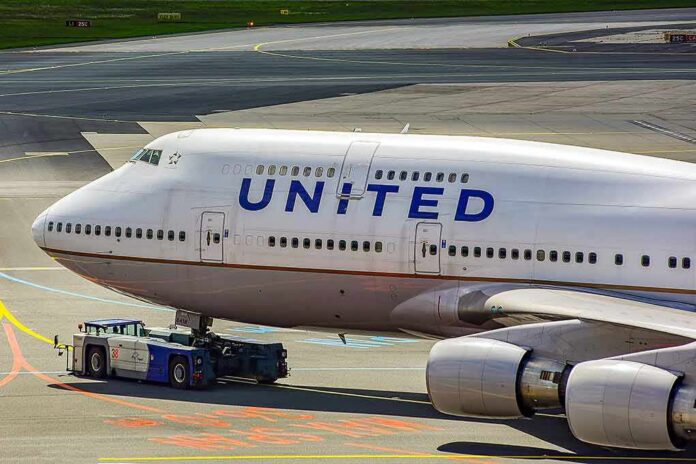
A twice-deported Honduran national triggered a hijack alert after allegedly rushing a United cockpit and claiming he had a bomb.
Story Snapshot
- United Flight 2174 sent a top-level hijacking alert after an attempted cockpit breach was reported.
- Deputies arrested 34-year-old Rony Alexander Gomez-Alberto after the plane landed in New Orleans.
- Officials say he claimed he had a bomb; no device was found, according to local reports.
- The Department of Homeland Security says he was twice deported and flagged with an immigration detainer.
What Happened Onboard United Flight 2174
United Flight 2174 from Newark to New Orleans reported a passenger who tried to rush the cockpit and claimed he had a bomb, prompting a hijack-level security response midair. The crew notified authorities and landed without incident. The Jefferson Parish Sheriff’s Office met the aircraft at Louis Armstrong New Orleans International Airport. Deputies arrested the man identified by authorities as Rony Alexander Gomez-Alberto, age 34, after the aircraft reached the gate and passengers deplaned in an orderly way.
Officials described the alert as a high-level cockpit-security event consistent with a hijacking response protocol. United Airlines followed standard procedures. The flight carried dozens of passengers and six crew members, according to local coverage, which said the man acted irrationally and made a bomb claim to crew. No explosive was reported recovered in post-landing checks. The arrest shifted the event from an in-flight scare to a formal criminal case handled by parish authorities.
Arrest, Charges, And The Federal Angle
The Jefferson Parish Sheriff’s Office booked Gomez-Alberto on state offenses that included communicating false information about planned arson and terrorizing, as reported by local outlets that cited parish authorities. The classifications mirror how many bomb-threat cases begin at the local level even when they start in the air. Federal involvement often follows later if evidence supports charges for interference with crew or attempted aircraft piracy under Title 49 of the United States Code.
The Department of Homeland Security said that Immigration and Customs Enforcement placed a detainer on Gomez-Alberto after the arrest. A spokesperson stated he attempted to gain entry to the cockpit during the flight, and that he is a Honduran national who is unlawfully present in the United States. That statement confirms federal awareness and sets up a likely handoff from parish custody to federal immigration authorities after the local case proceeds.
Twice-Deported Claim And Border History
Department of Homeland Security-linked reports say Gomez-Alberto was removed from the United States twice before this flight. Accounts attribute his prior border encounters to arrests near El Indio, Texas, in 2011, and near Columbus, New Mexico, in 2014, followed by deportations both times. Fox News reported the Department of Homeland Security placed the new immigration detainer on November 10, 2026, matching the flight date window and the Jefferson Parish arrest.
🚨 BREAKING: MAN ARRESTED AFTER ALLEGED BOMB THREAT ABOARD UNITED FLIGHT TO NEW ORLEANS
A flight headed to New Orleans was forced into an alarming situation Monday night after a passenger allegedly threatened to detonate a bomb and attempted to enter the cockpit.
Authorities… pic.twitter.com/IDpRy35XYr
— Hiveofsecrets (@Ash446381026218) November 11, 2026
Conservative readers will see a clear through-line: border failures ripple into homeland risks. This case ties a twice-deported individual to a bomb claim in a sealed cabin at altitude. Common sense says this is not abstract. Aviation protocols exist for a reason. A bomb threat and a run at the cockpit are treated as real until proven false because the cost of guessing wrong is mass death. That mindset reflects the post-2001 reality, not politics.
Aviation Security Context And Why The Alert Matters
Federal guidance on aviation crime sets clear lines. Threats and lies about bombs are crimes. Interference with crew is a crime. Attempts to seize control of an aircraft, even before takeoff, can qualify as attempted aircraft piracy if force, intimidation, and wrongful intent are present. Crews cannot diagnose motive in real time. They execute checklists, secure the flight deck, and alert law enforcement. That is exactly what happened on Flight 2174, according to contemporaneous reporting.
Unruly-passenger cases surged after 2019 and forced more referrals to the Federal Bureau of Investigation. The Federal Aviation Administration and industry groups have stressed hardening the cockpit and quick law enforcement coordination. Those steps drive fast, visible responses when a passenger claims a bomb and moves toward the cockpit. The process errs on the side of caution because speed and clarity save lives in the rare case when a threat is real.
Why The Labels Differ And What To Watch Next
Headlines mention “attempted hijacking,” while parish records show state charges like terrorizing and false information. That split is normal early in a case. Prosecutors pick charges they can prove with immediate evidence and witness statements. Federal charges can follow if the facts meet the legal test for interference or attempted aircraft piracy as defined in the Justice Manual and related case guidance. A conviction does not require a successful takeover, only an attempt shaped by force or intimidation.
One quick caveat belongs here: news accounts are consistent on the reported bomb claim and cockpit rush, but do not include a full arrest affidavit in public yet. The core facts remain established by named authorities and airline-side reporting. The key next steps will be courtroom filings, any federal complaint, and the immigration transfer after the parish case. For policy makers, the lesson is simple: secure borders, hard flight decks, and zero tolerance for threats keep people safe.
Sources:
thegatewaypundit.com, wwltv.com, foxnews.com, people.com, nypost.com, justice.gov