

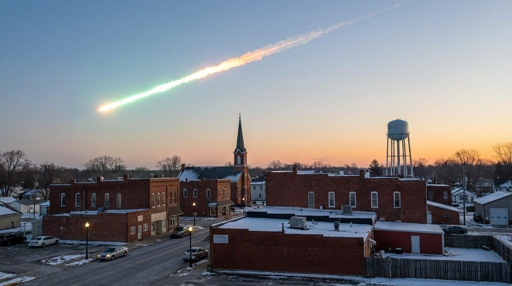
When a mystery boom strong enough to rattle homes from Boston to Rhode Island turns out to be a 3‑foot space rock, it raises a simple question many Americans now ask about everything: what else are we not being told until after the fact?
Story Snapshot
- A meteor about 3 feet wide exploded high above New England, creating a sonic boom equal to roughly 300 tons of TNT.
- The blast shook homes and rattled nerves from Massachusetts to Rhode Island, triggering a wave of 911 calls and explosion fears.
- NASA and meteorologists quickly ruled out earthquakes and military activity, but full technical details came later through the media.
- The event shows how vulnerable—and dependent on elite gatekeepers—Americans are when rare but powerful natural events hit without warning.
What Actually Happened Over New England’s Skies
Residents across Greater Boston and as far as Rhode Island heard a sudden, powerful boom around 2:11 p.m. on a clear Saturday, followed by shaking that some compared to an explosion or small earthquake.[1][2] Police, fire departments, and local newsrooms were flooded with calls reporting buildings rattling and windows vibrating.[1][3] The United States Geological Survey found no seismic activity, ruling out an earthquake, while radar picked up a flash where no thunderstorms were present, pointing to something entering the atmosphere.[2]
Officials with the American Meteor Society and the National Aeronautics and Space Administration (NASA) later confirmed that a roughly 3‑foot natural meteor had entered Earth’s atmosphere near the Massachusetts–New Hampshire border.[3] NASA said it was traveling at about 75,000 miles per hour before fragmenting roughly 40 miles above the ground.[1][3] The agency estimated that the breakup released energy comparable to about 300 tons of TNT, which produced a sonic boom powerful enough to be heard and felt across much of New England.[1][3]
How Scientists Know It Was a Meteor, Not Something Man‑Made
Meteorologists and federal scientists pieced together the cause using several independent clues. Weather radar detected a bright flash offshore over an area with no thunderstorm activity, consistent with what experts call a “bolide,” a meteor that explodes in the atmosphere.[1][2] Satellite lightning data from the National Oceanic and Atmospheric Administration showed a signature matching an incoming space rock.[1] The United States Geological Survey’s instruments showed no quake, eliminating a natural ground event, while the pattern of reports aligned with a shock wave spreading outward.
NASA later stated that this was a daytime fireball that produced a meteorite fall in Cape Cod Bay, over water about 34 meters deep.[1] Officials emphasized that the object was natural material, not a satellite, missile, or space junk, and that most similar meteors burn up harmlessly long before reaching the surface.[1][3] While this one created a dramatic sonic boom, researchers stressed there is no evidence that it signals a new or elevated impact threat to Earth; instead, it fits a known pattern of occasional but powerful fireball events.[1]
Why the Boom Felt So Intense — And Why People Were Alarmed
A sonic boom from an object moving tens of thousands of miles per hour delivers its energy in a tight wave front, which is why people described a sudden bang rather than a long rumble.[1][2][3] Residents reported startled pets, shaking homes, and windows rattling, with some convinced there had been an industrial explosion or military incident nearby.[1][2] In an era of constant headlines about war, terrorism, and domestic unrest, many understandably feared the worst before any official explanation arrived.
Local emergency dispatch centers and newsrooms saw a surge of 911 calls and messages as people sought answers and reassurance.[1][3] Only later did television reports quote NASA’s assessment about the speed, altitude, and energy of the blast, including the striking 300‑tons‑of‑TNT figure.[1][3] For several hours, citizens were left to trade rumors and speculation, reinforcing a familiar frustration on both the left and right: ordinary people feel they are the last to know what is happening when something unusual shakes their community.
What This Meteor Says About Risk, Transparency, and Trust
Space‑rock airbursts like this are rare for any one town but regular on a global scale, which is why NASA and other agencies maintain monitoring networks and rapid‑analysis teams.[1][3] The New England event shows those systems can work: scientists quickly ruled out earthquakes, traced the likely path, and distinguished a natural meteor from space debris.[1][2][3] At the same time, the public saw only fragments of that analysis, filtered through television segments and brief written statements rather than a complete technical report.
A meteor explosion startled New England on Saturday. See how this dog, Chicken, responded to the boom https://t.co/ebC3z8QBQj
— Jimmy's Wigwam (@jameskayTA) June 1, 2026
For Americans already skeptical of “elite” gatekeepers, that information gap matters. People on both the right and left see a pattern where those in charge—whether in Washington, federal agencies, or media—hold the detailed data, then share only what they decide the public needs to hear and when. This meteor was almost certainly just what NASA says it was: a natural rock that exploded high above Cape Cod Bay.[1][3] But the rush of fear before the facts arrived illustrates how fragile public trust has become whenever the ground—or the sky—suddenly shakes.
Sources:
[1] Web – A meteor causes loud boom as it enters atmosphere and breaks apart …
[2] Web – Meteor above New England created loud boom that rocked …
[3] Web – Meteor explodes off coast of Massachusetts, causing loud …