
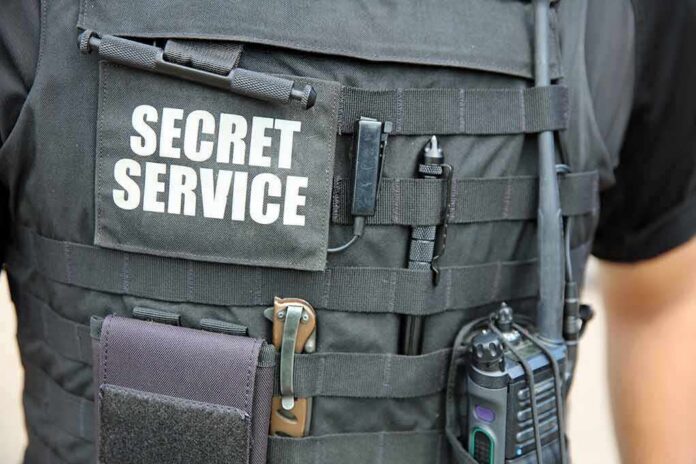
Three Secret Service communications officials, including the agency’s communications chief, were escorted out of headquarters and sidelined as investigators probe a suspected leak tied to presidential security.
Story Snapshot
- Three Secret Service communications staff placed on leave and lost clearances
- Office of Professional Responsibility leads the review; possible criminal angle noted
- Reported FBI and Central Intelligence Agency involvement signals higher stakes
- Probe follows Trump’s secret plane swap during an Iran-linked threat episode
Three Officials Removed From Access Amid Internal Probe
The United States Secret Service confirmed three non-law-enforcement employees are on administrative leave during an investigation into potential misconduct handled by its Office of Professional Responsibility. Multiple reports identified the officials as members of the communications office and said their security clearances were suspended. One of them is the agency’s communications chief, Anthony Guglielmi, according to outlets briefed by officials. Escorts from the Washington, D.C., headquarters and “do not admit” designations were also reported.
Reports said the Federal Bureau of Investigation (FBI) and the Central Intelligence Agency (CIA) are involved in the inquiry, which would be unusual for a simple personnel matter and points to a possible criminal or counterintelligence angle. The agency’s public line emphasizes an administrative investigation. That description aligns with standard steps in sensitive cases where access is pulled first, facts are sorted next, and charges—if any—come last.
The Security Backdrop: A Secret Flight And A Sensitive Timeline
The timing tracks with the recent covert aircraft switch that moved President Trump off his expected plane in Turkey after a reported Iranian threat. The Washington Post and others described a plan that used a decoy and a quiet transfer to a military aircraft to protect the president while public statements suggested he was on Air Force One. Trump later confirmed he changed planes at the direction of the Secret Service and the military due to a threat. That sequence raised the sensitivity of any travel or protection details.
Intelligence agencies assessed the threat with caution. Reporting said officials had doubts or “low confidence” in parts of the Iran-linked plot, even as the Secret Service pushed enhanced security steps. That split is not rare in protection work. Protection teams plan for worst cases; analysts often grade confidence. Both lanes can be true at once. What matters now is whether any protected operational detail leaked and, if so, by whom.
Why A Communications Office Leak Would Matter
The communications office handles messages to the public and the press, but it also sees sensitive timelines and operational notes. A leak from that space can tip off hostile actors, move crowds, or expose routes. That risk is why clearance suspensions are swift when questions arise. Prior Secret Service leak cases show the stakes. In 2015, dozens of personnel faced discipline after improper access and disclosure of a lawmaker’s records during oversight turbulence. Clear rules and fast containment protect both people and trust.
A leak probe that touches presidential movements draws more firepower. If the FBI and CIA are coordinating, that suggests investigators are mapping who had what information and whether any foreign service, media outlet, or cutout was in the loop. That is not theater. It is how you test intent, damage, and any outside reach. It also explains why the agency shut off access and escorted people out while facts are gathered.
The Broader Pattern: Lock Down First, Sort Out Next
National security leak responses often begin with administrative steps, not handcuffs. The goal is to stop any further exposure while investigators trace the path of information. The Pentagon’s recent leak inquiries followed a similar cadence, with multiple officials placed on leave as the scope widened. That rhythm can look harsh from the outside, but it reflects a common-sense view: once sensitive details might be compromised, access must pause until the picture is clear.
One sentence of caution belongs here: no public document shown in current reports proves a criminal leak by the named personnel. Still, the combination of a high-risk protection episode, on-record administrative actions, and reported interagency involvement signals this is more than office drama. The conservative test is simple: protect the president first, enforce rules fairly, and publish findings that show the standard was the same for everyone, title or rank aside.
Sources:
thegatewaypundit.com, yahoo.com, washingtonpost.com, newsbreak.com, bbc.com, nytimes.com, democracynow.org, cnn.com, aa.com.tr, oig.dhs.gov, hls.harvard.edu