

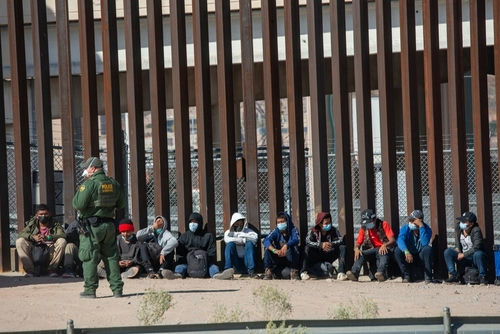
The Supreme Court just drew a hard line in the sand at the border — and it hinges on a single word: “in.”
Story Snapshot
- The Court ruled 6–3 that migrants stopped on the Mexican side have no right to seek asylum in the United States.
- Conservative justices said asylum protections start only after a person physically enters the country.[1]
- The decision wipes out years of lower‑court rulings that treated “arriving” asylum seekers at the border as already covered.[1][7]
- The ruling fits a long trend of the Court deferring to tough border policies when Congress will not act.[8][10][13]
The ruling that slammed the door before the first step
A six–justice conservative majority held that the government can turn away asylum seekers who appear at the border but are stopped on the Mexican side, without even processing their claims.[1] The case, Mullin v. Al Otro Lado, asked whether someone standing just outside the line has “arrived in the United States” under asylum law.[1] Justice Samuel Alito, writing for the Court, said arrival happens only when a person actually enters the country, so Customs and Border Protection has no duty to inspect or hear claims until then.[1]
The majority leaned on a simple, literal reading of the statute: the Immigration and Nationality Act says any alien “who is physically present in the United States or who arrives in the United States” may apply for asylum.[3] For the conservative justices, “in” means inside our territory. That narrow reading gives border agents legal cover to hold people back at the line and avoid triggering the asylum process. For an administration facing high crossings and political heat, that is a powerful tool.[1][7]
The clash over one word and thousands of lives
Three liberal justices, led by Sonia Sotomayor, pushed back hard. In dissent, she warned that the majority’s fixation on the word “in” ignored the broader purpose of asylum law and its history.[1] Congress built the system to protect people in the process of arriving, not only those who managed to slide a foot past a steel post.[1][7] She argued that it makes no sense to say legal rights hinge on whether a toe has crossed an invisible line, when the person is clearly seeking admission to escape danger.
This fight did not start at the Supreme Court. A district court in California ruled in favor of asylum seekers years ago, finding that systematic turnbacks at ports of entry violated federal law and due process.[7] The Ninth Circuit Court of Appeals agreed, holding that the law covered those who encounter officials at the border “whichever side of the border they are standing on.”[1][7] Advocates said the government’s “metering” and turnback policies were an unlawful tactic to dodge its duty to inspect and process asylum claims.[2][7] The Supreme Court has now overruled that entire line of cases.
How the decision fits a broader pattern of border power
This case is not a one‑off. It sits in a long pattern where presidents of both parties test the limits of asylum and courts argue over how far they can go.[2][4][10] The Trump administration pushed bans on those crossing between ports and on migrants who passed through other countries first.[4][10] The Biden administration tried its own “securing the border” rules tied to high encounter numbers.[2] Roughly half of these kinds of restrictions end up narrowed or struck by appellate courts,[2] but the Supreme Court has often been willing to let tough rules go forward while the fights continue.[10][11]
American conservatives tend to back this kind of clear boundary. From that lens, requiring physical entry before asylum rights kick in makes common sense: you draw a firm line, you enforce it, and you avoid incentives that draw more people into dangerous journeys. The Court’s textual focus on “in” matches that instinct. Congress wrote the word. The majority says judges must respect it unless lawmakers change it, instead of using vague notions of fairness to rewrite statutes from the bench.[1][8][13]
The legal tug‑of‑war that is still not over
Even with this ruling, the legal story is not neat or settled. The policy the Court blessed was formally ended by the Biden administration years ago, which is why some lawyers argued the case was not ready for review.[5][9] The D.C. Circuit Court, in a different case, struck down a presidential proclamation that tried to shut down asylum based on an alleged “invasion,” saying the president cannot invent extra procedures to override rights Congress put in law.[1][12] That decision shows another side of the judiciary: a refusal to let the executive branch wipe out asylum by slogan.
Supreme Court Rules Asylum Seekers May Be Turned Away at the Border https://t.co/Gzp7TfKGSe
— Carolyn Sue Burgess (@SingerRoyale) June 25, 2026
Advocacy groups and some international organizations now argue that the Supreme Court’s ruling brushes aside the principle of “non‑refoulement,” the idea that you do not send people back to danger without a fair chance to seek protection.[3][4] From a conservative, rule‑of‑law view, the strength of that criticism depends on facts: whether turnbacks are truly sending people into harm’s way, and whether Congress has clearly written those protections into United States statutes. Until lawmakers spell that out, the Court is likely to keep treating border entry as a political choice for elected branches, not an open‑ended promise judges can expand on their own.[8][10][11][13]
Sources:
[1] Web – BREAKING: Supreme Court Sides with Trump, Allows Immigration Officials …
[2] Web – [PDF] RAICES v. Noem, No. 25-5243 – United States Court of Appeals
[3] Web – Border Restrictions and Court Orders 2017-2026
[4] Web – Supreme Court Rules Defunct Border Turnback Policy Is Lawful
[5] Web – Mullin v. Al Otro Lado | Center for Gender and Refugee Studies
[7] Web – Supreme Court Today: Immigration Advocates Tell Justices Trump’s …
[8] Web – The Supreme Court Hears Asylum Turnback Case: What You Need …
[9] Web – How the Supreme Court is Shaping Immigration Policy
[10] Web – Supreme Court refuses to reinstate Trump’s “asylum ban”
[11] Web – Supreme Court Asylum Ruling Latest Sign J.. | migrationpolicy.org
[12] Web – Chevron’s Asylum: Judicial Deference in Refugee Cases
[13] Web – Federal Appeals Court Rules Trump Proclamation Eliminating …