
As Washington prepares for a July 4 spectacle billed as the biggest patriotic show in history, many Americans wonder if it is a unifying birthday party for the nation or a taxpayer-funded political rally dressed in red, white, and blue.
Story Snapshot
- President Trump will headline a massive July 4 event in Washington to mark 250 years of American independence, with a rally-style program and fireworks described as the biggest ever.
- The White House frames “Freedom 250” as a patriotic celebration on the National Mall, but critics on the left and right fear it blurs the line between civic ceremony and campaign rally.
- Key details about the cost, who pays for it, and how military symbols will be used remain unclear, echoing unresolved questions from Trump’s 2019 “Salute to America.”
- Protest movements like “No Kings” and long‑running anger at political “elites” set the stage for a July 4 that could show national pride or deepen distrust in a government many see as serving itself.
What Trump and the White House Say Will Happen on July 4
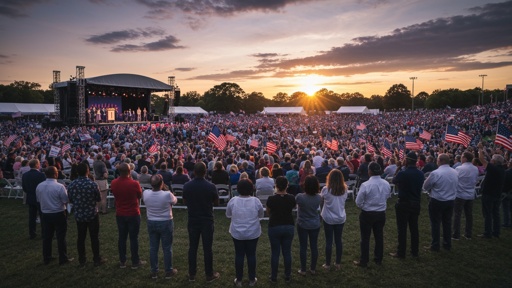
The White House Freedom 250 page says that on July 4, 2026, America will celebrate 250 years of independence with a major event in Washington, D.C.[4] The plan centers on the National Mall, where more than one million people are expected for a full day of programming, ending with what officials call the largest pyrotechnics display in history.[4] President Donald Trump is set to deliver keynote remarks, making his speech the anchor of the celebration.[4]
White House messaging describes the day as a sweeping patriotic showcase rather than a campaign event.[4] The schedule includes ceremonies honoring service members, stories of “everyday heroes,” and musical performances covering many decades of American music.[4] Officials also highlight extra elements, such as a special train trip to Philadelphia hosted by a cabinet secretary, meant to tie Washington back to the birthplace of the Declaration of Independence.[4] On paper, it looks like a civic birthday party for the nation, built around patriotic themes.[4]
Why Supporters See a Patriotic Celebration, Not a “MAGA Rally”
Supporters point to the official framing: this is the 250th birthday of the United States, a once‑in‑a‑lifetime milestone that many feel deserves a large, visible celebration.[4] They argue that honoring service members, sharing stories of ordinary citizens, and featuring American music are classic Independence Day traditions, not partisan tricks.[4] To them, a big crowd on the National Mall, a presidential address, and fireworks are exactly what a confident country should display on such a major anniversary.[4]
For many conservatives, especially older ones, this event feels like a rare bright spot after years of culture fights, economic stress, and what they see as elite contempt for patriotism.[1][2] They are tired of hearing that flag‑waving is “problematic” or that celebrating America is only for one party. They also believe that strong national pride can help push back against globalism, weak borders, and activist judges. From this view, Trump’s presence is a feature, not a bug: he represents an “America First” stance they feel Washington usually ignores.
Why Many Americans Fear a Politicized, Costly Spectacle
Critics, including many liberals and a growing number of independents, look at the same plans and see warning signs that this could become a “MAGA rally” funded by the public.[2][6] They remember the 2019 “Salute to America,” when Trump used the Lincoln Memorial, military hardware, and flyovers in ways that sparked backlash over politicizing the armed forces and public space.[2][3] Media outlets have already begun framing the 2026 effort through that lens, which shapes the story long before the first firework is launched.[2][6]
Cost is a major concern because the White House has not released a full budget or funding plan for Freedom 250.[2][4] In 2019, the National Park Service moved about $2.5 million in park fees to help pay for Trump’s event, raising questions about whether public money meant for shared spaces was used to boost one politician.[2] With similar transparency gaps today, Americans who already distrust both parties see a familiar pattern: big promises, big stages, and very few details about who really pays and who really benefits.[2][4]
Military Imagery, Faith Concerns, and the “No Kings” Backdrop
Another fault line is the use of military symbols and religious themes around the celebrations.[2][3] Critics of past Trump July 4 events argued that displaying tanks, flyovers, and uniformed troops near a campaign‑like speech blurred the line between the country and the person in power, creating images that reminded them of authoritarian shows in Russia or China.[2][3] Concerns are similar today, especially because Freedom 250 promises record‑breaking spectacle but does not yet spell out exactly which military assets will appear.[2][4]
🇺🇸A message from @POTUS 🇺🇸
On July 4th, at The Lincoln Memorial and Washington Monument, in beautiful and safe Washington D.C., we are going to host the most spectacular TRUMP RALLY of them all, a “TRIBUTE TO AMERICA.” Starting at 7 P.M. EST, this HUGE Celebration will honor our… pic.twitter.com/MYlz5eSGDt
— Trump Girl (@TrumpGirlLove) June 15, 2026
Questions about religious inclusivity also hang over the broader 250th‑anniversary season.[2] A related “Rededicate 250” prayer gathering drew fire from some lawmakers who said it pushed a narrow Christian nationalist message while using government resources.[2] For many Americans of faith and many nonreligious citizens, the fear is not about prayer itself. It is about government leaders favoring one religious story of America while millions of Jews, Muslims, other believers, and nonbelievers also call this country home.[2]
Protests, Shared Anger at Elites, and What July 4 Could Reveal
Large protest movements like the “No Kings” demonstrations, which have already drawn millions against what they describe as democratic backsliding and abuse of power, form the loud backdrop to this Independence Day.[3] Organizers accuse the administration and both parties’ leaders of caring more about their own power than the rule of law.[3] They also link their anger to issues like secretive wars, immigration abuses, and sealed court files, which feed a broader belief that an untouchable “deep state” protects the well‑connected while regular citizens struggle.[3]
That frustration is not limited to the left. Many conservatives see a government that failed to control the border, wasted trillions, and left working Americans with higher prices and weaker savings while insiders got richer.[1][2][3] Many liberals see a system that cuts safety nets, shrugs at inequality, and treats dissenters as threats. Both sides suspect that big shows in Washington distract from deeper failures. The July 4 rally may end up as both things at once: a genuine expression of love for country and a sharp reminder of how far the government has drifted from the people it claims to serve.
Sources:
[1] Web – Trump announces July 4 rally in Washington
[2] YouTube – July 4th In Washington, Trump’s ‘Salute To America’ Military Event
[3] Web – Donald Trump’s July 4 Speech Sparks Backlash. What to Know – TIME
[4] Web – 2019 Salute to America – Wikipedia
[6] YouTube – Protesters rally against Trump administration on Fourth of July