

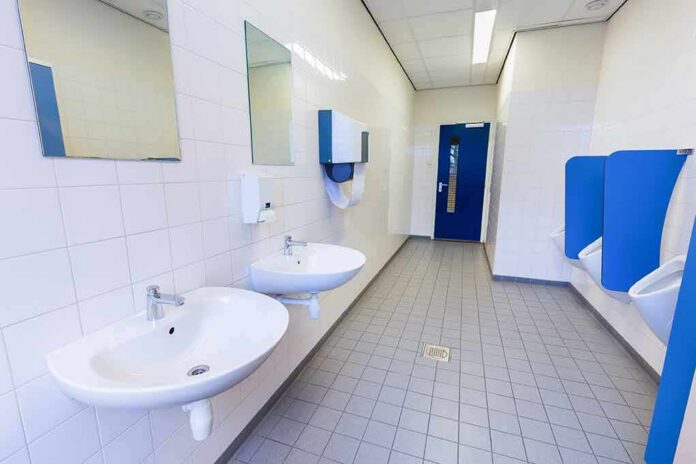
Dallas–Fort Worth International Airport will add two ablution stations in Terminal D restrooms, a small private project that is stirring a big public reaction.
Story Snapshot
- Texas filing lists one men’s and one women’s ablution station in Terminal D restrooms.
- Report says the goal is ritual washing space and drier restroom floors.
- The work is described as privately funded, not a public capital project.
- DFW added chapel-adjacent ablution stations in Terminal D in 2019.
What DFW Filed, What It Means
Texas records show a registered renovation at Dallas–Fort Worth International Airport that adds two ablution stations in existing Terminal D concourse restrooms. The scope lists one men’s and one women’s station. The description ties the work to a narrow restroom upgrade, not a terminal overhaul. This matches public summaries that mirror the filing’s details and note an estimated cost near three hundred thousand dollars, which signals scale and scope to travelers and taxpayers.
🚨Texas needs to wake the f#ck up!@GregAbbott_TX @KenPaxtonTX
DFW Airport is installing dedicated Islamic foot-washing stations (Wudu) inside the men’s and women’s restrooms in Terminal D. Official project. $300,000. Privately funded. Construction starts later this month.…
— Ethica Now (@EthicaNow) August 13, 2026
Local reporting says the stations are meant to give Muslim travelers a place for ritual washing before prayer and to keep sinks and floors drier when people otherwise wash feet at standard fixtures. That is a practical claim that fits what many airports see during peak travel. The story frames the project as privately funded, which places it closer to an amenity upgrade than a public spending push, a distinction many readers will care about.
Past Is Prologue: DFW Already Piloted This
Airport history matters here. In 2019, Dallas–Fort Worth International Airport moved and upgraded the Terminal D interfaith chapel and added two ablution stations next to it. The chapel announcement names the stations and lists other features like shoe storage and seating changes. That baseline makes the new restroom stations look like an expansion of an existing idea, or a shift from chapel-adjacent to inside main restrooms, rather than a first-time experiment.
Independent chapel directories place the Terminal D chapel after security near Gate 40. That lines up with the airport’s earlier pattern of pairing quiet-prayer space with nearby wash options. Travelers who use those rooms will likely understand why a restroom-based station helps when time is tight or gates are far. The corridor layout in big hubs makes proximity a practical issue, not a niche preference.
The Safety Pitch And The Evidence Gap
The safety pitch is simple: give a proper spot to wash, keep water off counters and floors, and you cut slip risk and sink damage. The reporting states this goal, and it tracks with common sense. Yet the public record offered so far does not include engineering memos, floor-slip incidents, or before-and-after logs that prove the scale of the gain. That leaves room for debate over how much risk drops and whether a small install moves the needle in crowded restrooms.
Dallas-Fort Worth International Airport is introducing dedicated Wudu stations to Terminal D restrooms. ✈️🕋 Fox News
The privately funded installation aims to provide a dedicated space for ritual cleansing while resolving a long-standing maintenance headache:
standard sinks… pic.twitter.com/uIULlLcMsc
— Mazi okwuoma (@MaziEzike_Nedu) August 13, 2026
Conservative readers will weigh two points. First, private funding reduces the case for public pushback on cost. Second, airports should treat all faiths and none with even hands. If a feature keeps shared areas safer and tidier for everyone, it earns support. Critics may call it redundant since Terminal D already had chapel-adjacent stations. That critique has merit on optics; the airport should show data on usage patterns and distance-to-gate time costs to justify a second site.
Culture-War Fuel Versus Facilities Reality
Social posts label the project “Islamic foot-washing stations,” which is catchy and polarizing. The filing and local report describe a narrow, practical upgrade with limited scope and private dollars. The facts support that low-drama reading. The questions that remain are technical, not ideological: what fixtures and drainage are planned, what anti-slip features are included, and how maintenance will measure success six and twelve months after install. Clear answers would defuse much of the spin.
Big hubs evolve by solving friction points you notice only when they fail: crowding at sinks, wet floors, bad flow near gates. Restroom stations sized for quick use can spare janitors time and keep travelers moving. The chapel test in 2019 set the precedent; this round brings the function to where most people already are. If Dallas–Fort Worth International Airport releases design sheets and later shares incident and cleaning data, the airport can show whether the small change earns its keep.
Sources:
facebook.com, x.com, wanderboat.ai, dfwairport.com