

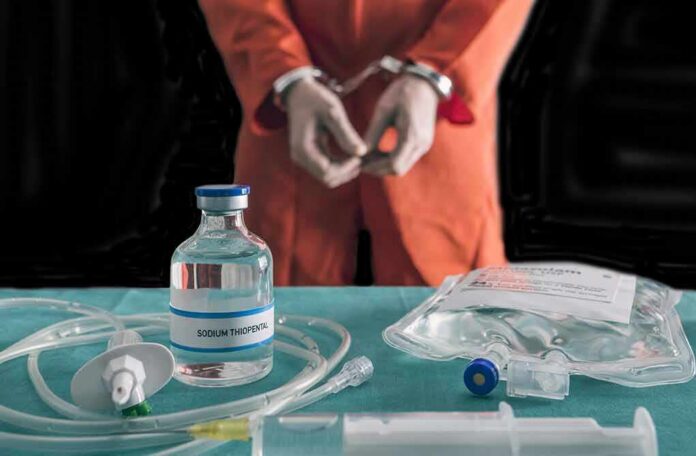
Tennessee tried twice to end a death sentence and instead ignited a firestorm over how the state carries it out.
Story Snapshot
- Christa Pike received two doses of pentobarbital yet left the prison alive and hospitalized.
- Governor Bill Lee halted all remaining 2026 executions and ordered a third-party review.
- Witnesses reported Pike appeared to be breathing and snoring after injections.
- The incident lands after years of scrutiny of Tennessee’s execution protocols.
What Happened Inside Tennessee’s Death Chamber
State officials began the execution of Christa Pike under Tennessee’s single-drug lethal injection protocol using pentobarbital. Media witnesses and Pike’s lawyers said two doses were administered. Witnesses reported she appeared to still be breathing and snoring afterward. Officials then stopped the attempt. The Tennessee Department of Correction told the state’s highest court that Pike was taken by ambulance to a hospital for medical care. Pike’s attorneys said the state failed to complete a lawful execution and filed emergency motions that night.
The picture that reached the public came from the witness room and court filings, not the chamber itself. Reporters described repeated curtain closures and confusion as staff moved in and out of view. Their accounts said Pike was still making audible breathing sounds minutes after the second syringe. That detail drew a sharp reaction from legal and medical voices who follow capital punishment. The state did not publicly confirm specific drug volumes or vein access steps that night, leaving those claims to the filings and witness summaries.
The Governor’s Response And Why It Matters
Governor Bill Lee suspended all remaining executions for 2026 and ordered an outside investigation to determine what went wrong and what must change. His move mirrored his earlier response in 2022, when he paused executions and commissioned an independent review after compliance problems surfaced with the prior multi-drug protocol. The Department of Correction later adopted a single-drug pentobarbital method and updated manuals and training, aiming for a cleaner, simpler process.
Pausing the machinery now protects two core principles many conservatives share: the rule of law and competence in government. A death sentence, once final, deserves exact execution under the law, not improvisation. If the team cannot follow the protocol to the letter, the state should stop, find the error, fix it, and only then proceed. That is not softness on crime; it is respect for the Constitution, the courts, and the victims’ families who deserve finality that stands up on appeal.
How Tennessee Reached This Point
Tennessee already faced pressure to restore public confidence in executions. An earlier independent review found failures to meet the state’s own testing and handling rules under the previous three-drug approach, prompting leadership changes and a pivot to pentobarbital. The promise was fewer steps, fewer failure points. Yet execution teams still face medical hurdles like vein access, timing, and documentation. Across the country, legal groups track “botched” injections tied to protocol departures and unplanned pain, even when executions eventually conclude.
Tennessee failed to carry out an execution TWICE in 4 months.
❌ May 21: Tony Carruthers. They spent over an hour trying and failing to get a backup IV in. Called off.
❌ Sept 30: Christa Pike. Two doses of pentobarbital. She ended up in a hospital.
Lethal injection already…
— Kentucky Girl (@Kentuckygirl1) October 1, 2026
Courts have also shaped what happens after failed attempts. Federal appellate rulings have allowed states to try again if they correct flaws and show no constitutional violation. That legal backdrop explains why witnesses’ details and the investigation’s findings now matter so much. If reviewers confirm deviations from the manual, expect fresh litigation to argue the Eighth Amendment and due process. If the review shows staff followed the book and the drug worked as designed, expect the state to reset and move forward under stricter oversight.
What To Watch Next
The third-party report will decide the next chapter. Investigators must answer four basic questions: whether the drugs met standards, whether storage and preparation matched the manual, whether the team secured reliable intravenous access, and whether medical monitoring and decision points were documented in real time. Clear answers will guide courts, reassure the public, and give the Department of Correction a blueprint for training and accountability. Anything vague will only invite more stays and more courtroom fights.
Sources:
redstate.com, theguardian.com, cnn.com, abcnews.com, bbc.com, tncourts.gov, yahoo.com, supremecourt.gov, abc7chicago.com