

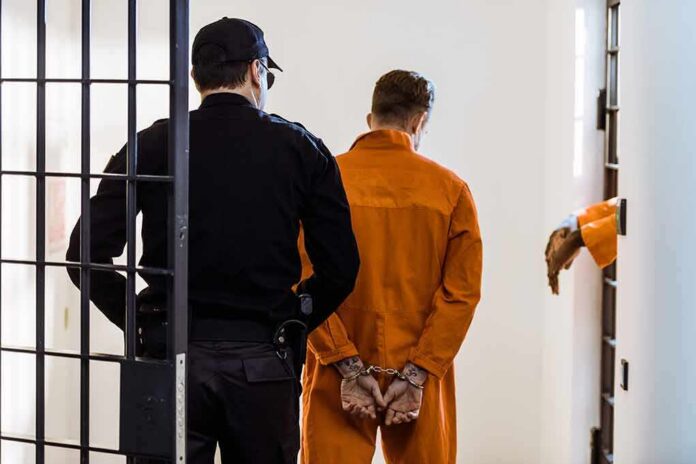
Texas resumed executions with a clinical precision that answered a botched week with a stark finality.
Story Snapshot
- Texas executed Jamaal Howard for a 2000 murder during a store robbery.
- Officials used pentobarbital and pronounced death at 8:03 p.m. in Huntsville.
- Courts rejected last-minute appeals citing Christa Pike’s failed execution in Tennessee.
- This marked the first U.S. execution since the Pike incident and the 30th this year.
What Texas Did And Why It Mattered Last Night
Texas carried out the execution of 46-year-old Jamaal Howard on Wednesday evening at the state prison in Huntsville. Officials used a dose of pentobarbital. Reporters on site said Howard was pronounced dead at 8:03 p.m. local time, confirming the state followed its current protocol and timeline. The case drew outsized attention because it was the nation’s first execution since Tennessee’s failed attempt to execute Christa Pike one week earlier, which had fueled fresh legal challenges.
Prosecutors secured Howard’s death sentence for the 2000 killing of 42-year-old clerk Vickie Swartout during a robbery in Silsbee. The Texas Department of Criminal Justice record states Howard shot Swartout once in the chest, causing her death. The straightforward facts of the crime never wavered across decades of appeals. That clarity kept the courtroom focus on punishment, not guilt. Families who live with such losses often measure justice in years, not days, and the state brought this case to its legal end.
The Last-Minute Fight Over Method, Not Guilt
Defense lawyers asked courts to stop the execution after Tennessee’s failed lethal injection of Christa Pike. They argued that similar drug and procedure risks could apply in Texas. The Texas Court of Criminal Appeals rejected those arguments, and the United States Supreme Court declined to intervene as the warrant window opened Wednesday evening. The rulings signaled that method-based objections, without specific proof of an imminent defect, would not outweigh a final judgment and a valid death warrant.
Texas uses pentobarbital obtained through compounding pharmacies when manufacturers refuse sales for executions. That drug choice, and the secrecy around suppliers, often drives late litigation. Still, Texas has maintained one of the nation’s most consistent records of completing executions under its protocol. Advocates claim that consistency masks risk. The record on Wednesday shows courts saw no concrete defect and let the sentence proceed within the law. From a common-sense lens, a court needs facts, not fear, to halt a lawful order.
Why Texas Keeps Setting The Pace
Capital punishment in America is shrinking in scope but concentrated in a few states. Texas remains a center of gravity, both because of statute and because its courts and agencies move cases to conclusion once appeals end. Newsrooms highlight botched executions because they shock the conscience. Yet most executions happen without incident, and the public’s attention drifts until the next high-profile failure somewhere else. Texas’s action this week reasserted a simple message: final judgments still carry force here.
Texas put Jamaal Howard, a mentally ill and disabled man. It was the first execution since the botched killing in Tennessee.
In this piece, his spiritual advisor describes their final conversations together: https://t.co/yKswvkIOtg
— Texas Observer (@TexasObserver) October 8, 2026
Policy pressure will now shift to two fronts. One is medical ethics and supply: compounding, testing, and storage for pentobarbital will keep drawing scrutiny. The other is legal process: how much evidence of risk must a prisoner show to earn a stay, and how close to the hour can that claim arrive. Courts answered part of that on Wednesday. They demanded specificity and proof tied to Texas’s protocol, not fear triggered by Tennessee’s failure. That standard aligns with equal justice and due process, not equal outcomes.
Sources:
foxnews.com, cbsnews.com, edition.cnn.com, abc13.com, supremecourt.gov