
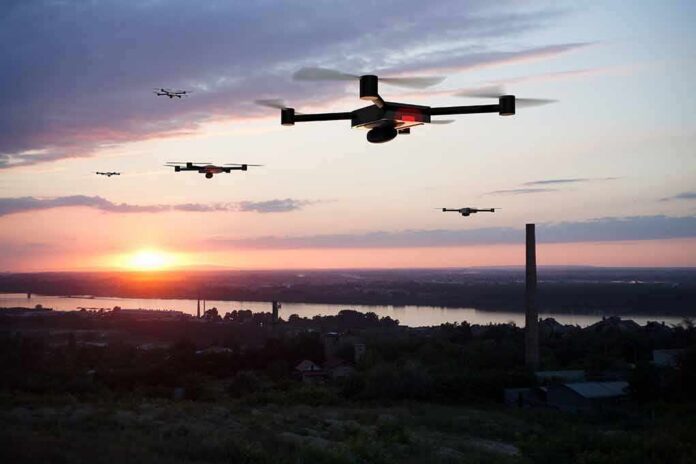
Beijing just turned its entire sky into controlled airspace and made private drone ownership illegal citywide.
Story Snapshot
- Beijing’s legislature enacted a binding regulation that bans drone flight, possession, storage, and entry across the city.
- The rule took effect November 15, 2026, after an earlier sales halt in May.
- Authorities can confiscate drones and issue fines to people and companies.
- Officials link the crackdown to security and public safety after a fatal June crash near the tallest tower.
What Beijing Passed And When It Took Effect
Beijing’s Municipal People’s Congress approved revised drone rules that declare the entire municipality controlled airspace and prohibit drone flight, possession, storage, and bringing drones or core parts into the city. The regulation is not a suggestion; it is law and applies across urban and rural districts. It took effect on November 15, 2026, closing the door on private drone ownership within city limits. The official summary frames the step as strengthening the capital’s security perimeter.
The new line follows a phased path. The city first restricted the sale of drones in May 2026. In November, it moved beyond sales to bar possession and storage. That means even keeping a drone in a closet inside Beijing is illegal. Officials gave current owners a path to comply: take drones out of Beijing by the effective date using air, rail, or road. The rule also bars transporting drones into the city after that date.
How The Ban Works And What Happens If You Ignore It
The regulation gives teeth to enforcement. Authorities can seize drones that violate the rule and fine individuals or companies that hold, store, or bring them into the city. That raises the stakes for hobbyists, travelers, and businesses that once used small platforms for photography, inspection, or training. The text that is public emphasizes prevention through a citywide buffer. It aims to remove the gray areas and simplify front-line checks at stations, depots, and warehouses.
Travelers face a clear test. You cannot carry a drone or its core parts into Beijing, whether by plane, train, or car. Residents who still had drones when the rule was announced were told to move them out before November 15. That cut the chance of last-minute confusion and gave owners a legal off-ramp. Penalties now apply to those who did not act in time, and confiscation is on the table for any noncompliant device found inside the city.
Why Officials Say They Did It
City leaders point to safety and security as the driver. The ban followed a deadly late-June crash near Beijing’s tallest skyscraper that killed the pilot and injured 13 people. While the incident involved a small aircraft, it rattled confidence in low-altitude management and raised pressure to lock down the capital’s airspace. The timing makes the policy response easy to understand, even as investigators did not say a drone caused that crash.
The move also fits a wider global pattern. Governments tighten control when adoption outpaces safety systems. China’s low-altitude rules have grown in layers, with local, civil aviation, and military pieces that sometimes overlap. Beijing’s citywide approach removes ambiguity at the capital’s core, even if it runs against the grain of broader efforts to grow a “low-altitude economy” through drones and other services elsewhere in the country.
What This Means For Residents, Business, And Visitors
Residents must treat drones like contraband inside Beijing. Keeping one at home risks fines and seizure. Businesses that relied on small drones for inspection or media work need alternatives or approved contractors outside city lines. Visitors cannot transit the city with drones in their bags. The rule’s sweep reduces screening friction for police and transport staff. It also shrinks the risk of stray flights around sensitive zones by removing most civilian platforms from the environment.
Drone ownership ban comes into force in Beijing over security concerns https://t.co/FfVuCm5cpo
— The Straits Times (@straits_times) November 15, 2026
Critics abroad may say a blanket ban sacrifices innovation to control. The counterpoint is simple: a capital city faces unique risks. The question is not whether to regulate, but how much. On the facts, Beijing chose maximum certainty over tailored exceptions. That aligns with a conservative reading of public safety: set bright lines, enforce them, and accept fewer edge cases. Future data on exemptions, fines, and incident trends will show how well that bargain holds.
Sources:
nst.com.my, apnews.com, rutlandherald.com