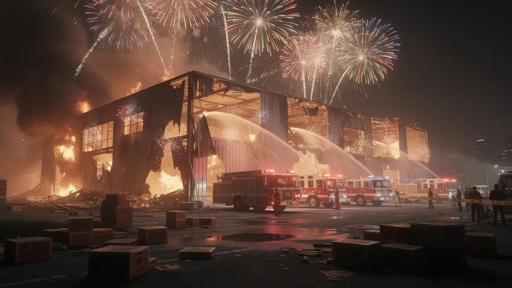
A quiet Whidbey Island neighborhood turned into a war zone in seconds when a house packed with fireworks blew apart and nearly took firefighters with it.
Story Snapshot
- About 700 pounds of fireworks stored in a home detonated and leveled two houses[2].
- Five people were hurt, including three firefighters; one needed hand surgery[1][3].
- Investigators say smoking near the stash likely lit the fuse, but no one is charged yet[1][2][6].
- The blast fits a larger pattern of illegal fireworks storage turning normal streets into instant disaster zones[18].
How a quiet road became a blast zone in seconds
On Smugglers Cove Road on Whidbey Island, a normal afternoon turned violent when a home holding a huge cache of fireworks exploded. Fire officials say roughly 700 pounds of fireworks were stored inside, enough to fill a pallet and fuel a sustained barrage once ignited[2]. The blast destroyed two homes and damaged a third, with debris thrown across the neighborhood[2][6]. Neighbors described the scene as sounding like a battlefield, with explosions continuing for hours after the first blast[2].
Three firefighters from Central Whidbey Island Fire and Rescue were hurt when one of the later explosions went off while they were already on scene[1]. Two were treated and released, but one firefighter needed surgery for a serious hand injury[4]. Two residents were also injured but managed to drive themselves to a hospital[2][3]. Fire officials later said the timing was razor thin; a difference of one or two seconds as crews approached the house could easily have turned injuries into deaths[4].
Smoking near a pallet of explosives and an unanswered “why”
Fire Chief Jerry Helm says investigators believe smoking materials near the fireworks started the chain reaction[1][2]. His description is blunt: someone was smoking around the fireworks and ash or a similar material dropped into the box, starting the fireworks going off[1]. Reports from local television add that a cigarette is believed to have ignited the stash[6]. Yet there is no named witness who says they saw the exact moment when ash hit the box, and the chief himself calls it an estimation based on evidence at the scene[1][6].
The reason that mountain of fireworks was inside a house is still murky. Helm has said the fireworks were bought for a private event on a nearby peninsula[2][6]. Neighbors back this up, saying they watched crates of fireworks delivered and had seen big backyard displays in past years[2][6][7]. But investigators admit they do not fully know why such a large quantity ended up stored in a residence instead of a proper facility[2][6]. That gap matters because it sits at the heart of the negligence question: who knew what, and when.
Illegal storage, angry neighbors, and conservative common sense
Local coverage now calls the fireworks “illegally stored,” and that label fits the facts that have surfaced so far[6]. Neighbors say they had complained before about illegal burning and even accused the homeowner of “burning toxic stuff” days before the explosion[2]. One neighbor described semi-trucks delivering fireworks earlier in the week and wondered aloud how anyone could buy that much without a license[7]. From a basic common-sense and conservative perspective, the picture looks like textbook reckless behavior: huge quantities of explosives in a neighborhood, no clear permit, and prior warnings brushed aside.
A massive fireworks explosion destroyed multiple homes on Whidbey Island on Tuesday afternoon, leaving families homeless and triggering a federal investigation. https://t.co/2nucci8UsK
— FOX 13 Seattle (@fox13seattle) June 26, 2026
Yet despite all this, the Island County Sheriff says there have been no arrests and the investigation continues[6]. That detail matters. It means the “smoking ash” story is still a theory, even if repeated as fact by multiple media outlets. It also leaves room for questions about whether there were deeper failures, such as weak enforcement of fireworks rules or local ties between event organizers and authorities. When government is slow to act in a case this glaring, residents are right to ask if the system protects them or the people who cut corners.
This blast is part of a bigger and growing problem
Medical research shows firework-related injuries have been rising across the United States since 2012, with half of documented blast cases involving alcohol use[18]. Wider reporting has also highlighted similar disasters at commercial fireworks sites, like the warehouse explosion in Esparto, California that killed seven people and led the State Fire Marshal to find clear illegal activity by the company involved[15][16]. Federal firearms and explosives officials warn that even tiny sparks can ignite vapors and fuel deadly explosions when safety rules are ignored[20]. The Whidbey blast fits squarely into that pattern: casual behavior around stockpiled explosives and a community that pays the price.
The Ring doorbell footage that captured the explosion on Whidbey Island gives visual proof of the scale of the blast and how fast a normal street can turn lethal[3][4]. For families now homeless, and for a firefighter relearning how to use an injured hand, the cause is not abstract. Someone chose to store hundreds of pounds of fireworks in a home, and someone apparently chose to smoke nearby. That mix of personal recklessness and weak oversight is exactly what conservative values warn against: when common sense is ignored, innocent neighbors pay.
Sources:
[1] Web – Hundreds of pounds of fireworks explode, destroying homes and injuring …
[2] Web – Whidbey Island, WA fireworks blast destroys homes, injures 5
[3] Web – ATF report IDs ‘blast seats’ in fatal explosion – Whidbey News-Times
[4] YouTube – 700lbs of fireworks destroys 2 Whidbey homes
[6] YouTube – Fireworks explosion destroys Whidbey Island homes | FOX 13 Seattle
[7] Web – A massive explosion triggered by hundreds of pounds of stored …
[15] YouTube – Esparto explosion investigation ends with evidence of illegal activity
[16] Web – 7 unaccounted for after explosion at California fireworks warehouse
[18] Web – Patterns of Firework-blast Injuries: A Descriptive Case Series – PMC
[20] Web – ATF controls burn of illegal fireworks manufacturing home – Facebook