
Two justices who rarely vote alike just drew a bright line around your front door: when government breaks your stuff, someone should probably pay.
Story Snapshot
- Justice Sonia Sotomayor, joined by Justice Neil Gorsuch, questioned a broad “police-power” shield to property claims.
- The statement came as the Supreme Court declined to hear multiple takings cases, leaving a split in place.
- Some courts bar compensation for police destruction; others allow claims if destruction was not strictly necessary.
- The justices urged more lower-court rulings before the Supreme Court sets a national rule.
A rare cross-ideological signal with real stakes
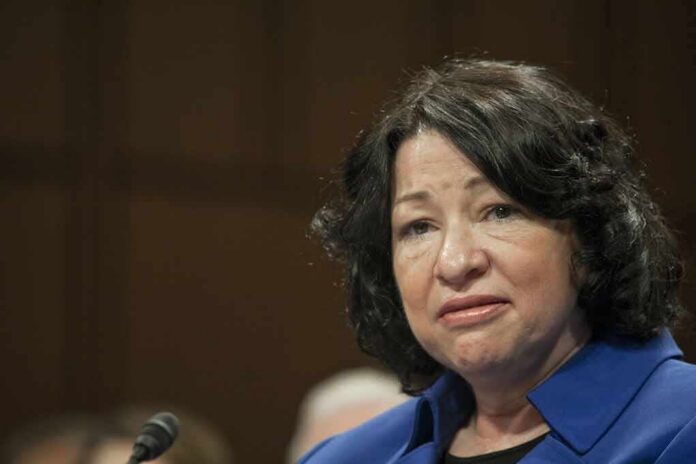
Justice Sonia Sotomayor, joined by Justice Neil Gorsuch, wrote that the Court should soon take a hard look at whether a categorical police-power exception to the Takings Clause exists. Their statement, tied to the Supreme Court’s refusal to review Baker v. City of McKinney, called the issue “important and complex” and said more lower-court work would help the Court set a clear rule. The denial did not decide the merits. It kept the question open and alive for a future case.
The spark is simple to grasp and hard to ignore. When police or city agents use authority to destroy or keep private property, should the government pay just compensation? Sotomayor suggested that when a person alleges a classic taking—like direct appropriation, or when the government keeps the value of property—mere labels about “police power” should not end the inquiry. That is a call for tighter lines and stronger respect for basic property rights rooted in the text of the Fifth Amendment.
The split that leaves homeowners guessing
Lower courts do not agree. The Seventh Circuit and the Tenth Circuit have leaned toward a broad shield for actions done under police authority, even where homes were wrecked in the hunt for a suspect. Other courts, including the Ninth Circuit, have framed the question around necessity. If destruction was necessary to defend public safety, no compensation is owed. If not necessary, a takings claim may proceed. Sotomayor described this as a continuing conflict worth careful national resolution.
One recent petition, O’Donnell v. City of Chicago, asked whether a city can keep the sale value of a car after impounding it over unpaid tickets. The Supreme Court denied review but again flagged the issue as unresolved and not yet ready for a clear, final rule. The Court’s message was steady: the problem is real, the law is split, and the right case will come. For now, drivers and homeowners face different rules depending on where they live.
Why this matters to your wallet and your street
Property is not theory. Think of a family’s home torn apart during a manhunt, or a small shop left shattered after a raid that finds the suspect blocks away. Cities say emergencies demand quick action, and they worry that paying every time would chill policing. Owners reply that the Constitution does not make them the insurer for public safety missions. The text says the government must pay for takings. The fight is over what counts as a taking when police act fast.
Two unpaid parking tickets can cost a Chicago driver the car.
Chicago may impound a vehicle while the owner's ticket debt stays unpaid. The city can then keep the car, sell it, or surrender it to a lienholder, with no compensation, no offset against the debt, and no return of…
— @DMartinoLaw (@DMartinoLaw) October 26, 2026
American conservative values favor clear rules, limited government, and strong property rights. On the facts now in view, Sotomayor and Gorsuch have it right to press for a line that stops magical phrases from wiping out your claim. If the government directly takes or keeps your property, the default should be compensation. Emergency necessity can be a real defense. But it should be proven, not presumed. That balance respects both safety and the Constitution’s promise.
What happens next and what to watch
The justices asked for better vehicles and fuller records. That means a case with clean facts, clear proof of destruction, and a square conflict between courts is most likely to get review. Lawyers are already lining up those records in cases involving destroyed homes and retained sale proceeds. Expect one of them to reach the Court soon. When it does, the ruling will decide who pays when government force meets private walls and wheels.
For now, homeowners and drivers should track local rules and document damages. City leaders should set fair claims processes and reserve funds for obvious losses. Police need clear necessity standards that command respect in court and on the street. The Supreme Court did not duck. It is waiting for the right test. When it lands, do not be surprised if the vote crosses the usual lines—again—and puts your deed and your garage back near the center of the Fifth Amendment where they belong.
Sources:
reason.com, supremecourt.gov, law.cornell.edu