

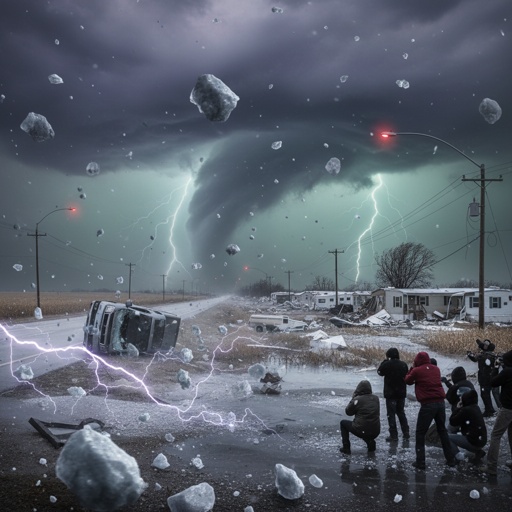
America’s most infamous stretch of tornado-ravaged land has quietly packed up and moved 500 miles east, and millions of people living in its new path have no idea they’re now sitting in the crosshairs.
The Great Plains Tornado Decline Nobody Expected
For seven decades, Texas, Oklahoma, Kansas, Nebraska, and South Dakota defined America’s tornado identity. The term Tornado Alley emerged in the 1950s to describe this collision zone where dry Rocky Mountain air slammed into Gulf moisture under an unstable jet stream, spawning hundreds of twisters annually across wide-open farmland. Between 1950 and 1984, this region dominated tornado statistics and shaped national storm preparedness strategies. Storm chasers, meteorologists, and Hollywood cemented the Great Plains as America’s twister capital, but data from 1985 onward tells a starkly different story that challenges everything Americans thought they knew about tornado geography.
AccuWeather analyzed 35 years of tornado data and discovered what NOAA Senior Research Scientist Dr. Harold Brooks confirmed as physically real: tornado frequency dropped across the traditional Alley while surging in the Mississippi Valley and Southeast. A 2018 study published in Nature documented that tornado-favorable atmospheric conditions declined sharply in the Plains while simultaneously increasing east of the Mississippi River. By comparing periods from 1950-1984 against 1985-2019, researchers identified not just a temporary fluctuation but a persistent geographical redistribution of America’s most violent weather phenomenon that shows no signs of reversing.
Why Moisture Followed the Money East
The Southwest endured a relentless 20-year mega-drought that starved the traditional Alley of the moisture tornadoes require. Meanwhile, the Gulf of Mexico warmed, pumping increased humidity and energy into states historically spared from frequent twisters. Paul Pastelok, AccuWeather’s Lead Long-Range Forecaster, attributes the shift to drought-forced changes in storm tracks and jet stream positioning. Higher dew points and atmospheric instability now concentrate over eastern Missouri through Alabama rather than dissipating across Kansas wheat fields. Storm chaser Chimera Comstock, who has tracked tornadoes for years, observed the pattern change firsthand and fears it represents a permanent climatic realignment rather than a temporary anomaly.
The atmospheric mechanics driving this shift create a dangerous convergence over the Southeast. Warm, moist air from the Gulf now collides with cooler continental air masses farther east than before, generating supercells over regions with vastly different terrain, population density, and infrastructure compared to the Plains. The traditional Alley still produces tornadoes, but the nucleus of large outbreak events documented between 1989 and 2019 migrated southeastward according to a 2022 peer-reviewed paper. This geographic redistribution carries consequences that extend far beyond meteorological curiosity, fundamentally threatening communities never designed to withstand rotating columns of 200-mile-per-hour wind.
When Tornadoes Strike Subdivisions at Midnight
The deadly difference between old and new Tornado Alley lies not just in location but timing and targets. Great Plains tornadoes typically formed during afternoon hours over open farmland, providing visibility for warnings and minimal structures to destroy. Southeastern tornadoes frequently strike after dark, roaring through wooded terrain into subdivisions, shopping centers, and industrial parks filled with people who lack basements or reinforced safe rooms. Tennessee, Alabama, and Kentucky residents face tornadoes hitting densely populated areas with less warning time, limited shelter options, and building codes never calibrated for EF3-plus wind speeds. The December 2021 quad-state tornado outbreak that devastated Kentucky exemplified this new reality, killing dozens in communities like Wingo that had minimal tornado-resilient infrastructure.
Insurance adjusters report claim surges across the new tornado corridor, overwhelming companies unprepared for this risk redistribution. AdjusterPro documented spiking property damage in Tennessee, Alabama, Iowa, and Ohio while traditional Plains states see declining claims, forcing the insurance industry to recalculate decades of actuarial assumptions. The economic impact ripples through property values, development planning, and municipal budgets suddenly facing demands for warning sirens, public shelters, and upgraded building standards. Homeowners who purchased properties believing they lived outside high-risk zones now confront insurance rate increases and the sobering reality that their families sleep unprotected in structures built for hurricanes or ice storms, not tornadoes.
The Preparedness Gap That Kills
Awareness remains the deadliest deficit in the new Tornado Alley. Great Plains residents grew up drilling tornado safety, recognizing wall clouds, and knowing their nearest shelter. Southeastern communities lack this cultural conditioning, often dismissing tornado warnings as rare events not worth disrupting daily life. NOAA and FEMA face the challenge of educating millions who never considered tornadoes a primary threat, while local governments balance budget constraints against urgent infrastructure needs. Storm chasers now travel east instead of west, documenting tornadoes in terrain that complicates visibility and escape routes compared to open Plains highways.
The shift demands a fundamental rethinking of American severe weather preparedness. Building codes must evolve to require safe rooms in new construction across the Southeast. Public shelter networks need expansion into schools, community centers, and commercial buildings. Warning systems require upgrades to account for nighttime strikes and heavily forested areas that obscure visual confirmation. The traditional Tornado Alley remains active enough to maintain vigilance, but resources and attention must flow toward states where the deck is stacked against unprepared populations facing an escalating threat they never anticipated. This geographic realignment of America’s deadliest weather phenomenon represents not just a meteorological curiosity but a public safety crisis unfolding in slow motion across millions of acres and millions of lives now sitting in the new path of destruction.
Sources:
Is Tornado Alley Shifting East?