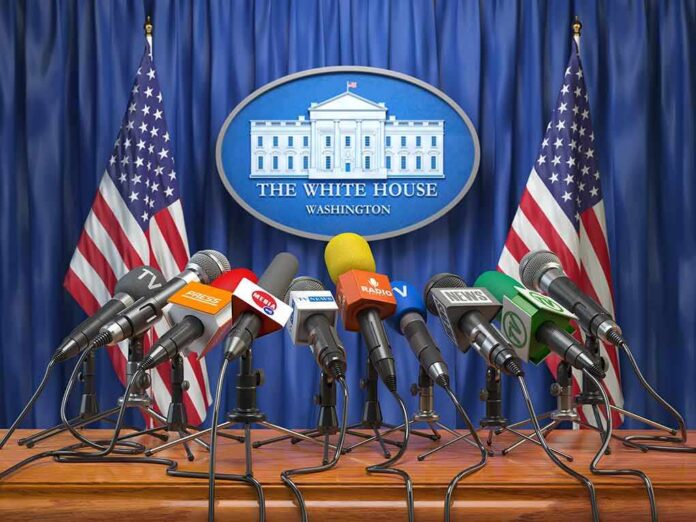
Major outlets are suing after the White House enforced President Trump’s ban on CNN, MS NOW, and Politico, thrusting press access and the First Amendment into a direct legal clash.
Story Highlights
- President Trump announced bans on CNN, MS NOW, and Politico over “fake news,” and security enforced it at the gates.
- The outlets plan court action to restore access, calling the move unconstitutional retaliation.
- Past court rulings on the Associated Press show mixed outcomes across different White House spaces.
- Legal fight now centers on viewpoint discrimination rules versus executive control of limited venues.
What Triggered The Lawsuits
President Trump said on Truth Social that he was banning CNN, MS NOW, and Politico from the White House because of “constant ‘reporting’ FAKE NEWS,” naming the outlets directly and warning others could face action next. The following day, White House security turned away reporters from those organizations at the checkpoints, confirming the policy was not a bluff but an enforced access decision on the grounds. The targeted outlets then vowed to sue to restore entry and their hard passes.
Outlets framed the move as a direct assault on press freedom and a violation of the First Amendment. CNN called the ban an “illegal assault” after its reporter’s pass was seized at the gate. Statements from media groups and experts amplified the charge that exclusion for coverage content is unconstitutional. The White House Correspondents’ Association echoed concern that the action threatened a free press, ensuring the dispute would move from rhetoric into the courts with speed.
The Legal Battleground Taking Shape
The lawsuit will likely test a familiar fault line: courts have said the White House cannot exclude journalists from opened press facilities based on viewpoint, but can enforce reasonable, neutral controls in smaller, nonpublic spaces. Reporting on the Associated Press dispute shows a judge criticized viewpoint-based exclusion, while an appeals panel later allowed some limits in tightly controlled venues like the Oval Office and Air Force One. That split matters because the ban here swept across the grounds without a narrow venue rule.
Legal briefs and prior cases suggest the key questions are where the administration drew the line and why. If the White House applies viewpoint-neutral rules to security-limited areas, courts sometimes uphold them. If officials target named outlets for their coverage, courts often strike that down as retaliation. Prior filings and summaries emphasize that once the government opens briefing rooms to the press broadly, viewpoint-based exclusion is impermissible under First Amendment standards.
What The White House Can Argue
The administration can cite past rulings that recognize the government has more control over access to restricted spaces than to broadly open press areas. Officials can also point to operational needs and decorum rules, as seen in other cases, to argue access is a privilege that can be limited when standards are broken, so long as those standards are neutral and enforced evenly. Reporting indicates courts drew that exact line in the Associated Press litigation on appeal.
Still, the stated reason of “fake news” poses a hurdle. The ban singled out outlets by name for their coverage, and public reporting does not show a written, viewpoint-neutral policy or an administrative record that spells out a conduct-based trigger. That absence makes it harder to defend as a standard credential action. Judges often look for clear, published criteria and some due process when access is removed, especially from facilities historically open to a broad press corps.
Why It Matters To Readers
Everyday Americans want honest news and a government that is not bullied by activist media. Many remember years of slanted stories that attacked secure borders, low-cost energy, and traditional values. Those patterns built deep mistrust. This legal fight is not about pampering big outlets; it is about drawing a clean line between free speech and the right of elected leaders to run secure, orderly operations without constant disruption or narrative warfare from hostile organizations.
🧵1/2 ICYMI — Weekend of Sept. 18–20, 2026
If you logged off Friday, this was a busy one in the news cycle: drones over Moscow, a U.S.–Denmark Greenland deal, a White House press ban, an ICE shooting in Austin, Houthis aiming at Riyadh, and Germany’s center taking another…
— Holly Kesler (@HollyKesler) September 21, 2026
The court will decide whether this ban went too far or if the White House may set tighter rules, especially in smaller, restricted venues. Readers should expect a fast timeline, possible temporary orders, and a focus on whether the administration can show neutral standards and consistent enforcement. If the court finds viewpoint retaliation, access could be restored. If it upholds venue-based limits, the White House may keep firmer control in sensitive spaces while allowing broader press access elsewhere.
What To Watch Next
Watch for the lawsuit’s filing details: does it target full grounds access, or specific facilities like the briefing room? Look for any White House policy memo that defines criteria for suspension and appeal. Track whether badges are disabled across all areas or only certain rooms. Compare the orders here to the Associated Press case. Those documents and rulings will show how far a president can push back on hostile coverage without crossing into unconstitutional viewpoint discrimination.
Sources:
cnbc.com, bbc.com, cnn.com, npr.org, apnews.com, ap.org, abc45.com, nytimes.com