
Riot police blasted water cannons at protesters trying to march toward Manila’s summit grounds, just as leaders from across Asia arrived to meet President Trump.
Quick Take
- Thousands of demonstrators marched toward the ASEAN summit site in Manila on November 15, demanding President Trump stay away.
- Police blocked the march at Liwasang Bonifacio, a public park set aside by law for free assembly.
- Officers used water cannons, truncheons, and a sonic alarm to break up the crowd.
- Organizers and officials gave different numbers for how many people were arrested and hurt.
A Massive Security Operation Meets a Massive Protest
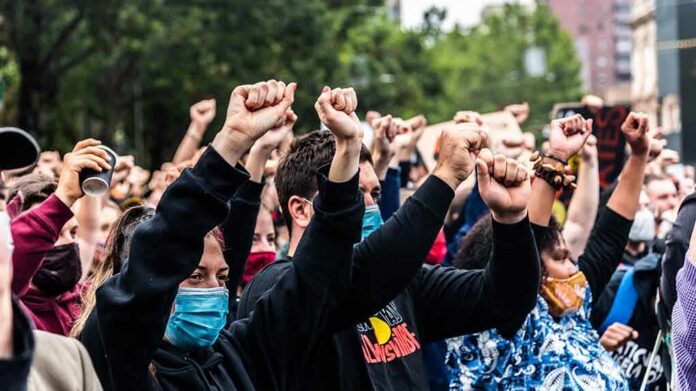
Philippine authorities deployed nearly 23,000 security personnel to protect the 49th ASEAN Summit, a gathering of Southeast Asian leaders that drew President Trump to Manila. The scale of the operation matched the scale of the opposition. Organizers said more than 9,000 people joined marches from student groups, labor unions, Indigenous communities, Muslim organizations, and LGBT advocates, all converging on the capital from different provinces to voice their anger over the visit.
Protesters burned effigies of President Trump and chanted slogans calling him a “fascist imperialist leader.” Their anger was not just about the visit itself but about broader frustrations with inequality and government policy in the Philippines. The demonstrations ran for nearly a week, with crowds returning to the streets day after day as summit activities continued inside the heavily guarded conference venue.
Police Block the March at a Legally Protected Gathering Spot
The clash centered on Liwasang Bonifacio, a freedom park in Manila. Philippine law lets people gather there without a government permit, a protection built into Batas Pambansa Blg. 880, the law governing public rallies. Protesters planned to march from that park to the Philippine International Convention Center, but police set up a barricade on the road outside, saying the group lacked a permit to move beyond the designated gathering site.
When demonstrators pushed forward anyway, officers responded with force. Reuters captured protesters being hit by a water cannon as they tried to reach the U.S. embassy during the same stretch of unrest. Rappler reported that police also used truncheons and a sonic alarm device during the clashes. Police said the crowd needed to remain inside the park rather than march toward the summit venue.
Conflicting Counts of Arrests and Injuries
Numbers from the Liwasang Bonifacio confrontation vary by outlet. The Manila Times reported seven arrests and two injuries. Inquirer cited organizers claiming nine arrests, a figure GMA News also reported. DZRH said organizers estimated fewer than ten arrests while they worked to confirm the total. None of the reports fully match, though all describe the same basic standoff between marchers and riot police.
A protest representative also alleged that one demonstrator lost consciousness after being struck by officers and was taken away by police rather than to a hospital, with organizers still trying to locate him afterward. That specific claim has not been independently resolved in available reporting. Separately, the Health Alliance for Democracy counted 123 injured activists across the broader six-day protest period, a figure tied mainly to an earlier confrontation on Taft Avenue.
A Legal Fight Over Where Free Speech Can Happen
This standoff fits a pattern that has played out before in Philippine courts. The Supreme Court ruled in Bayan v. Ermita that officials commit grave abuse of discretion when they alter an approved rally location without clear justification. That 2006 case centered on a permit dispute much like the one in Manila, where organizers argued the government cannot simply redirect peaceful assembly without strong cause.
Philippine law requires local governments to set aside freedom parks specifically so citizens can gather without jumping through bureaucratic hoops. The tension in Manila was never about whether people could protest. It was about how far they could walk while doing it. That distinction, small on paper, is exactly what turned a peaceful rally into a clash with riot shields and water cannons.
For American readers watching from afar, the scene is a reminder that the right to assemble means little if authorities can redraw its boundaries at will. A free society allows loud, even hostile, protest against visiting leaders without turning routine permit disputes into street battles. Manila’s planners deserve credit for securing a major summit, but the heavy-handed response to marchers headed toward a public park raises fair questions about proportion.
🇵🇭 Philippines
PROTESTS GREET THE ASEAN SUMMIT.Demonstrators face police in Manila as Southeast Asian leaders arrive. They cite the cost of basic goods and a US-led AI supply plan known as Pax Silica.
Al Jazeera reports from the streets.Will leaders hear them? pic.twitter.com/R2SCF9Gn5r
— Silent Politics◾️ (@silentpolitics1) November 15, 2026
The summit concluded with President Trump’s broader Asia trip continuing on schedule, while Manila’s streets returned to normal within days. The underlying dispute over permits, parks, and police power, however, remains a live issue for the next gathering that draws both world leaders and the crowds who want them to hear a different message.
Sources:
youtube.com, dw.com, rappler.com, dzrh.com.ph, mindanews.com, newsinfo.inquirer.net, reuters.com, en.wikipedia.org, gmanetwork.com, elibrary.judiciary.gov.ph, philstar.com, old.pcij.org, aa.com.tr