

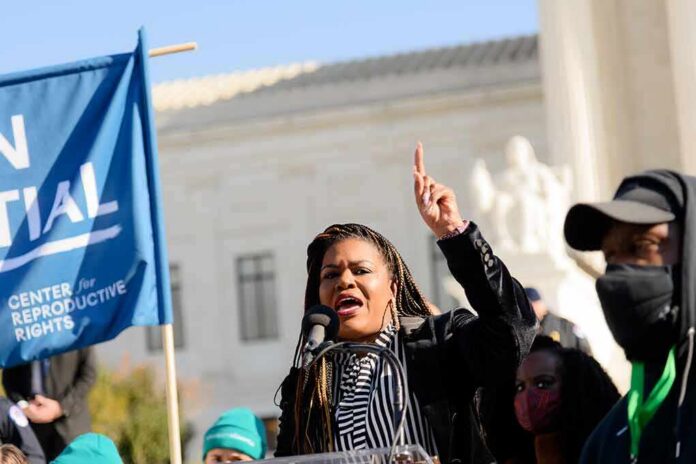
Jasmine Crockett’s July Fourth remarks lit up a deeper fight: who gets credit for building America, and who gets left out.
Story Snapshot
- Viral clips claim Jasmine Crockett said America “owes everything” to Black women; no verified transcript confirms that exact line.
- At a 250th anniversary forum, speakers cited stark economic gaps and underinvestment facing Black women today.
- Critics call her message divisive, but they rarely challenge the core data she cites.
- The argument fits a long pattern: Black women do work that shapes the nation but often go unnamed in the story we tell.
What Crockett Actually Said Versus What Went Viral
Social media posts pushed a claim that Jasmine Crockett declared the United States “owes everything to Black women.” The exact quote remains unverified in official records. Her Senate-run speech and press releases do not contain that specific line, and no primary transcript of a July Fourth speech has surfaced that proves it word-for-word. That gap matters. Facts should beat memes every time. But the broader thrust of her July talk, seen in circulating clips, centered on recognition of Black women’s contributions.
Jasmine Crockett on July 4th: "The US owes everything to black women" for inventions, democracy, pic.twitter.com/BPNH57eVTm
— Miley🇺🇸 Joy (@Miley__Joy) July 5, 2026
Conservative commentators slammed the message as divisive. That reaction follows a familiar script in modern politics. It attacks tone more than substance. The better test is whether the underlying facts hold. Do Black women face persistent economic and representation gaps today? Do many of their past efforts go unnamed in popular histories? These are concrete claims. They can be checked. The debate should start there, not with a slogan no one can verify in the record.
The Data Point to a Hard Present, Not Just a Heroic Past
A Global Black Economic Forum panel tied today’s gaps to long patterns. Speakers cited research that Black women get a tiny share of venture capital, make up a sliver of the tech workforce, and sit at the low end of wealth measures. They noted a common figure for Black wealth at fifteen dollars for every one hundred dollars of white wealth, a statistic often sourced to think tank work on racial wealth inequality. The panel’s focus was simple: the pipeline to power and ownership remains tight for Black women now.
These numbers do not prove that America “owes everything” to anyone. They show barriers that strain common sense ideas of fairness and merit. A market that funds founders should chase value wherever it lives. If Black women get shut out despite strong ideas, that is wasteful, not just unfair. A conservative lens values reward for effort and results. If gatekeeping blocks both, policy and culture should clear the path so talent can win on the merits.
History Shows Labor and Leadership, Even When Credit Lags
Historians and public institutions have chronicled how Black women drove change without getting their names in lights. Museum scholars describe them as the backbone of local civil rights work, even when national leaders passed them over for the mic. That pattern runs back through suffrage networks, community schools, and church organizing. The result is a split-screen: the country benefits from their effort, while the story many of us learn leaves them out of frame.
Kimberlé Crenshaw and forum speakers linked this erasure to a “boom and bust” cycle. Gains come in bursts, then pushback follows. Reconstruction opened doors, then white terror and Jim Crow slammed them shut. After the 2020 reckoning, funding pledges and attention spiked, then many stalled out. The claim is not that Black women built all of America. It is that they often pay in sweat and courage during the boom, then get cut out in the bust—and in the telling later on.
What Critics Get Right, And What They Skip
Critics are right to flag absolute language. “Owes everything” is not a serious historical claim, and Crockett’s public record does not confirm that exact quote. But the same critics often ignore the testable points. They seldom present primary data that refutes the wealth gap figures or the tiny slice of venture capital that goes to Black women founders. They also skip the long paper trail showing Black women’s organizing power in civil rights work across generations.
Jasmine Crockett on July 4th: "The US owes everything to black women" for inventions, democracy, pic.twitter.com/BPNH57eVTm
— Miley🇺🇸 Joy (@Miley__Joy) July 5, 2026
Common sense says pride in country grows when the story is honest. Credit should match contribution. If the market is missing value by habit or bias, fix the inputs and open the gates. If history books skip builders because they were women and Black, update the lesson, not the loyalty. Independence Day can hold two truths: we love the nation we have, and we name the people who helped make it—especially when the record missed them the first time.
Sources:
thedemlabs.org, youtube.com, instagram.com, facebook.com