

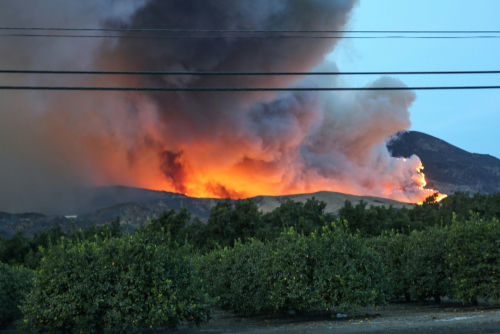
A fast-moving wildfire on Spokane’s eastern edge has forced families from their homes and raised fresh questions about how government prepares — and fails — when disaster hits close to town.
Story Snapshot
- Strong winds drove the Upriver Fire into Spokane-area neighborhoods, forcing about 1,500 people to evacuate.[1]
- Fire officials confirm multiple homes and other structures have burned, with the exact damage still being counted.[1]
- The blaze, about 225–250 acres and only 10% contained, shows how quickly danger can reach populated areas.[1][2]
- Roughly 11,000 residents have been under some level of evacuation orders as crews fight to protect more homes.[2][13]
Wind-Driven Fire Slams Into Spokane Neighborhoods
Strong, dry winds pushed the Upriver Fire up a hillside and into neighborhoods northeast of Spokane on Tuesday, turning a local brush fire into a life-or-death scramble for families told to get out now.[1][2] Fire officials say the blaze ignited shortly after noon and was driven by shifting winds into a residential area, where it quickly found dry fuel in grass, brush, and trees.[1] Within hours, it had raced across roughly 225 to 250 acres on the edge of a major population center.[1][2]
County and state crews from Washington and neighboring Idaho are attacking the blaze from the ground and the air, but containment remains low.[1][2] By Wednesday morning, federal fire tracking data put containment at only about 10%, meaning most of the fire line is still open and dangerous.[1] Fire officials warn that winds are expected to stay gusty, and low humidity will keep fuels ready to burn, giving this fire plenty of chances to jump lines and move again.[2][13]
Evacuations, Destroyed Homes, and Families in Limbo
Spokane County Emergency Management says about 1,500 people remain under active evacuation orders as crews work to slow the flames near homes.[1] Broader evacuation directives and warnings have touched more than 11,000 residents across the area as officials try to keep people ahead of any sudden wind shift.[2][13] Fire leaders describe the Upriver Fire as posing the “highest immediate risk to life and property” among current Spokane County fires, because it sits in a densely populated zone with many homes in the path.[13]
Officials confirm that several homes and other primary structures have already been destroyed, though they are still counting the exact number.[1][2] Fire District 9 Chief Matthew Vinci reported Tuesday that “several homes” had been consumed and said teams are out assessing damage as conditions allow.[1] Earlier local reports described at least five homes burned as the fire skirted Beacon Hill and Camp Sekani, and state briefings say as many as 500 homes were threatened at one point along Upriver Drive.[2][5]
Why These Fires Keep Hitting Eastern Washington Hard
Fire experts and state emergency planners have long warned that eastern Washington’s dry summers, wind patterns, and mix of grass, timber, and growing suburbs make these kinds of events more likely.[3][12][13] The National Weather Service placed much of eastern Washington under a red flag warning around the time the Upriver Fire exploded, citing strong winds, low humidity, and dry fuels that make rapid fire spread almost certain when a spark hits.[2][13] In this case, once the blaze started, the weather turned it into a serious threat within hours.
State wildfire guidance explains that “Level 3” evacuation — the order many Spokane families received — means “go now” because danger is current or coming fast.[11][12][18] Residents in these zones are told not to delay to gather belongings and warned that emergency services may not be able to reach them if they choose to stay behind.[11][12] This is why local fire officials and the Washington Department of Natural Resources keep urging people to obey alerts on their phones and from local law enforcement when a blaze moves toward town.[1][12]
What Prepared Families Can Do — and Where Government Falls Short
Wildfire planners in Washington say families should treat these Spokane evacuations as a clear warning: in a wind-driven fire, you may only get minutes to act.[18][21] State and county emergency guides stress simple, practical steps that protect life — keeping a “go bag” ready, mapping at least two exit routes, knowing where family will meet if roads are blocked, and staying signed up for local alert systems.[12][14][18] Research on wildfire evacuations shows that people who prepare in advance are far less likely to get trapped in traffic or cut off by fast-moving flames.[19][21]
Eastern Washington wildfire forces evacuations and destroys homes @WashTimes https://t.co/Aw2nwGloly
— Washington Times Local (@WashTimesLocal) June 17, 2026
At the same time, the Upriver Fire underscores gaps that many conservative residents have warned about for years: slow fuel reduction around communities, confusing early evacuation numbers, and a system that often seems reactive instead of ready.[13][19] Fire scientists note that early reports can mix up people “threatened” with people actually evacuated, which confuses both the public and later damage reviews.[13][19] For families on the ground, all that noise still boils down to a simple goal: protect your home if you can, but protect your life and your family first.
Sources:
[1] Web – Eastern Washington wildfire forces evacuations and destroys homes
[2] YouTube – Washington DNR gives update on Upriver Fire
[3] Web – 352-acre wildfire on Upriver Drive east of Spokane prompts …
[5] Web – Alexandra Coenjaerts spoke to fire officials this morning at …
[11] Web – Eastern Washington Wildfire Resource Kit – Michael Baumgartner
[12] Web – FIRE INFORMATION – Washington Smoke Blog
[13] Web – Wildfire | Washington State Military Department
[14] Web – Washington Fires Map | Wildfire Explorer
[18] YouTube – Clackamas, Washington counties implement new wildfire …
[19] Web – Wildfire Evacuations: Understanding Levels and Tips to Prepare |
[21] Web – Eastern Washington Wildfire & Hazard Incidents – Facebook